

StableHLO 是機器學習 (ML) 模型中高階作業 (HLO) 的作業集。StableHLO 可做為不同機器學習架構和機器學習編譯器之間的移植層:產生 StableHLO 程式的機器學習架構,與使用 StableHLO 程式的機器學習編譯器相容。
我們的目標是簡化及加速機器學習開發作業,在各種機器學習架構 (例如 TensorFlow、JAX 和 PyTorch) 和機器學習編譯器 (例如 XLA 和 IREE) 之間建立更多互通性。為此,本文件提供 StableHLO 程式設計語言的規格。
這項規格包含三個主要部分。首先,「程式」部分說明 StableHLO 程式的結構,這類程式由 StableHLO 函式組成,而函式本身則由 StableHLO 作業組成。在該結構中,「Ops」部分會指定個別作業的語意。「執行」部分提供在程式中一起執行的所有作業語意。最後,「符號」一節會討論整個規格中使用的符號。
如要查看先前 StableHLO 版本的規格,請開啟感興趣的已標記版本的存放區。例如 StableHLO v0.19.0 規格。 如要查看 StableHLO 各個次要版本升級時發生的變更,請參閱 VhloDialect.td 中的版本記錄。
程式
Program ::= {Func}
StableHLO 程式包含任意數量的 StableHLO 函式。以下是範例程式,其中包含 1 個輸出和 3 個輸入 (%image、%weights 和 %bias) 的 @main 函式。函式主體有 6 個運算。
func.func @main(
  %image: tensor<28x28xf32>,
  %weights: tensor<784x10xf32>,
  %bias: tensor<1x10xf32>
) -> tensor<1x10xf32> {
  %0 = "stablehlo.reshape"(%image) : (tensor<28x28xf32>) -> tensor<1x784xf32>
  %1 = "stablehlo.dot"(%0, %weights) : (tensor<1x784xf32>, tensor<784x10xf32>) -> tensor<1x10xf32>
  %2 = "stablehlo.add"(%1, %bias) : (tensor<1x10xf32>, tensor<1x10xf32>) -> tensor<1x10xf32>
  %3 = "stablehlo.constant"() {value = dense<0.0> : tensor<1x10xf32>} : () -> tensor<1x10xf32>
  %4 = "stablehlo.maximum"(%2, %3) : (tensor<1x10xf32>, tensor<1x10xf32>) -> tensor<1x10xf32>
  "func.return"(%4): (tensor<1x10xf32>) -> ()
}
函式
Func        ::= 'func' '.' 'func' FuncId FuncInputs FuncOutputs '{' FuncBody '}'
FuncInputs  ::= '(' [FuncInput {',' FuncInput}] `)`
FuncInput   ::= ValueId ':' ValueType
FuncOutputs ::= ['->' FuncOutput, {',' FuncOutput}]
FuncOutput  ::= ValueType
FuncBody    ::= {Op}
StableHLO 函式 (也稱為「已命名函式」) 具有 ID 識別碼、輸入/輸出內容和主體。我們計畫在日後為函式導入其他中繼資料,以提升與 HLO 的相容性 (#425、#626、#740、#744)。
ID
FuncId  ::= '@' letter {letter | digit}
ValueId ::= '%' digit {digit}
          | '%' letter {letter | digit}
letter  ::= 'a' | ... | 'z' | 'A' | ... | 'Z' | '_'
digit   ::= '0' | ... | '9'
StableHLO ID與許多程式設計語言中的 ID 類似,但有兩項特點:1) 所有 ID 都有符記,可區分不同類型的 ID;2) 值 ID 可以完全是數字,簡化 StableHLO 程式的產生作業。
類型
Type         ::= ValueType | NonValueType
ValueType    ::= TensorType | QuantizedTensorType | TokenType | TupleType | BufferType
NonValueType ::= TensorElementType | QuantizedTensorElementType | FunctionType | StringType
StableHLO 型別可分為值型別 (也稱為第一類型別),代表 StableHLO 值,以及非值型別,用於描述其他程式元素。StableHLO 型別與許多程式設計語言中的型別相似,主要特點是 StableHLO 的領域專屬性質,因此會產生一些異常結果 (例如純量型別不是值型別)。
TensorType ::= 'tensor' '<' Shape TensorElementType '>'
Shape ::= {DimensionSize 'x'}
DimensionSize ::= digit {digit} | '?'
張量型別代表張量,也就是多維陣列。這類張量具有形狀和元素類型,其中形狀代表對應維度 (也稱為軸) 的非負或不明維度大小,並以遞增順序編號,從 0 到 R-1。維度的數量 R 稱為等級。舉例來說,tensor<2x3xf32> 是形狀為 2x3 且元素類型為 f32 的張量類型。這個陣列有兩個維度 (或兩個軸),分別是第 0 個維度和第 1 個維度,大小為 2 和 3。排名第 2。
形狀可能部分或完全不明 (動態),例如 tensor<?x2xf64> 部分不明,而 tensor<?x?xf64> 完全不明。動態維度大小會以 ? 表示。形狀無法取消排名。
未來我們計畫將張量型別擴展到維度大小和元素型別以外的範圍,例如納入版面配置 (#629) 和稀疏性 (#1078)。
QuantizedTensorType ::= 'tensor' '<' Shape QuantizedTensorElementType '>'
QuantizedTensorElementType ::= '!quant.uniform' '<'
                  QuantizationStorageType
                  ['<' QuantizationStorageMin ':' QuantizationStorageMax '>']
                  ':' QuantizationExpressedType
                  [':' QuantizationDimension]
                  ',' QuantizationParameters '>'
QuantizationStorageType ::= IntegerType
QuantizationStorageMin ::= IntegerLiteral
QuantizationStorageMax ::= IntegerLiteral
QuantizationExpressedType ::= FloatType
QuantizationDimension ::= IntegerLiteral
QuantizationParameters ::= QuantizationParameter
                         | '{' QuantizationParameter {',' QuantizationParameter} '}'
QuantizationParameter ::= QuantizationScale [':' QuantizationZeroPoint]
QuantizationScale ::= FloatLiteral
QuantizationZeroPoint ::= IntegerLiteral
| 名稱 | 類型 | 限制 |
|---|---|---|
storage_type |
整數類型 | (C1-C3)、(C8) |
storage_min |
整數常數 | (C1)、(C3)、(C7) |
storage_max |
整數常數 | (C2)、(C3)、(C7) |
expressed_type |
浮點類型 | (C4) |
quantization_dimension |
選用整數常數 | (C10-C12) |
scales |
可變數量的浮點常數 | (C4-C6)、(C9)、(C10)、(C13) |
zero_points |
可變數量的整數常數 | (C7-C9) |
量化元素類型代表儲存類型的整數值,範圍從 storage_min 到 storage_max (含),對應至表示類型的浮點值。對於指定整數值 i,對應的浮點值 f 可計算為 f = (i - zero_point) * scale,其中 scale 和 zero_point 稱為量化參數。storage_min 和 storage_max 在文法中為選用項目,但預設值分別為 min_value(storage_type) 和 max_value(storage_type)。量化元素類型有下列限制:
- (C1)
type(storage_min) = storage_type。 - (C2)
type(storage_max) = storage_type。 - (C3)
min_value(storage_type) <= storage_min < storage_max <= max_value(storage_type)。 - (C4)
type(scales...) = expressed_type。 - (C5)
0 < scales。 - (C6)
is_finite(scales...)。 - (C7)
storage_min <= zero_points <= storage_max。 - (C8)
type(zero_points...) = storage_type。 - (C9)
size(scales) = size(zero_points)。 - (C10) 如果
is_empty(quantization_dimension),則size(scales) = 1。 - (C11)
0 <= quantization_dimension。
目前 QuantizationScale 是浮點常數,但大家對以整數為基礎的比例很感興趣,這類比例會以乘數和位移表示。我們計畫在不久的將來探討這項功能 (#1404)。
目前正在討論 QuantizationZeroPoint 的語意,包括型別、值,以及量化張量型別中是否只能有一個或可能有多個零點。根據這項討論的結果,未來零分相關規格可能會有所變更 (#1405)。
另一個持續進行的討論涉及 QuantizationStorageMin 和 QuantizationStorageMax 的語意,以判斷是否應對這些值和量化張量的值 (#1406) 施加任何限制。
最後,我們計畫探索如何表示不明比例和零點,這與我們計畫探索如何表示不明尺寸 (#1407) 類似。
量化張量類型代表具有量化元素的張量。這些張量與一般張量完全相同,但元素具有量化元素型別,而非一般元素型別。
在量化張量中,量化可以是每個張量,也就是整個張量有一個 scale 和 zero_point,也可以是每個軸,也就是有多個 scales 和 zero_points,每個特定維度 quantization_dimension 的切片各有一對。更正式地說,在具有每軸量化的張量 t 中,有 dim(t, quantization_dimension) 個 quantization_dimension 的切片:t[:, ..., 0, ..., :], t[:, ..., 1, ..., :] 等。第 i 個切片中的所有元素都會使用 scales[i] 和 zero_points[i] 做為量化參數。量化張量類型有下列限制:
- 如要進行張量量化:
- 沒有其他限制。
- 如要進行每個軸的量化:
- (C12)
quantization_dimension < rank(self)。 - (C13)
dim(self, quantization_dimension) = size(scales)。
- (C12)
TokenType ::= 'token'
符記類型代表符記,也就是某些作業產生及使用的不透明值。如「執行」一節所述,權杖可用於對作業強制執行順序。
TupleType ::= 'tuple' '<' TupleElementTypes '>'
TupleElementTypes ::= [ValueType {',' ValueType}]
緩衝區型別代表緩衝區。舉例來說,在 XLA 中,緩衝區是具有一致儲存空間的多維陣列。與張量型別類似,緩衝區型別也有形狀和元素型別,其中形狀代表對應維度 (也稱為軸) 的非負數或不明維度大小,並以遞增順序從 0 編號至 R-1。維度的數量 R 稱為階數。舉例來說,memref<2x3xf32> 是緩衝區類型,形狀為 2x3,元素類型為 f32。這個陣列有兩個維度 (或兩個軸),分別是第 0 個維度和第 1 個維度,大小為 2 和 3。排名第 2。
緩衝區可使用 custom_call 至 CreateBuffer 或 Pin 分配,並透過 custom_call 至 Unpin 解除分配。只有 custom_call op 才能讀取及寫入緩衝區內的內容。詳情請參閱 custom_call。
元組型別代表元組,也就是異質清單。元組是舊版功能,僅用於與 HLO 相容。在 HLO 中,元組用於表示可變長度的輸入和輸出。在 StableHLO 中,系統原生支援可變輸入和輸出,且 StableHLO 中元組的唯一用途是全面表示 HLO ABI,例如 T、tuple<T> 和 tuple<tuple<T>> 可能會因特定實作項目而有實質差異。我們計畫在日後變更 HLO ABI,屆時或許就能從 StableHLO 中移除元組型別 (#598)。
TensorElementType ::= BooleanType | IntegerType | FloatType | ComplexType
BooleanType ::= 'i1'
IntegerType ::= SignedIntegerType | UnsignedIntegerType
SignedIntegerType ::= 'si2' | 'si4' | 'si8' | 'si16' | 'si32' | 'si64'
UnsignedIntegerType ::= 'ui2' | 'ui4' | 'ui8' | 'ui16' | 'ui32' | 'ui64'
FloatType ::= 'f4E2M1FN' | 'f6E2M3FN' | 'f6E3M2FN' | 'f8E3M4' | 'f8E4M3'
            | 'f8E4M3FN' | 'f8E4M3FNUZ' | 'f8E4M3B11FNUZ' | 'f8E5M2'
            | 'f8E5M2FNUZ' | 'f8E8M0FNU' | 'bf16' | 'f16' | 'f32' | 'f64'
TensorFloat32 ::= 'tf32'
ComplexType ::= 'complex' '<' ComplexElementType '>'
ComplexElementType ::= 'f32' | 'f64'
元素型別代表張量型別的元素。與許多程式設計語言不同,這些型別在 StableHLO 中並非第一類。也就是說,StableHLO 程式無法直接表示這些類型的值 (因此,以 0 維張量值表示 T 類型純量值是慣用做法)。tensor<T>
- 布林型別代表布林值
true和false。 - 整數型別可為帶正負號 (
si) 或不帶正負號 (ui),且具有其中一個支援的位元寬度 (2、4、8、16、32或64)。帶正負號的siN型別代表介於-2^(N-1)到2^(N-1)-1(含) 之間的整數值,不帶正負號的uiN型別則代表介於0到2^N-1(含) 之間的整數值。 - 浮點類型可以是下列其中一種:
f8E3M4、f8E4M3和f8E5M28 位元浮點數,遵循 IEEE-754 慣例。f8E4M3FN和f8E5M2類型分別對應至「深度學習的 FP8 格式」一文所述的 FP8 格式E4M3和E5M2編碼。f8E4M3FNUZ和f8E5M2FNUZ型別,分別對應於「8-bit Numerical Formats for Deep Neural Networks」一文所述 FP8 格式的E4M3和E5M2編碼。f8E4M3B11FNUZ類型,對應於「Hybrid 8-bit Floating Point (HFP8) Training and Inference for Deep Neural Networks」一文所述 FP8 格式的E4M3編碼。bf16類型,對應於「bfloat16」格式,詳情請參閱「BFloat16:Cloud TPU 高效能的秘密」。f16、f32和f64型別分別對應至binary16(「半精度」)、binary32(「單精度」) 和binary64(「雙精度」) 格式,詳情請參閱 IEEE 754 標準。tf32型別對應至 TensorFloat32 格式,且 StableHLO 僅支援部分功能。f4E2M1FN、f6E2M3FN、f6E3M2FN和f8E8M0FNUMX (微縮放) 類型,詳情請參閱 OCP 微縮放格式規格。
- 複數型別代表具有相同元素型別的實部和虛部的複數值。支援的複雜類型包括
complex<f32>(兩部分都是f32類型) 和complex<f64>(兩部分都是f64類型)。
FunctionType ::= '(' InputTypes ')' '->' '(' OutputTypes ')'
InputTypes ::= [ValueType {',' ValueType}]
OutputTypes ::= [ValueType {',' ValueType}]
函式型別代表具名和匿名函式。這些函式具有輸入型別 (-> 左側的型別清單) 和輸出型別 (-> 右側的型別清單)。在許多程式設計語言中,函式型別都是第一類,但 StableHLO 並非如此。
StringType ::= 'string'
字串型別代表位元組序列。與許多程式設計語言不同,字串型別在 StableHLO 中不是第一類,只用於指定程式元素的靜態中繼資料。
作業
StableHLO 作業 (也稱為「作業」) 代表機器學習模型中的一組封閉式高階作業。如上所述,StableHLO 語法深受 MLIR 影響,這不一定是人體工學最佳替代方案,但可說是為了達成 StableHLO 目標 (在機器學習架構和機器學習編譯器之間建立更多互通性) 而採取的最佳做法。
Op            ::= [OpOutputs] OpName OpInputs ':' OpSignature
OpName        ::= '"' 'stablehlo' '.' OpMnemonic '"'
OpMnemonic    ::= 'abs' | 'add' | ...
StableHLO 作業 (也稱為「作業」) 具有名稱、輸入/輸出內容和簽章。名稱由 stablehlo. 前置字元和助記符組成,可唯一識別其中一個支援的作業。如需所有支援的作業完整清單,請參閱下文。
OpInputs        ::= OpInputValues OpInputFuncs OpInputAttrs
OpInputValues   ::= '(' [OpInputValue {',' OpInputValue}] ')'
OpInputValue    ::= ValueId
OpInputFuncs    ::= ['(' OpInputFunc {',' OpInputFunc} ')']
OpInputAttrs    ::= ['{' OpInputAttr {',' OpInputAttr} '}']
OpOutputs       ::= [OpOutput {',' OpOutput} '=']
OpOutput        ::= ValueId
運算會使用輸入並產生輸出。輸入內容可分為輸入值 (在執行期間計算)、輸入函式 (靜態提供,因為 StableHLO 函式不是一級值) 和輸入屬性 (也是靜態提供)。Op 消耗及產生的輸入和輸出內容種類取決於其助記符。舉例來說,add op 會耗用 2 個輸入值,並產生 1 個輸出值。相較之下,select_and_scatter op 會耗用 3 個輸入值、2 個輸入函式和 3 個輸入屬性。
OpInputFunc ::= '{' Unused FuncInputs ':' FuncBody '}'
Unused      ::= '^' digit {digit}
              | '^' letter {letter | digit}
輸入函式 (也稱為匿名函式) 與具名函式非常相似,但有以下例外:1) 輸入函式沒有 ID (因此稱為「匿名」),2) 輸入函式不會宣告輸出型別 (輸出型別是從函式中的 return 作業推斷而來)。
輸入函式的語法包含目前未使用的部分 (請參閱上方的 Unused 產生),這是為了與 MLIR 相容。在 MLIR 中,有更一般的「區域」概念,其中可包含多個透過跳躍作業連結在一起的「區塊」。這些區塊的 ID 對應至Unused正式環境,因此可以彼此區別。StableHLO 沒有跳躍作業,因此 MLIR 語法中對應的部分不會使用 (但仍存在)。
OpInputAttr      ::= OpInputAttrName '=' OpInputAttrValue
OpInputAttrName  ::= letter {letter | digit}
OpInputAttrValue ::= Constant
輸入屬性具有名稱和值,值是其中一個支援的常數。這是為節目元素指定靜態中繼資料的主要方式。舉例來說,concatenate op 會使用 dimension 屬性,指定要沿著哪個維度串連輸入值。同樣地,slice op 會使用 start_indices 和 limit_indices 等多個屬性,指定用於切片輸入值的界限。
目前,實際使用的 StableHLO 程式有時會包含本文未說明的屬性。我們計畫在日後將這些屬性併入 StableHLO opset,或禁止這些屬性出現在 StableHLO 程式中。以下列出這些屬性:
layout(#629)。mhlo.frontend_attributes(#628)。mhlo.sharding(#619)。output_operand_aliases(#740)。- 地點中繼資料 (#594)。
OpSignature ::= '(' [ValueType {',' ValueType}] ')' '->' '(' [ValueType {',' ValueType}] ')'
Op 簽章包含所有輸入值的型別 (-> 左側的型別清單),以及所有輸出值的型別 (-> 右側的型別清單)。嚴格來說,輸入型別是多餘的,輸出型別也幾乎總是多餘的 (因為對於大多數 StableHLO 作業,輸出型別可以從輸入推斷)。不過,為了與 MLIR 相容,op 簽章刻意成為 StableHLO 語法的一部分。
以下是助記符為 select_and_scatter 的 op 範例。這個函式會耗用 3 個輸入值 (%operand、%source 和 %init_value)、2 個輸入函式和 3 個輸入屬性 (window_dimensions、window_strides 和 padding)。請注意,運算元的簽章只會包含輸入值的型別 (但不會包含內建的輸入函式和屬性型別)。
%result = "stablehlo.select_and_scatter"(%operand, %source, %init_value) ({
  ^bb0(%arg0: tensor<i32>, %arg1: tensor<i32>):
    %0 = "stablehlo.compare"(%arg0, %arg1) {
      comparison_direction = #stablehlo<comparison_direction GE>
    } : (tensor<i32>, tensor<i32>) -> tensor<i1>
    "stablehlo.return"(%0) : (tensor<i1>) -> ()
}, {
  ^bb0(%arg0: tensor<i32>, %arg1: tensor<i32>):
    %0 = "stablehlo.add"(%arg0, %arg1) : (tensor<i32>, tensor<i32>) -> tensor<i32>
    "stablehlo.return"(%0) : (tensor<i32>) -> ()
}) {
  window_dimensions = dense<[3, 1]> : tensor<2xi64>,
  window_strides = dense<[2, 1]> : tensor<2xi64>,
  padding = dense<[[0, 1], [0, 0]]> : tensor<2x2xi64>
} : (tensor<4x2xi32>, tensor<2x2xi32>, tensor<i32>) -> tensor<4x2xi32>
常數
Constant ::= BooleanConstant
           | IntegerConstant
           | FloatConstant
           | ComplexConstant
           | TensorConstant
           | QuantizedTensorConstant
           | StringConstant
           | EnumConstant
StableHLO 常數具有常值和型別,兩者共同代表 StableHLO 值。一般來說,型別是常數語法的一部分,但如果型別明確 (例如布林常數的型別明確為 i1,而整數常數可能有多種型別),則不在此限。
BooleanConstant ::= BooleanLiteral
BooleanLiteral  ::= 'true' | 'false'
布林常數代表布林值 true 和 false。布林常數的型別為 i1。
IntegerConstant   ::= IntegerLiteral ':' IntegerType
IntegerLiteral    ::= ['-' | '+'] DecimalDigits
                    | ['-' | '+'] '0x' HexadecimalDigits
DecimalDigits     ::= decimalDigit {decimalDigit}
HexadecimalDigits ::= hexadecimalDigit {hexadecimalDigit}
decimalDigit      ::= '0' | ... | '9'
hexadecimalDigit  ::= decimalDigit | 'a' | ... | 'f' | 'A' | ... | 'F'
整數常數會透過使用十進位或十六進位表示法的字串,代表整數值。系統不支援其他進位制,例如二進位或八進位。 整數常數有下列限制:
- (C1)
is_wellformed(integer_literal, integer_type)。
FloatConstant  ::= FloatLiteral ':' FloatType
FloatLiteral   ::= SignPart IntegerPart FractionalPart ScientificPart
                 | '0x' [HexadecimalDigits]
SignPart       ::= ['-' | '+']
IntegerPart    ::= DecimalDigits
FractionalPart ::= ['.' [DecimalDigits]]
ScientificPart ::= [('e' | 'E') ['-' | '+'] DecimalDigits]
浮點常數會透過使用十進位或科學記號的字串,表示浮點值。此外,十六進位標記法可用於直接指定相應型別浮點格式中的基礎位元。浮點常數有下列限制:
- (C1) 如果使用非十六進位標記法,請使用
is_wellformed(float_literal, float_type)。 - (C2) 如果使用十六進位標記法,請輸入
size(hexadecimal_digits) = num_bits(float_type) / 4。
ComplexConstant ::= ComplexLiteral ':' ComplexType
ComplexLiteral  ::= '(' RealPart ',' ImaginaryPart ')'
RealPart        ::= FloatLiteral
ImaginaryPart   ::= FloatLiteral
複數常數會使用實數部分 (在前) 和虛數部分 (在後) 的清單表示複數值。例如,(1.0, 0.0) : complex<f32> 代表 1.0 + 0.0i,(0.0, 1.0) : complex<f32> 代表 0.0 + 1.0i。這些部分在記憶體中的儲存順序取決於實作方式。複雜常數有下列限制:
- (C1)
is_wellformed(real_part, complex_element_type(complex_type))。 - (C2)
is_wellformed(imaginary_part, complex_element_type(complex_type))。
TensorConstant ::= TensorLiteral ':' TensorType
TensorLiteral  ::= 'dense' '<' (DenseLiteral | ElementLiteral) '>'
DenseLiteral   ::= DenseDimension | DenseElements
DenseDimension ::= '[' [DenseLiteral {',' DenseLiteral}] ']'
DenseElements  ::= [ElementLiteral {',' ElementLiteral}]
ElementLiteral ::= BooleanLiteral | IntegerLiteral | FloatLiteral | ComplexLiteral
張量常數會使用透過 NumPy 標記指定的巢狀清單,代表張量值。舉例來說,dense<[[1, 2, 3], [4, 5, 6]]> : tensor<2x3xi32> 代表張量值,索引至元素的對應如下:{0, 0} => 1、{0, 1} => 2、{0, 2} => 3、{1, 0} => 4、{1, 1} => 5、{1, 2} => 6。這些元素在記憶體中的儲存順序由實作定義。張量常數有下列限制:
- (C1)
has_syntax(tensor_literal, element_type(tensor_type)),其中:has_syntax(element_literal: Syntax, element_type: Type) = is_wellformed(element_literal, type)。has_syntax(tensor_literal: List, element_type: Type) = has_syntax(tensor_literal..., element_type)。
- (C2)
has_shape(tensor_literal, shape(tensor_type)),其中:has_shape(element_literal: Syntax, []) = true。has_shape(tensor_literal: List, shape: List) = size(tensor_literal) = shape[0] and has_shape(tensor_literal..., shape[1:])。- 否則為
false。
QuantizedTensorConstant ::= QuantizedTensorLiteral ':' QuantizedTensorType
QuantizedTensorLiteral  ::= 'dense' '<' (DenseLiteral | ElementLiteral) '>'
量化張量常數會使用與張量常數相同的標記法表示量化張量值,且元素會指定為其儲存類型的常數。量化張量常數有下列限制:
- (C1)
has_syntax(quantized_tensor_literal, storage_type(quantized_tensor_type))。 - (C2)
has_shape(quantized_tensor_literal, shape(quantized_tensor_type))。
StringConstant  ::= StringLiteral
StringLiteral   ::= '"' {stringCharacter | escapeSequence} '"'
stringCharacter ::= all ASCII characters except '\00', '\01', ... '\1f' and '"'
escapeSequence  ::= '\' ('"' | '\' | 'n' | 't' | (hexadecimalDigit hexadecimalDigit))
字串常值是由使用 ASCII 字元和逸出序列指定的位元組組成。這些位元組與編碼無關,因此這些位元組的解讀方式由實作項目定義。字串常值會採用 string 型別。
作業數
ABS
語意
對 operand 張量執行元素級別的 abs 運算,並產生 result 張量。視元素類型而定,執行下列操作:
- 帶正負號整數:整數模數。
- 浮點數:IEEE-754 的
abs。 - 如果是複數,則為複數模數。
- 量化型別:
dequantize_op_quantize(abs, operand, type(result))。
輸入
| 標籤 | 名稱 | 類型 | 限制 |
|---|---|---|---|
| (I1) | operand |
有符號整數、浮點數或複數型別的張量,或是每個張量的量化張量 | (C1-C2) |
輸出內容
| 名稱 | 類型 | 限制 |
|---|---|---|
result |
有符號整數或浮點類型張量,或每個張量的量化張量 | (C1-C2) |
限制
- (C1)
shape(result) = shape(operand)。 - (C2)
baseline_element_type(result)的定義為:complex_element_type(element_type(operand))(如果is_complex(operand))。- 其他情況則為
baseline_element_type(operand)。
範例
// %operand: [-2, 0, 2]
%result = "stablehlo.abs"(%operand) : (tensor<3xi32>) -> tensor<3xi32>
// %result: [2, 0, 2]
add
語意
執行兩個張量 lhs 和 rhs 的元素加法,並產生 result 張量。視元素類型而定,執行下列操作:
- 布林值:邏輯 OR。
- 整數:整數加法。
- 浮點數:IEEE-754 的
addition。 - 複數:複數加法。
- 量化型別:
dequantize_op_quantize(add, lhs, rhs, type(result))。
輸入
| 標籤 | 名稱 | 類型 | 限制 |
|---|---|---|---|
| (I1) | lhs |
張量或量化張量 | (C1-C6) |
| (I2) | rhs |
張量或量化張量 | (C1-C5)、(C7) |
輸出內容
| 名稱 | 類型 | 限制 |
|---|---|---|
result |
張量或量化張量 | (C1-C7) |
限制
- 如果作業使用非量化張量:
- (C1)
type(lhs) = type(rhs) = type(result)。
- (C1)
- 如果作業使用量化張量:
- (C2)
is_quantized(lhs) and is_quantized(rhs) and is_quantized(result)。 - (C3)
storage_type(lhs) = storage_type(rhs) = storage_type(result)。 - (C4)
expressed_type(lhs) = expressed_type(rhs) = expressed_type(result)。 - (C5)
(is_per_axis_quantized(lhs) or is_per_axis_quantized(rhs)) =
is_per_axis_quantized(result)
。 - (C6) If
is_per_axis_quantized(lhs), thenquantization_dimension(lhs) = quantization_dimension(result). - (C7) If
is_per_axis_quantized(rhs), thenquantization_dimension(rhs) = quantization_dimension(result).
- (C2)
範例
// %lhs: [[1, 2], [3, 4]]
// %rhs: [[5, 6], [7, 8]]
%result = "stablehlo.add"(%lhs, %rhs) : (tensor<2x2xi32>, tensor<2x2xi32>) -> tensor<2x2xi32>
// %result: [[6, 8], [10, 12]]
after_all
語意
確保產生 inputs 的作業會在任何依附於 result 的作業之前執行。執行這項作業不會有任何作用,只是為了建立從 result 到 inputs 的資料依附元件。
輸入
| 標籤 | 名稱 | 類型 |
|---|---|---|
| (I1) | inputs |
可變數量的 token |
輸出內容
| 名稱 | 類型 |
|---|---|
result |
token |
範例
// %input0: !stablehlo.token
// %input1: !stablehlo.token
%result = "stablehlo.after_all"(%input0, %input1) : (!stablehlo.token, !stablehlo.token) -> !stablehlo.token
all_gather
語意
在 StableHLO 程序格的每個程序群組中,沿著 all_gather_dim 串連每個程序中的 operands 張量值,並產生 results 張量。
這項作業會將 StableHLO 程序格線分割成 process_groups,定義如下:
cross_replica(replica_groups)ifchannel_id <= 0 and use_global_device_ids = false。cross_replica_and_partition(replica_groups)ifchannel_id > 0 and use_global_device_ids = false。flattened_ids(replica_groups)ifchannel_id > 0 and use_global_device_ids = true。
接著,在每個 process_group 中執行下列操作:
operands...@receiver = [operand@sender for sender in process_group],適用於所有receiver的process_group。results...@process = concatenate(operands...@process, all_gather_dim),適用於所有process的process_group。
輸入
| 標籤 | 名稱 | 類型 | 限制 |
|---|---|---|---|
| (I1) | operands |
可變數量的張量或每個張量的量化張量 | (C1)、(C6) |
| (I2) | all_gather_dim |
si64 類型的常數 |
(C1)、(C6) |
| (I3) | replica_groups |
si64 類型的 2 維張量常數 |
(C2-C4) |
| (I4) | channel_id |
si64 類型的常數 |
(C5) |
| (I5) | use_global_device_ids |
i1 類型的常數 |
(C5) |
輸出內容
| 名稱 | 類型 | 限制 |
|---|---|---|
results |
可變數量的張量或每個張量的量化張量 | (C6) |
限制
- (C1)
0 <= all_gather_dim < rank(operands...)。 - (C2)
is_unique(replica_groups)。 - (C3)
size(replica_groups)的定義為:- 如果使用
cross_replica,則為num_replicas。 - 如果使用
cross_replica_and_partition,則為num_replicas。 - 如果使用
flattened_ids,則為num_processes。
- 如果使用
- (C4)
0 <= replica_groups < size(replica_groups)。 - (C5) If
use_global_device_ids = true, thenchannel_id > 0. - (C6)
type(results...) = type(operands...)除外:dim(results..., all_gather_dim) = dim(operands..., all_gather_dim) * dim(process_groups, 1)。
範例
// num_replicas: 2
// num_partitions: 1
// %operand0@(0, 0): [[1, 2], [3, 4]]
// %operand0@(1, 0): [[5, 6], [7, 8]]
// %operand1@(0, 0): [[11, 12], [13, 14]]
// %operand1@(1, 0): [[15, 16], [17, 18]]
%result:2 = "stablehlo.all_gather"(%operand0, %operand1) {
  all_gather_dim = 1 : i64,
  replica_groups = dense<[[0, 1]]> : tensor<1x2xi64>,
  // channel_id = 0
  channel_handle = #stablehlo.channel_handle<handle = 0, type = 0>
  // use_global_device_ids = false
} : (tensor<2x2xi64>, tensor<2x2xi64>) -> (tensor<2x4xi64>, tensor<2x4xi64>)
// %result0@(0, 0): [[1, 2, 5, 6], [3, 4, 7, 8]]
// %result0@(1, 0): [[1, 2, 5, 6], [3, 4, 7, 8]]
// %result1@(0, 0): [[11, 12, 15, 16], [13, 14, 17, 18]]
// %result1@(1, 0): [[11, 12, 15, 16], [13, 14, 17, 18]]
all_reduce
語意
在 StableHLO 處理網格的每個處理群組中,將縮減函式 computation 套用至每個處理程序的 operands 張量值,並產生 results 張量。
這項作業會將 StableHLO 程序格線分割成 process_groups,定義如下:
cross_replica(replica_groups)ifchannel_id <= 0 and use_global_device_ids = false。cross_replica_and_partition(replica_groups)ifchannel_id > 0 and use_global_device_ids = false。flattened_ids(replica_groups)ifchannel_id > 0 and use_global_device_ids = true。
接著,在每個 process_group 中執行下列操作:
results...@process[result_index] = exec(schedule),其中:scheduleexec(node)=computation(exec(node.left), exec(node.right))。exec(leaf)=leaf.value。
schedule是實作定義的二元樹,其中序遍歷為to_destination_type(operands...@process_group...[result_index], type(func_inputs(computation)[0]))。
輸入
| 標籤 | 名稱 | 類型 | 限制 |
|---|---|---|---|
| (I1) | operands |
可變數量的張量或每個張量的量化張量 | (C5)、(C6) |
| (I2) | replica_groups |
si64 型別的一維張量常數可變引數數量 |
(C1-C3) |
| (I3) | channel_id |
si64 類型的常數 |
(C4) |
| (I4) | use_global_device_ids |
i1 類型的常數 |
(C4) |
| (I5) | computation |
函式 | (C5) |
輸出內容
| 名稱 | 類型 | 限制 |
|---|---|---|
results |
可變數量的張量或每個張量的量化張量 | (C6-C7) |
限制
- (C1)
is_unique(replica_groups)。 - (C2)
size(replica_groups)的定義為:- 如果使用
cross_replica,則為num_replicas。 - 如果使用
cross_replica_and_partition,則為num_replicas。 - 如果使用
flattened_ids,則為num_processes。
- 如果使用
- (C3)
0 <= replica_groups < size(replica_groups)。 - (C4) 如果
use_global_device_ids = true,則channel_id > 0。 - (C5)
computation具有(tensor<E>, tensor<E>) -> (tensor<E>)類型,其中is_promotable(element_type(operand), E)。 - (C6)
shape(results...) = shape(operands...)。 - (C7)
element_type(results...) = E。
範例
// num_replicas: 2
// num_partitions: 1
// %operand0@(0, 0): [1, 2, 3, 4]
// %operand0@(1, 0): [5, 6, 7, 8]
// %operand1@(0, 0): [9, 10, 11, 12]
// %operand1@(1, 0): [13, 14, 15, 16]
%result:2 = "stablehlo.all_reduce"(%operand0, %operand0) ({
  ^bb0(%arg0: tensor<i64>, %arg1: tensor<i64>):
    %0 = "stablehlo.add"(%arg0, %arg1) : (tensor<i64>, tensor<i64>) -> tensor<i64>
    "stablehlo.return"(%0) : (tensor<i64>) -> ()
}) {
  replica_groups = dense<[[0, 1]]> : tensor<1x2xi64>,
  // channel_id = 0
  channel_handle = #stablehlo.channel_handle<handle = 0, type = 0>
  // use_global_device_ids = false
} : (tensor<4xi64>, tensor<4xi64>) -> (tensor<4xi64>, tensor<4xi64>)
// %result0@(0, 0): [6, 8, 10, 12]
// %result0@(1, 0): [6, 8, 10, 12]
// %result1@(0, 0): [22, 24, 26, 28]
// %result1@(1, 0): [22, 24, 26, 28]
all_to_all
語意
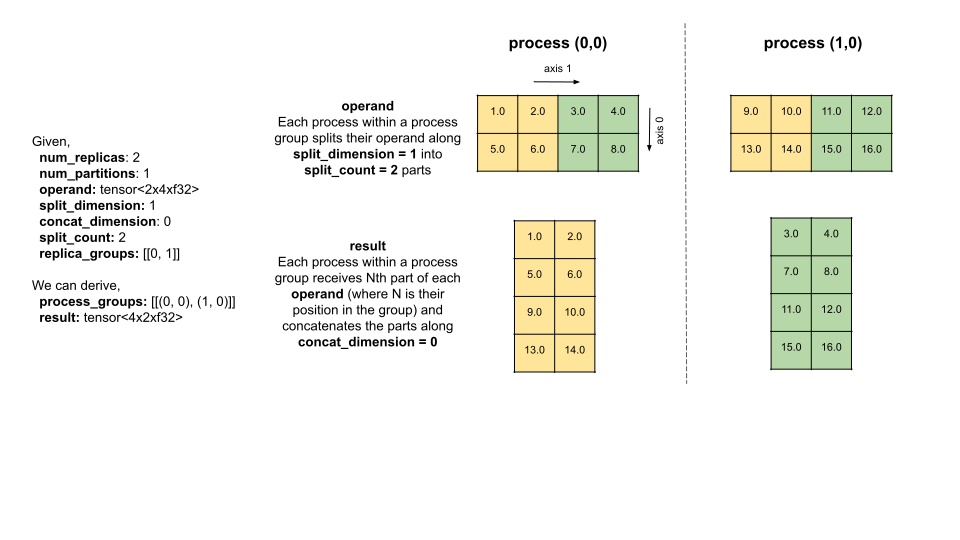
在 StableHLO 程序格的每個程序群組中,沿著 split_dimension 將 operands 張量的值分割成多個部分,在程序之間分散分割部分,沿著 concat_dimension 串連分散部分,並產生 results 張量。這項作業會將 StableHLO 程序格線分割成 process_groups,定義如下:
cross_replica(replica_groups)(如果channel_id <= 0)。cross_partition(replica_groups)(如果channel_id > 0)。
接著,在每個 process_group 中執行下列操作:
split_parts...@sender = split(operands...@sender, split_count, split_dimension)適用於「process_group」中的所有sender。scattered_parts...@receiver = [split_parts...@sender[receiver_index] for sender in process_group](其中receiver_index = process_group.index(receiver))。results...@process = concatenate(scattered_parts...@process, concat_dimension)。
輸入
| 標籤 | 名稱 | 類型 | 限制 |
|---|---|---|---|
| (I1) | operands |
可變數量的張量或每個張量的量化張量 | (C1-C3)、(C9) |
| (I2) | split_dimension |
si64 類型的常數 |
(C1)、(C2)、(C9) |
| (I3) | concat_dimension |
si64 類型的常數 |
(C3)、(C9) |
| (I4) | split_count |
si64 類型的常數 |
(C2)、(C4)、(C8)、(C9) |
| (I5) | replica_groups |
si64 類型的 2 維張量常數 |
(C5-C8) |
| (I6) | channel_id |
si64 類型的常數 |
輸出內容
| 名稱 | 類型 | 限制 |
|---|---|---|
results |
可變數量的張量或每個張量的量化張量 | (C9) |
限制
- (C1)
0 <= split_dimension < rank(operands...)。 - (C2)
dim(operands..., split_dimension) % split_count = 0。 - (C3)
0 <= concat_dimension < rank(operands...)。 - (C4)
0 < split_count。 - (C5)
is_unique(replica_groups)。 - (C6)
size(replica_groups)的定義為:- 如果使用
cross_replica,則為num_replicas。 - 如果使用
cross_partition,則為num_partitions。
- 如果使用
- (C7)
0 <= replica_groups < size(replica_groups)。 - (C8)
dim(replica_groups, 1) = split_count。 - (C9)
type(results...) = type(operands...),但如果split_dimension != concat_dimension:dim(results..., split_dimension) = dim(operands..., split_dimension) / split_count。dim(results..., concat_dimension) = dim(operands..., concat_dimension) * split_count。
範例
// num_replicas: 2
// num_partitions: 1
// %operand1@(0, 0): [[1, 2, 3, 4],
//                    [5, 6, 7, 8]]
// %operand1@(1, 0): [[9, 10, 11, 12],
//                    [13, 14, 15, 16]]
// %operand2@(0, 0): [[17, 18, 19, 20],
//                    [21, 22, 23, 24]]
// %operand2@(1, 0): [[25, 26, 27, 28],
//                    [29, 30, 31, 32]]
%result:2 = "stablehlo.all_to_all"(%operand1, %operand2) {
  split_dimension = 1 : i64,
  concat_dimension = 0 : i64,
  split_count = 2 : i64,
  replica_groups = dense<[[0, 1]]> : tensor<1x2xi64>
  // channel_id = 0
} : (tensor<2x4xi64>, tensor<2x4xi64>) -> (tensor<4x2xi64>, tensor<4x2xi64>)
// %result#0@(0, 0): [[1, 2], [5, 6], [9, 10], [13, 14]]
// %result#0@(1, 0): [[3, 4], [7, 8], [11, 12], [15, 16]]
// %result#1@(0, 0): [[17, 18], [21, 22], [25, 26], [29, 30]]
// %result#1@(1, 0): [[19, 20], [23, 24], [27, 28], [31, 32]]
和
語意
對兩個張量 lhs 和 rhs 執行元素層級的 AND 運算,並產生 result 張量。視元素類型而定,執行下列操作:
- 布林值:邏輯 AND。
- 如果是整數:位元 AND。
輸入
| 標籤 | 名稱 | 類型 | 限制 |
|---|---|---|---|
| (I1) | lhs |
布林值或整數類型的張量 | (C1) |
| (I2) | rhs |
布林值或整數類型的張量 | (C1) |
輸出內容
| 名稱 | 類型 | 限制 |
|---|---|---|
result |
布林值或整數類型的張量 | (C1) |
限制
- (C1)
type(lhs) = type(rhs) = type(result)。
範例
// %lhs: [[1, 2], [3, 4]]
// %rhs: [[5, 6], [7, 8]]
%result = "stablehlo.and"(%lhs, %rhs) : (tensor<2x2xi32>, tensor<2x2xi32>) -> tensor<2x2xi32>
// %result: [[1, 2], [3, 0]]
atan2
語意
對 lhs 和 rhs 張量執行元素級別的 atan2 運算,並產生 result 張量。視元素類型而定,執行下列操作:
- 浮點數:IEEE-754 的
atan2。 - 如果是複數,則為複數 atan2。
- 量化型別:
dequantize_op_quantize(atan2, lhs, rhs, type(result))。
輸入
| 標籤 | 名稱 | 類型 | 限制 |
|---|---|---|---|
| (I1) | lhs |
浮點或複數型別的張量,或是每個張量的量化張量 | (C1) |
| (I2) | rhs |
浮點或複數型別的張量,或是每個張量的量化張量 | (C1) |
輸出內容
| 名稱 | 類型 | 限制 |
|---|---|---|
result |
浮點或複數型別的張量,或是每個張量的量化張量 | (C1) |
限制
- (C1)
baseline_type(lhs) = baseline_type(rhs) = baseline_type(result)。
範例
// %lhs: [0.0, 1.0, -1.0]
// %rhs: [0.0, 0.0, 0.0]
%result = "stablehlo.atan2"(%lhs, %rhs) : (tensor<3xf64>, tensor<3xf64>) -> tensor<3xf64>
// %result: [0.0, 1.57079637, -1.57079637] // [0.0, pi/2, -pi/2]
batch_norm_grad
語意
計算 batch_norm_training 的多個輸入內容的梯度,從 grad_output 反向傳播,並產生 grad_operand、grad_scale 和 grad_offset 張量。更正式地來說,這項作業可以表示為使用 Python 語法分解為現有的 StableHLO 作業,如下所示:
def compute_sum(operand, feature_index):
  (sum,) = reduce(
      inputs=[operand],
      init_values=[constant(0, element_type(operand))],
      dimensions=[i for i in range(rank(operand)) if i != feature_index],
      body=lambda x, y: add(x, y))
  return sum

def compute_mean(operand, feature_index):
  sum = compute_sum(operand, feature_index)
  divisor = constant(size(operand) / dim(operand, feature_index),
                     element_type(operand))
  divisor_bcast = broadcast_in_dim(divisor, [], type(sum))
  return divide(sum, divisor_bcast)

def batch_norm_grad(operand, scale, mean, variance, grad_output, epsilon, feature_index):
  # Broadcast inputs to type(operand)
  scale_bcast = broadcast_in_dim(scale, [feature_index], type(operand))
  mean_bcast = broadcast_in_dim(mean, [feature_index], type(operand))
  variance_bcast = broadcast_in_dim(variance, [feature_index], type(operand))
  epsilon_bcast = broadcast_in_dim(constant(epsilon, element_type(operand)), [],
                                   type(operand))

  # Perform normalization using the provided `mean` and `variance`
  # Intermediate values will be useful for computing gradients
  centered_operand = subtract(operand, mean_bcast)
  stddev = sqrt(add(variance_bcast, epsilon_bcast))
  normalized_operand = divide(centered_operand, stddev)

  # Use the implementation from batchnorm_expander.cc in XLA
  # Temporary variables have exactly the same names as in the C++ code
  elements_per_feature = broadcast_in_dim(
      constant(divide(size(operand), dim(operand, feature_index)),
               element_type(grad_output)),
      [], type(operand))
  i1 = multiply(grad_output, elements_per_feature)
  i2 = broadcast_in_dim(
      compute_sum(grad_output, feature_index), [feature_index], type(operand))
  i3 = broadcast_in_dim(
      compute_sum(multiply(grad_output, centered_operand), feature_index),
      [feature_index], type(operand))
  i4 = multiply(i3, centered_operand)
  i5 = divide(i4, add(variance_bcast, epsilon_bcast))
  i6 = subtract(subtract(i1, i2), i5)

  grad_operand =
      multiply(divide(divide(scale_bcast, stddev), elements_per_feature), i6)
  grad_scale =
      compute_sum(multiply(grad_output, normalized_operand), feature_index)
  grad_offset = compute_sum(grad_output, feature_index)

  return grad_operand, grad_scale, grad_offset
如果是量化型別,則會執行 dequantize_batch_norm_grad_or_training_quantize(lambda operand, scale, mean,
variance, grad_output: batch_norm_grad(operand, scale, mean, variance,
grad_output, epsilon, feature_index), operand, scale, mean, variance,
grad_output, type(grad_operand), type(grad_scale), type(feature_index))。
輸入
| 標籤 | 名稱 | 類型 | 限制 |
|---|---|---|---|
| (I1) | operand |
浮點類型張量或每個張量的量化張量 | (C1-C3)、(C5) |
| (I2) | scale |
浮點或每個張量量化型別的一維張量 | (C2)、(C4)、(C5) |
| (I3) | mean |
浮點或每個張量量化型別的一維張量 | (C2)、(C4) |
| (I4) | variance |
浮點或每個張量量化型別的一維張量 | (C2)、(C4) |
| (I5) | grad_output |
浮點類型張量或每個張量的量化張量 | (C2)、(C3) |
| (I6) | epsilon |
f32 類型的常數 |
|
| (I7) | feature_index |
si64 類型的常數 |
(C1)、(C5) |
輸出內容
| 名稱 | 類型 | 限制 |
|---|---|---|
grad_operand |
浮點類型張量或每個張量的量化張量 | (C2)、(C3) |
grad_scale |
浮點或每個張量量化型別的一維張量 | (C2)、(C4) |
grad_offset |
浮點或每個張量量化型別的一維張量 | (C2)、(C4) |
限制
- (C1)
0 <= feature_index < rank(operand)。 - (C2)
operand、scale、mean、variance、grad_output、grad_operand、grad_scale和grad_offset具有相同的baseline_element_type。 - (C3)
operand、grad_output和grad_operand的形狀相同。 - (C4)
scale、mean、variance、grad_scale和grad_offset的形狀相同。 - (C5)
size(scale) = dim(operand, feature_index)。
範例
// %operand: [
//            [[1.0, 2.0], [3.0, 4.0]],
//            [[3.0, 4.0], [1.0, 2.0]]
//           ]
// %scale: [1.0, 1.0]
// %mean: [2.0, 3.0]
// %variance: [1.0, 1.0]
// %grad_output: [
//                [[0.1, 0.1], [0.1, 0.1]],
//                [[0.1, 0.1], [0.1, 0.1]]
//               ]
%grad_operand, %grad_scale, %grad_offset =
"stablehlo.batch_norm_grad"(%operand, %scale, %mean, %variance, %grad_output) {
  epsilon = 0.0 : f32,
  feature_index = 2 : i64
} : (tensor<2x2x2xf64>, tensor<2xf64>, tensor<2xf64>, tensor<2xf64>,
     tensor<2x2x2xf64>) -> (tensor<2x2x2xf64>, tensor<2xf64>, tensor<2xf64>)
// %grad_operand: [
//                 [[0.0, 0.0], [0.0, 0.0]],
//                 [[0.0, 0.0], [0.0, 0.0]]
//                ]
// %grad_scale:  [0.0, 0.0]
// %grad_offset: [0.4, 0.4]
batch_norm_inference
語意
將 operand 張量在所有維度中正規化,但 feature_index 維度除外,並產生 result 張量。更正式地來說,這項作業可使用 Python 語法,表示為分解成現有 StableHLO 作業,如下所示:
def batch_norm_inference(operand, scale, offset, mean, variance, epsilon, feature_index):
  # Broadcast inputs to shape(operand)
  scale_bcast = broadcast_in_dim(scale, [feature_index], type(operand))
  offset_bcast = broadcast_in_dim(offset, [feature_index], type(operand))
  mean_bcast = broadcast_in_dim(mean, [feature_index], type(operand))
  variance_bcast = broadcast_in_dim(variance, [feature_index], type(operand))
  epsilon_bcast = broadcast_in_dim(constant(epsilon, element_type(operand)), [],
                                   type(operand))

  # Perform normalization using the provided `mean` and `variance` instead of
  # computing them like `batch_norm_training` does.
  centered_operand = subtract(operand, mean_bcast)
  stddev = sqrt(add(variance_bcast, epsilon_bcast))
  normalized_operand = divide(centered_operand, stddev)
  return add(multiply(scale_bcast, normalized_operand), offset_bcast)
如果是量化型別,則會執行 dequantize_op_quantize(lambda operand, scale, offset, mean, variance:
batch_norm_inference(operand, scale, offset, mean, variance, epsilon,
feature_index), operand, scale, offset, mean, variance, type(result))。
輸入
| 標籤 | 名稱 | 類型 | 限制 |
|---|---|---|---|
| (I1) | operand |
浮點類型張量或每個張量的量化張量 | (C1-C7) |
| (I2) | scale |
浮點或每個張量量化型別的一維張量 | (C2)、(C3) |
| (I3) | offset |
浮點或每個張量量化型別的一維張量 | (C2)、(C4) |
| (I4) | mean |
浮點或每個張量量化型別的一維張量 | (C5) |
| (I5) | variance |
浮點或每個張量量化型別的一維張量 | (C2)、(C6) |
| (I6) | epsilon |
f32 類型的常數 |
|
| (I7) | feature_index |
si64 類型的常數 |
(C1)、(C3-C6) |
輸出內容
| 名稱 | 類型 | 限制 |
|---|---|---|
result |
浮點類型張量或每個張量的量化張量 | (C2)、(C7) |
限制
- (C1)
0 <= feature_index < rank(operand)。 - (C2)
operand、scale、offset、mean、variance和result具有相同的baseline_element_type。 - (C3)
size(scale) = dim(operand, feature_index)。 - (C4)
size(offset) = dim(operand, feature_index)。 - (C5)
size(mean) = dim(operand, feature_index)。 - (C6)
size(variance) = dim(operand, feature_index)。 - (C7)
baseline_type(operand) = baseline_type(result)。
範例
// %operand: [
//            [[1.0, 2.0], [3.0, 4.0]],
//            [[3.0, 4.0], [1.0, 2.0]]
//           ]
// %scale: [1.0, 1.0]
// %offset: [1.0, 1.0]
// %mean: [2.0, 3.0]
// %variance: [1.0, 1.0]
%result = "stablehlo.batch_norm_inference"(%operand, %scale, %offset, %mean, %variance) {
  epsilon = 0.0 : f32,
  feature_index = 2 : i64
} : (tensor<2x2x2xf64>, tensor<2xf64>, tensor<2xf64>, tensor<2xf64>, tensor<2xf64>) -> tensor<2x2x2xf64>
// %result: [
//           [[0.0, 0.0], [2.0, 2.0]],
//           [[2.0, 2.0], [0.0, 0.0]]
//          ]
batch_norm_training
語意
計算所有維度的平均值和變異數 (feature_index維度除外),並產生 output、batch_mean 和 batch_var 張量,藉此正規化 operand 張量。更正式地來說,這項作業可以表示為使用 Python 語法分解為現有的 StableHLO 作業,如下所示:
def compute_mean(operand, feature_index):
  (sum,) = reduce(
      inputs=[operand],
      init_values=[constant(0, element_type(operand))],
      dimensions=[i for i in range(rank(operand)) if i != feature_index],
      body=lambda x, y: add(x, y))
  divisor = constant(size(operand) / dim(operand, feature_index),
                     element_type(operand))
  divisor_bcast = broadcast_in_dim(divisor, [], type(sum))
  return divide(sum, divisor_bcast)

def compute_variance(operand, feature_index):
  mean = compute_mean(operand, feature_index)
  mean_bcast = broadcast_in_dim(mean, [feature_index], type(operand))
  centered_operand = subtract(operand, mean_bcast)
  return compute_mean(mul(centered_operand, centered_operand), feature_index)

def batch_norm_training(operand, scale, offset, epsilon, feature_index):
  mean = compute_mean(operand, feature_index)
  variance = compute_variance(operand, feature_index)
  return batch_norm_inference(operand, scale, offset, mean, variance, epsilon,
                              feature_index),
         mean, variance
如果是量化型別,則會執行 dequantize_batch_norm_grad_or_training_quantize(lambda operand, scale, offset:
batch_norm_training(operand, scale, offset, epsilon, feature_index), operand,
scale, offset, type(output), type(batch_mean), type(batch_var))。
輸入
| 標籤 | 名稱 | 類型 | 限制 |
|---|---|---|---|
| (I1) | operand |
浮點類型張量或每個張量的量化張量 | (C1) |
| (I2) | scale |
浮點或每個張量量化的 1 維張量 | (C2)、(C3) |
| (I3) | offset |
浮點或每個張量量化的 1 維張量 | (C2)、(C4) |
| (I4) | epsilon |
f32 類型的常數 |
(C1)、(C3-C6) |
| (I5) | feature_index |
si64 類型的常數 |
(C1)、(C3-C6) |
輸出內容
| 名稱 | 類型 | 限制 |
|---|---|---|
output |
浮點類型張量或每個張量的量化張量 | (C7) |
batch_mean |
浮點或每個張量量化的 1 維張量 | (C2)、(C5) |
batch_var |
浮點或每個張量量化的 1 維張量 | (C2)、(C6) |
限制
- (C1)
0 <= feature_index < rank(operand)。 - (C2)
operand、scale、offset、batch_mean、batch_var和output具有相同的baseline_element_type。 - (C3)
size(scale) = dim(operand, feature_index)。 - (C4)
size(offset) = dim(operand, feature_index)。 - (C5)
size(batch_mean) = dim(operand, feature_index)。 - (C6)
size(batch_var) = dim(operand, feature_index)。 - (C7)
baseline_type(output) = baseline_type(operand)。
範例
// %operand: [
//            [[1.0, 2.0], [3.0, 4.0]],
//            [[3.0, 4.0], [1.0, 2.0]]
//           ]
// %scale: [1.0, 1.0]
// %offset: [1.0, 1.0]
%output, %batch_mean, %batch_var = "stablehlo.batch_norm_training"(%operand, %scale, %offset) {
  epsilon = 0.0 : f32,
  feature_index = 2 : i64
} : (tensor<2x2x2xf64>, tensor<2xf64>, tensor<2xf64>) ->
    (tensor<2x2x2xf64>, tensor<2xf64>, tensor<2xf64>)
// %output: [
//           [[0.0, 0.0], [2.0, 2.0]],
//           [[2.0, 2.0], [0.0, 0.0]]
//          ]
// %batch_mean: [2.0, 3.0]
// %batch_var: [1.0, 1.0]
bitcast_convert
語意
對 operand 張量執行位元轉換運算,並產生 result 張量,其中整個 operand 張量的位元會使用 result 張量的型別重新解讀。
更正式地說,假設有 E = element_type(operand)、E' = element_type(result) 和 R = rank(operand):
- 如果
num_bits(E') < num_bits(E),bits(result[i0, ..., iR-1, :]) = bits(operand[i0, ..., iR-1])。 - 如果
num_bits(E') > num_bits(E),bits(result[i0, ..., iR-2]) = bits(operand[i0, ..., iR-2, :])。 - 如果
num_bits(E') = num_bits(E),bits(result[i0, ..., iR-1]) = bits(operand[i0, ..., iR-1])。
bits 會傳回指定值的記憶體內表示法,且其行為是由實作定義,因為張量的確切表示法是由實作定義,元素類型的確切表示法也是由實作定義。
輸入
| 標籤 | 名稱 | 類型 | 限制 |
|---|---|---|---|
| (I1) | operand |
張量或量化張量 | (C1-C2) |
輸出內容
| 名稱 | 類型 | 限制 |
|---|---|---|
result |
張量或量化張量 | (C1-C2) |
限制
- (C1) 已知
E = is_quantized(operand) ? storage_type(operand) : element_type(operand)、E' = is_quantized(result) ? storage_type(result) : element_type(result)和R = rank(operand):- 如果
num_bits(E') = num_bits(E),請參閱shape(result) = shape(operand)。 - 如果
num_bits(E') < num_bits(E): rank(result) = R + 1。dim(result, i) = dim(operand, i),費用只要0 <= i < R。dim(result, R) * num_bits(E') = num_bits(E)。- 如果
num_bits(E') > num_bits(E): rank(result) = R - 1。dim(result, i) = dim(operand, i),費用只要0 <= i < R。dim(operand, R - 1) * num_bits(E) = num_bits(E')。
- 如果
- (C2) If
is_complex(operand) or is_complex(result), thenis_complex(operand) and is_complex(result).
範例
// %operand: 0x0123456789ABCDEF
%result = "stablehlo.bitcast_convert"(%operand) : (tensor<f64>) -> tensor<4xf16>
// %result: [0xCDEF, 0x89AB, 0x4567, 0x0123] // little-endian representation
broadcast_in_dim
語意
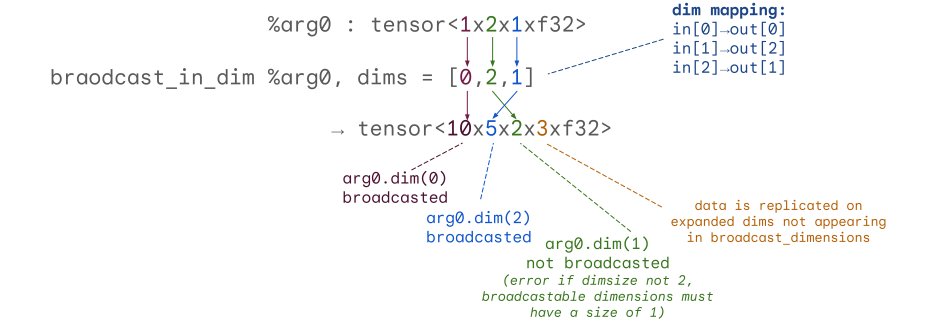
藉由複製 operand 張量中的資料,擴展輸入張量的維度和/或等級,並產生 result 張量。更正式地說,result[result_index] = operand[operand_index],其中對於 axes(operand) 中的所有 d:
operand_index[d] = 0(如果dim(operand, d) = 1)。- 其他情況則為
operand_index[d] = result_index[broadcast_dimensions[d]]。
輸入
| 標籤 | 名稱 | 類型 | 限制 |
|---|---|---|---|
| (I1) | operand |
張量或量化張量 | (C1-C2)、(C5-C6) |
| (I2) | broadcast_dimensions |
si64 類型的 1 維張量常數 |
(C2-C6) |
輸出內容
| 名稱 | 類型 | 限制 |
|---|---|---|
result |
張量或量化張量 | (C1)、(C3)、(C5-C6) |
限制
- (C1)
element_type(result)由以下項目提供:element_type(operand)(如果!is_per_axis_quantized(operand))。element_type(operand),但quantization_dimension(operand)、scales(operand)和zero_points(operand)可能與quantization_dimension(result)、scales(result)和zero_points(result)不同,除非另有規定。
- (C2)
size(broadcast_dimensions) = rank(operand)。 - (C3)
0 <= broadcast_dimensions < rank(result)。 - (C4)
is_unique(broadcast_dimensions)。 - (C5) 針對
d中的所有axes(operand):dim(operand, d) = 1或dim(operand, d) = dim(result, broadcast_dimensions[d])。
- (C6) If
is_per_axis_quantized(result):quantization_dimension(result) = broadcast_dimensions[quantization_dimension(operand)]。- 如果值為
dim(operand, quantization_dimension(operand)) = 1,則scales(result)[i] = scales(operand)[0] and zero_points(result)[i] = zero_points(operand)[0] for i in range(dim(result, quantization_dimension(result)))。
範例
// %operand: [
//            [1, 2, 3]
//           ]
%result = "stablehlo.broadcast_in_dim"(%operand) {
  broadcast_dimensions = array<i64: 2, 1>
} : (tensor<1x3xi32>) -> tensor<2x3x2xi32>
// %result: [
//            [
//             [1, 1],
//             [2, 2],
//             [3, 3]
//            ],
//            [
//             [1, 1],
//             [2, 2],
//             [3, 3]
//            ]
//          ]
保護殼
語意
根據 index 的值,從 branches 執行一個函式,並產生輸出內容。更正式地說,result = selected_branch(),其中:
selected_branch = branches[index](如果0 <= index < size(branches))。- 其他情況則為
selected_branch = branches[-1]。
輸入
| 標籤 | 名稱 | 類型 | 限制 |
|---|---|---|---|
| (I1) | index |
si32 類型的 0 維張量 |
|
| (I2) | branches |
函式數量可變 | (C1-C4) |
輸出內容
| 名稱 | 類型 | 限制 |
|---|---|---|
results |
可變數量的張量、量化張量或權杖 | (C4) |
限制
- (C1)
0 < size(branches)。 - (C2)
input_types(branches...) = []。 - (C3)
same(output_types(branches...))。 - (C4)
type(results...) = output_types(branches[0])。
範例
// %index: -1
// %result_branch0: [0, 0]
// %result_branch1: [1, 1]
%result0, %result1 = "stablehlo.case"(%index) ({
  "stablehlo.return"(%result_branch0, %result_branch0) : (tensor<2xi64>, tensor<2xi64>) -> ()
}, {
  "stablehlo.return"(%result_branch1, %result_branch1) : (tensor<2xi64>, tensor<2xi64>) -> ()
}) : (tensor<i32>) -> (tensor<2xi64>, tensor<2xi64>)
// %result0: [1, 1]
// %result1: [1, 1]
cbrt
語意
對 operand 張量執行元素級別的立方根運算,並產生 result 張量。視元素類型而定,執行下列操作:
- 浮點數:IEEE-754 的
rootn(x, 3)。 - 複數:複數立方根。
- 量化型別:
dequantize_op_quantize(cbrt, operand, type(result))
輸入
| 標籤 | 名稱 | 類型 | 限制 |
|---|---|---|---|
| (I1) | operand |
浮點或複數型別的張量,或是每個張量的量化張量 | (C1) |
輸出內容
| 名稱 | 類型 | 限制 |
|---|---|---|
result |
浮點或複數型別的張量,或是每個張量的量化張量 | (C1) |
限制
- (C1)
baseline_type(operand) = baseline_type(result)。
範例
// %operand: [0.0, 1.0, 8.0, 27.0]
%result = "stablehlo.cbrt"(%operand) : (tensor<4xf64>) -> tensor<4xf64>
// %result: [0.0, 1.0, 2.0, 3.0]
ceil
語意
對 operand 張量執行元素層級的 ceil 運算,並產生 result 張量。
實作 IEEE-754 規格的 roundToIntegralTowardPositive 運算。如果是量化型別,則會執行 dequantize_op_quantize(ceil, operand, type(result))。
輸入
| 標籤 | 名稱 | 類型 | 限制 |
|---|---|---|---|
| (I1) | operand |
浮點類型張量或每個張量的量化張量 | (C1) |
輸出內容
| 名稱 | 類型 | 限制 |
|---|---|---|
result |
浮點類型張量或每個張量的量化張量 | (C1) |
限制
- (C1)
baseline_type(operand) = baseline_type(result)。
範例
// %operand: [-0.8166, -0.2530, 0.2530, 0.8166, 2.0]
%result = "stablehlo.ceil"(%operand) : (tensor<5xf32>) -> tensor<5xf32>
// %result: [-0.0, -0.0, 1.0, 1.0, 2.0]
cholesky
語意
計算一批矩陣的 Cholesky 分解。
更正式地說,對於 index_space(result) 中的所有 i,result[i0, ..., iR-3, :, :] 是 a[i0, ..., iR-3, :, :] 的 Cholesky 分解,形式為下三角 (如果 lower 是 true) 或上三角 (如果 lower 是 false) 矩陣。對向三角形中的輸出值 (即嚴格上三角形或嚴格下三角形) 則由實作定義。
如果存在輸入矩陣不是 Hermitian 正定矩陣的 i,則行為未定義。
如果是量化型別,則會執行 dequantize_op_quantize(lambda operand: cholesky(operand, lower), a, type(result))。
輸入
| 標籤 | 名稱 | 類型 | 限制 |
|---|---|---|---|
| (I1) | a |
浮點或複數型別的張量,或是每個張量的量化張量 | (C1-C3) |
| (I2) | lower |
i1 類型的常數 |
輸出內容
| 名稱 | 類型 | 限制 |
|---|---|---|
result |
浮點或複數型別的張量,或是每個張量的量化張量 | (C1) |
限制
- (C1)
baseline_type(a) = baseline_type(result)。 - (C2)
2 <= rank(a)。 - (C3)
dim(a, -2) = dim(a, -1)。
範例
// %a: [
//      [1.0, 2.0, 3.0],
//      [2.0, 20.0, 26.0],
//      [3.0, 26.0, 70.0]
//     ]
%result = "stablehlo.cholesky"(%a) {
  lower = true
} : (tensor<3x3xf32>) -> tensor<3x3xf64>
// %result: [
//           [1.0, 0.0, 0.0],
//           [2.0, 4.0, 0.0],
//           [3.0, 5.0, 6.0]
//          ]
限制取值範圍
語意
將 operand 張量中的每個元素限制在最小值和最大值之間,並產生 result 張量。更正式地說,result[result_index] =
minimum(maximum(operand[result_index], min_element), max_element),其中 min_element = rank(min) = 0 ? min[] : min[result_index],max_element = rank(max) = 0 ? max[] : max[result_index]。如果是量化型別,則會執行 dequantize_op_quantize(clamp, min, operand, max, type(result))。
對複數強制排序會涉及令人意外的語意,因此我們計畫在未來移除對這項作業的複數支援 (#560)。
輸入
| 標籤 | 名稱 | 類型 | 限制 |
|---|---|---|---|
| (I1) | min |
張量或每個張量的量化張量 | (C1)、(C3) |
| (I2) | operand |
張量或每個張量的量化張量 | (C1-C4) |
| (I3) | max |
張量或每個張量的量化張量 | (C2)、(C3) |
輸出內容
| 名稱 | 類型 | 限制 |
|---|---|---|
result |
張量或每個張量的量化張量 | (C4) |
限制
- (C1)
rank(min) = 0 or shape(min) = shape(operand)。 - (C2)
rank(max) = 0 or shape(max) = shape(operand)。 - (C3)
baseline_element_type(min) = baseline_element_type(operand) = baseline_element_type(max)。 - (C4)
baseline_type(operand) = baseline_type(result)。
範例
// %min: [5, 10, 15]
// %operand: [3, 13, 23]
// %max: [10, 15, 20]
%result = "stablehlo.clamp"(%min, %operand, %max) : (tensor<3xi32>, tensor<3xi32>, tensor<3xi32>) -> tensor<3xi32>
// %result: [5, 13, 20]
collective_broadcast
語意
在 StableHLO 程序格的每個程序群組中,將來源程序的 operand 張量值傳送至目標程序,並產生 result 張量。
這項作業會將 StableHLO 程序格線分割成 process_groups,定義如下:
cross_replica(replica_groups)(如果channel_id <= 0)。cross_partition(replica_groups)(如果channel_id > 0)。
之後,result@process 會由下列人員提供:
- 如果存在
i,且程序位於process_groups[i]中。operand@process_groups[i, 0] broadcast_in_dim(constant(is_quantized(result) ? quantize(0, element_type(result)) : 0, element_type(result)), [], type(result)),否則為其他情況。
輸入
| 標籤 | 名稱 | 類型 | 限制 |
|---|---|---|---|
| (I1) | operand |
張量或每個張量的量化張量 | (C3) |
| (I2) | replica_groups |
si64 型別的一維張量常數可變引數數量 |
(C1)、(C2) |
| (I3) | channel_id |
si64 類型的常數 |
輸出內容
| 名稱 | 類型 | 限制 |
|---|---|---|
result |
張量或每個張量的量化張量 | (C3) |
限制
- (C1)
is_unique(replica_groups)。 - (C2)
0 <= replica_groups < N,其中N定義如下:- 如果使用
cross_replica,則為num_replicas。 - 如果使用
cross_partition,則為num_partitions。
- 如果使用
- (C3)
type(result) = type(operand)。
範例
// num_replicas: 4
// num_partitions: 1
// %operand@(0, 0): [[1, 2]]
// %operand@(1, 0): [[3, 4]]
// %operand@(2, 0): [[5, 6]]
// %operand@(3, 0): [[7, 8]]
%result = "stablehlo.collective_broadcast"(%operand) {
  replica_groups = dense<[[2, 1]]> : tensor<1x2xi64>,
  channel_handle = #stablehlo.channel_handle<handle = 0, type = 0>
} : (tensor1x2xi64>) -> tensor<1x2xi64>
// %result@(0, 0): [[0, 0]]
// %result@(1, 0): [[5, 6]]
// %result@(2, 0): [[5, 6]]
// %result@(3, 0): [[0, 0]]
collective_permute
語意
在 StableHLO 程序格的每個程序群組中,將來源程序的 operand 張量值傳送至目標程序,並產生 result 張量。
這項作業會將 StableHLO 程序格線分割成 process_groups,定義如下:
cross_replica(source_target_pairs)(如果channel_id <= 0)。cross_partition(source_target_pairs)(如果channel_id > 0)。
之後,result@process 會由下列人員提供:
operand@process_groups[i, 0],如果存在i,使得process_groups[i, 1] = process。broadcast_in_dim(constant(is_quantized(result) ? quantize(0, element_type(result)) : 0, element_type(result)), [], type(result)),否則為其他情況。
輸入
| 標籤 | 名稱 | 類型 | 限制 |
|---|---|---|---|
| (I1) | operand |
張量或每個張量的量化張量 | (C5) |
| (I2) | source_target_pairs |
si64 類型的 2 維張量常數 |
(C1-C4) |
| (I3) | channel_id |
si64 類型的常數 |
輸出內容
| 名稱 | 類型 | 限制 |
|---|---|---|
result |
張量或每個張量的量化張量 | (C1) |
限制
- (C1)
dim(source_target_pairs, 1) = 2。 - (C2)
is_unique(source_target_pairs[:, 0])。 - (C3)
is_unique(source_target_pairs[:, 1])。 - (C4)
0 <= source_target_pairs < N,其中N定義為:- 如果使用
cross_replica,則為num_replicas。 - 如果使用
cross_partition,則為num_partitions。
- 如果使用
- (C5)
type(result) = type(operand)。
範例
// num_replicas: 3
// num_partitions: 1
// %operand@(0, 0): [[1, 2], [3, 4]]
// %operand@(1, 0): [[5, 6], [7, 8]]
// %operand@(2, 0): [[9, 10], [11, 12]]
%result = "stablehlo.collective_permute"(%operand) {
  source_target_pairs = dense<[[0, 1], [1, 2]]> : tensor<2x2xi64>,
  channel_handle = #stablehlo.channel_handle<handle = 0, type = 0>
} : (tensor<2x2xi64>) -> tensor<2x2xi64>
//
// %result@(0, 0): [[0, 0], [0, 0]]
// %result@(1, 0): [[1, 2], [3, 4]]
// %result@(2, 0): [[5, 6], [7, 8]]
compare
語意
根據 comparison_direction 和 compare_type,對 lhs 和 rhs 張量執行元素層級的比較,並產生 result 張量。
comparison_direction 和 compare_type 的值具有下列語意:
如果是布林值和整數元素類型:
EQ:lhs = rhs。NE:lhs != rhs。GE:lhs >= rhs。GT:lhs > rhs。LE:lhs <= rhs。LT:lhs < rhs。
如為具有 compare_type = FLOAT 的浮點元素類型,運算子會實作下列 IEEE-754 作業:
EQ:compareQuietEqual。NE:compareQuietNotEqual。GE:compareQuietGreaterEqual。GT:compareQuietGreater。LE:compareQuietLessEqual。LT:compareQuietLess。
如果是具有 compare_type = TOTALORDER 的浮點元素類型,運算子會使用 IEEE-754 的 totalOrder 和 compareQuietEqual 運算組合。
如果是複雜的元素類型,系統會使用提供的 comparison_direction 和 compare_type 執行 (real, imag) 配對的字典順序比較。對複數強制排序會牽涉到令人意外的語意,因此我們計畫在 comparison_direction 為 GE、GT、LE 或 LT 時,移除對複數的支援 (#560)。
適用於量化型別,會執行 dequantize_compare(lhs, rhs,
comparison_direction)。
輸入
| 標籤 | 名稱 | 類型 | 限制 |
|---|---|---|---|
| (I1) | lhs |
張量或每個張量的量化張量 | (C1-C3) |
| (I2) | rhs |
張量或每個張量的量化張量 | (C1-C2) |
| (I3) | comparison_direction |
EQ、NE、GE、GT、LE 和 LT 的列舉 |
|
| (I4) | compare_type |
FLOAT、TOTALORDER、SIGNED 和 UNSIGNED 的列舉 |
(C3) |
輸出內容
| 名稱 | 類型 | 限制 |
|---|---|---|
result |
布林值類型的張量 | (C2) |
限制
- (C1)
baseline_element_type(lhs) = baseline_element_type(rhs)。 - (C2)
shape(lhs) = shape(rhs) = shape(result)。 - (C3)
compare_type的定義為:SIGNED(如果is_signed_integer(element_type(lhs)))。UNSIGNED(如果is_unsigned_integer(element_type(lhs)) or is_boolean(element_type(lhs)))。FLOAT或TOTALORDER(如果is_float(element_type(lhs)))。FLOAT(如果is_complex(element_type(lhs)))。
範例
// %lhs: [1.0, 3.0]
// %rhs: [1.1, 2.9]
%result = "stablehlo.compare"(%lhs, %rhs) {
  comparison_direction = #stablehlo<comparison_direction LT>,
  compare_type = #stablehlo<comparison_type FLOAT>
} : (tensor<2xf32>, tensor<2xf32>) -> tensor<2xi1>
// %result: [true, false]
複雜
語意
從實數和虛數值 (lhs 和 rhs) 逐一轉換為複數值,並產生 result 張量。
輸入
| 標籤 | 名稱 | 類型 | 限制 |
|---|---|---|---|
| (I1) | lhs |
f32 或 f64 類型的張量 |
(C1-C3) |
| (I2) | rhs |
f32 或 f64 類型的張量 |
(C1) |
輸出內容
| 名稱 | 類型 | 限制 |
|---|---|---|
result |
複數型別的張量 | (C2)、(C3) |
限制
- (C1)
type(lhs) = type(rhs)。 - (C2)
shape(result) = shape(lhs)。 - (C3)
element_type(result)的型別為complex<E>,其中E = element_type(lhs)。
範例
// %lhs: [1.0, 3.0]
// %rhs: [2.0, 4.0]
%result = "stablehlo.complex"(%lhs, %rhs) : (tensor<2xf64>, tensor<2xf64>) -> tensor<2xcomplex<f64>>
// %result: [(1.0, 2.0), (3.0, 4.0)]
複合
語意
封裝由其他 StableHLO 作業組成的作業,並採用 inputs 和 composite_attributes,產生 results。op 的語意是由 decomposition 屬性實作。composite op 可以替換為其分解,而不會變更程式語意。如果將分解作業內嵌無法提供相同的作業語意,建議使用 custom_call。
version 欄位 (預設為 0) 用於表示複合項目的語意何時會變更。
輸入
| 標籤 | 名稱 | 類型 |
|---|---|---|
| (I1) | inputs |
可變數量的數值 |
| (I2) | name |
string 類型的常數 |
| (I3) | composite_attributes |
屬性字典 |
| (I4) | decomposition |
string 類型的常數 |
| (I5) | version |
si32 類型的常數 |
輸出內容
| 名稱 | 類型 |
|---|---|
results |
可變數量的數值 |
限制
- (C1)
is_namespaced_op_name(name) - (C2)
is_defined_in_parent_scope(decomposition) - (C3)
types(inputs...) == input_types(decomposition) - (C4)
types(results...) == output_types(decomposition)
範例
%results = "stablehlo.composite"(%input0, %input1) {
  name = "my_namespace.my_op",
  composite_attributes = {
    my_attribute = "my_value"
  },
  decomposition = @my_op,
  version = 1 : i32
} : (tensor<f32>, tensor<f32>) -> tensor<f32>
串連
語意
沿著 dimension 維度串連 inputs,順序與指定引數相同,並產生 result 張量。更正式地說,
result[i0, ..., id, ..., iR-1] = inputs[k][i0, ..., kd, ..., iR-1],其中:
id = d0 + ... + dk-1 + kd。d等於dimension,而d0等則是inputs的第d個維度大小。
輸入
| 標籤 | 名稱 | 類型 | 限制 |
|---|---|---|---|
| (I1) | inputs |
可變數量的張量或每個張量的量化張量 | (C1-C6) |
| (I2) | dimension |
si64 類型的常數 |
(C2)、(C4)、(C6) |
輸出內容
| 名稱 | 類型 | 限制 |
|---|---|---|
result |
張量或每個張量的量化張量 | (C5-C6) |
限制
- (C1)
same(element_type(inputs...))。 - (C2)
same(shape(inputs...))(dim(inputs..., dimension)除外)。 - (C3)
0 < size(inputs)。 - (C4)
0 <= dimension < rank(inputs[0])。 - (C5)
element_type(result) = element_type(inputs[0])。 - (C6)
shape(result) = shape(inputs[0])(下列項目除外):dim(result, dimension) = dim(inputs[0], dimension) + ...。
範例
// %input0: [[1, 2], [3, 4], [5, 6]]
// %input1: [[7, 8]]
%result = "stablehlo.concatenate"(%input0, %input1) {
  dimension = 0 : i64
} : (tensor<3x2xi64>, tensor<1x2xi64>) -> tensor<4x2xi64>
// %result: [[1, 2], [3, 4], [5, 6], [7, 8]]
常數
語意
從常數 value 產生 output 張量。
輸入
| 標籤 | 名稱 | 類型 | 限制 |
|---|---|---|---|
| (I1) | value |
常數 | (C1) |
輸出內容
| 名稱 | 類型 | 限制 |
|---|---|---|
output |
張量或量化張量 | (C1) |
限制
- (C1)
type(value) = type(output)。
範例
%output = "stablehlo.constant"() {
  value = dense<[[0.0, 1.0], [2.0, 3.0]]> : tensor<2x2xf32>
} : () -> tensor<2x2xf32>
// %output: [[0.0, 1.0], [2.0, 3.0]]
完成轉換
語意
在 operand 張量上執行元素式轉換,從一種元素型別轉換為另一種,並產生 result 張量。
如果是boolean-to-any-supported-type的轉換,值 false 會轉換為零,值 true 則會轉換為一。對於any-supported-type-to-boolean的轉換,零值會轉換為 false,非零值則會轉換為 true。如要瞭解這項功能如何處理複雜類型,請參閱下文。
如果是整數對整數、整數對浮點數或浮點數對浮點數的轉換,如果來源值可以精確地以目標型別表示,結果值就是該精確表示法。否則,行為待定 (#180)。
如果是floating-point-to-integer的轉換,系統會截斷小數部分。如果截斷的值無法以目的地型別表示,則行為待定 (#180)。
複數到複數的轉換會遵循浮點到浮點轉換的相同行為,以轉換實部和虛部。
如果是複數到任何其他型別和任何其他型別到複數的轉換,系統會分別忽略來源虛數值或將目的地虛數值歸零。實部轉換遵循 浮點轉換。
原則上,這項作業可以表示去量化 (從量化張量轉換為一般張量)、量化 (從一般張量轉換為量化張量) 和重新量化 (在量化張量之間轉換),但目前我們有專用的作業:第一個用途是 uniform_dequantize,第二個和第三個用途是 uniform_quantize。日後,這兩項作業可能會合併為 convert (#1576)。
輸入
| 標籤 | 名稱 | 類型 | 限制 |
|---|---|---|---|
| (I1) | operand |
張量 | (C1) |
輸出內容
| 名稱 | 類型 | 限制 |
|---|---|---|
result |
張量 | (C1) |
限制
- (C1)
shape(operand) = shape(result)。
範例
// %operand: [-1, 0, 1]
%result = "stablehlo.convert"(%operand) : (tensor<3xi64>) -> tensor<3xcomplex<f64>>
// %result: [(-1.0, 0.0), (0.0, 0.0), (1.0, 0.0)]
卷積
語意
計算 lhs 視窗與 rhs 切片之間的點積,並產生 result。下圖以具體範例說明如何從 lhs 和 rhs 計算 result 中的元素。
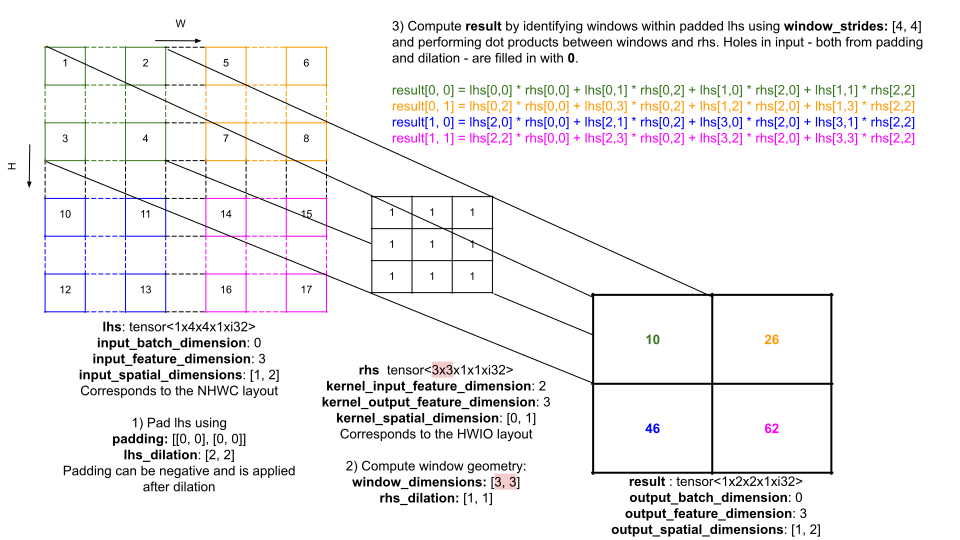
更正式地來說,請考慮以 lhs 表示輸入內容,以便表示 lhs 的視窗:
lhs_window_dimensions = lhs_shape(dim(lhs, input_batch_dimension), dim(rhs, kernel_spatial_dimensions), dim(lhs, input_feature_dimension))。lhs_window_strides = lhs_shape(1, window_strides, 1)。lhs_padding = lhs_shape([0, 0], padding, [0, 0])。lhs_base_dilations = lhs_shape(1, lhs_dilation, 1)。lhs_window_dilations = lhs_shape(1, rhs_dilation, 1)。
這項重構作業會使用下列輔助函式:
lhs_shape(n, hw, c) = permute([n] + hw + [c], [input_batch_dimension] + input_spatial_dimensions + [input_feature_dimension])。result_shape(n1, hw, c1) = permute([n1] + hw + [c1], [output_batch_dimension] + output_spatial_dimensions + [output_feature_dimension])。permute([j0, j1, ..., jR-1], permutation) = [i0, i1, ..., iR-1](其中j[d] = i[permutation[d]])。
如果 feature_group_count = 1 和 batch_group_count = 1,則對於 index_space(dim(result, output_spatial_dimensions...)) 中的所有 output_spatial_index,result[result_shape(:, output_spatial_index, :)] = dot_product 其中:
padding_value = constant(0, element_type(lhs))。padded_lhs = pad(lhs, padding_value, lhs_padding[:, 0], lhs_padding[:, 1], lhs_base_dilations - 1)。lhs_window_start = lhs_shape(0, output_spatial_index, 0) * lhs_window_strides。lhs_window = slice(padded_lhs, lhs_window_start, lhs_window_start + lhs_window_dimensions, lhs_window_dilations)。reversed_lhs_window = reverse(lhs_window, [input_spatial_dimensions[dim] for dim in range(size(window_reversal)) if window_reversal[dim] = true])。 這項功能似乎未被使用,因此我們計畫在日後移除這項功能 (#1181)。dot_product = dot_general(reversed_lhs_window, rhs, lhs_batching_dimensions=[], lhs_contracting_dimensions=input_spatial_dimensions + [input_feature_dimension], rhs_batching_dimensions=[], rhs_contracting_dimensions=kernel_spatial_dimensions + [kernel_input_feature_dimension])。
如果 feature_group_count > 1:
lhses = split(lhs, feature_group_count, input_feature_dimension)。rhses = split(rhs, feature_group_count, kernel_output_feature_dimension)。results... = convolution(lhses..., rhses..., ..., feature_group_count=1, ...)。result = concatenate(results, output_feature_dimension)。
如果 batch_group_count > 1:
lhses = split(lhs, batch_group_count, input_batch_dimension)。rhses = split(rhs, batch_group_count, kernel_output_feature_dimension)。results... = convolution(lhses..., rhses..., ..., batch_group_count=1, ...)。result = concatenate(results, output_feature_dimension)。
如果是量化型別,則會執行 dequantize_op_quantize(
lambda lhs, rhs: convolution(lhs, rhs, window_strides, padding,
lhs_dilation, rhs_dilation, window_reversal, input_batch_dimension,
input_feature_dimension, input_spatial_dimensions,
kernel_input_feature_dimension, kernel_output_feature_dimension,
kernel_spatial_dimensions, output_batch_dimension,
output_feature_dimension, output_spatial_dimensions,
feature_group_count, batch_group_count, precision_config), lhs, rhs,
type(result))。
如果是混合量化型別,則會執行 hybrid_dequantize_then_op(
lambda lhs, rhs: convolution(lhs, rhs, window_strides, padding,
lhs_dilation, rhs_dilation, window_reversal, input_batch_dimension,
input_feature_dimension, input_spatial_dimensions,
kernel_input_feature_dimension, kernel_output_feature_dimension,
kernel_spatial_dimensions, output_batch_dimension,
output_feature_dimension, output_spatial_dimensions,
feature_group_count, batch_group_count, precision_config), lhs, rhs)。
輸入
| 標籤 | 名稱 | 類型 | 限制 |
|---|---|---|---|
| (I1) | lhs |
張量或每個張量的量化張量 | (C1)、(C10-C11)、(C14)、(C25)、(C27-C28)、(C31-C32)、(C34) |
| (I2) | rhs |
張量或量化張量 | (C1)、(C14-C16)、(C25)、(C27-C29)、(C31-C34) |
| (I3) | window_strides |
si64 類型的 1 維張量常數 |
(C2-C3)、(C25) |
| (I4) | padding |
si64 類型的 2 維張量常數 |
(C4)、(C25) |
| (I5) | lhs_dilation |
si64 類型的 1 維張量常數 |
(C5-C6)、(C25) |
| (I6) | rhs_dilation |
si64 類型的 1 維張量常數 |
(C7-C8)、(C25) |
| (I7) | window_reversal |
i1 類型的 1 維張量常數 |
(C9) |
| (I8) | input_batch_dimension |
si64 類型的常數 |
(C10)、(C13)、(C25) |
| (I9) | input_feature_dimension |
si64 類型的常數 |
(C11)、(C13-C14) |
| (I10) | input_spatial_dimensions |
si64 類型的 1 維張量常數 |
(C12)、(C13)、(C25) |
| (I11) | kernel_input_feature_dimension |
si64 類型的常數 |
(C14)、(C18) |
| (I12) | kernel_output_feature_dimension |
si64 類型的常數 |
(C15-C16)、(C18)、(C25)、(C29) |
| (I13) | kernel_spatial_dimensions |
si64 類型的 1 維張量常數 |
(C17-C18)、(C25) |
| (I14) | output_batch_dimension |
si64 類型的常數 |
(C20)、(C25) |
| (I15) | output_feature_dimension |
si64 類型的常數 |
(C20)、(C25)、(C30) |
| (I16) | output_spatial_dimensions |
si64 類型的 1 維張量常數 |
(C19-C20)、(C25) |
| (I17) | feature_group_count |
si64 類型的常數 |
(C11)、(C14)、(C16)、(C21)、(C23) |
| (I18) | batch_group_count |
si64 類型的常數 |
(C10)、(C15)、(C22)、(C23)、(C25) |
| (I19) | precision_config |
DEFAULT、HIGH 和 HIGHEST 的可變數量列舉 |
(C24) |
輸出內容
| 名稱 | 類型 | 限制 |
|---|---|---|
result |
張量或量化張量 | (C25-C28)、(C30)、(C32-34) |
限制
- (C1)
N = rank(lhs) = rank(rhs)。 - (C2)
size(window_strides) = N - 2。 - (C3)
0 < window_strides。 - (C4)
shape(padding) = [N - 2, 2]。 - (C5)
size(lhs_dilation) = N - 2。 - (C6)
0 < lhs_dilation。 - (C7)
size(rhs_dilation) = N - 2。 - (C8)
0 < rhs_dilation。 - (C9)
size(window_reversal) = N - 2。 - (C10)
dim(lhs, input_batch_dimension) % batch_group_count = 0。 - (C11)
dim(lhs, input_feature_dimension) % feature_group_count = 0。 - (C12)
size(input_spatial_dimensions) = N - 2。 - (C13) Given
input_dimensions = [input_batch_dimension] + input_spatial_dimensions + [input_feature_dimension]:is_unique(input_dimensions)。0 <= input_dimensions < N。
- (C14)
dim(rhs, kernel_input_feature_dimension) = dim(lhs, input_feature_dimension) / feature_group_count。 - (C15)
dim(rhs, kernel_output_feature_dimension) % batch_group_count = 0。 - (C16)
dim(rhs, kernel_output_feature_dimension) % feature_group_count = 0。 - (C17)
size(kernel_spatial_dimensions) = N - 2。 - (C18) Given
kernel_dimensions = kernel_spatial_dimensions + [kernel_input_feature_dimension] + [kernel_output_feature_dimension]:is_unique(kernel_dimensions)。0 <= kernel_dimensions < N。
- (C19)
size(output_spatial_dimensions) = N - 2。 - (C20) Given
output_dimensions = [output_batch_dimension] + output_spatial_dimensions + [output_feature_dimension]:is_unique(output_dimensions)。0 <= output_dimensions < N。
- (C21)
0 < feature_group_count。 - (C22)
0 < batch_group_count。 - (C23)
feature_group_count = 1 or batch_group_count = 1。 - (C24)
size(precision_config) = 2。 - (C25)
dim(result, result_dim)的定義為:dim(lhs, input_batch_dimension) / batch_group_count(如果result_dim = output_batch_dimension)。dim(rhs, kernel_output_feature_dimension)(如果result_dim = output_feature_dimension)。- 其他情況則為
num_windows,其中: output_spatial_dimensions[spatial_dim] = result_dim。lhs_dim = input_spatial_dimensions[spatial_dim]。rhs_dim = kernel_spatial_dimensions[spatial_dim]。dilated_input_shape[lhs_dim] = dim(lhs, lhs_dim) = 0 ? 0 : (dim(lhs, lhs_dim) - 1) * lhs_dilation[spatial_dim] + 1。padded_input_shape[lhs_dim] = padding[spatial_dim, 0] + dilated_input_shape[lhs_dim] + padding[spatial_dim, 1]。dilated_window_shape[lhs_dim] = dim(rhs, rhs_dim) = 0 ? 0 : (dim(rhs, rhs_dim) - 1) * rhs_dilation[spatial_dim] + 1。is_empty_window[lhs_dim] = padded_input_shape[lhs_dim] = 0 || dilated_window_shape[lhs_dim] > padded_input_shape[lhs_dim]。num_windows = is_empty_window[lhs_dim] ? 0 : floor((padded_input_shape[lhs_dim] - dilated_window_shape[lhs_dim]) / window_strides[spatial_dim]) + 1。
- (C26)
rank(result) = N。 - 如果作業使用非量化張量:
- (C27)
element_type(lhs) = element_type(rhs) = element_type(result)。
- (C27)
- 如果作業使用量化張量:
- (C28)
is_quantized(lhs) = is_quantized(result) and is_quantized(rhs)。 - (C29) If
is_per_axis_quantized(rhs), thenquantization_dimension(rhs) = kernel_output_feature_dimension. - (C30) If
is_per_axis_quantized(result), thenquantization_dimension(result) = output_feature_dimension. - 如果
is_quantized(lhs): - (C31)
storage_type(lhs) = storage_type(rhs)。 - (C32)
expressed_type(lhs) = expressed_type(rhs) = expressed_type(result)。 - (C33) If
is_per_tensor_quantized(rhs), thenis_per_tensor_quantized(result). - 如果
!is_quantized(lhs): - (C34)
element_type(lhs) = expressed_type(rhs) = element_type(result)。
- (C28)
範例
// %lhs: [[
//        [
//          [1], [2], [5], [6]
//        ],
//        [
//          [3], [4], [7], [8]
//        ],
//        [
//          [10], [11], [14], [15]
//        ],
//        [
//          [12], [13], [16], [17]
//        ]
//      ]]
//
// %rhs: [
//        [[[1]], [[1]], [[1]]],
//        [[[1]], [[1]], [[1]]],
//        [[[1]], [[1]], [[1]]]
//       ]
%result = "stablehlo.convolution"(%lhs, %rhs) {
  window_strides = array<i64: 4, 4>,
  padding = dense<0> : tensor<2x2xi64>,
  lhs_dilation = array<i64: 2, 2>,
  rhs_dilation = array<i64: 1, 1>,
  window_reversal = array<i1: false, false>,
  // In the StableHLO dialect, dimension numbers are encoded via:
  // `[<input dimensions>]x[<kernel dimensions>]->[output dimensions]`.
  // "b" is batch dimension, "f" is feature dimension,
  // "i" is input feature dimension, "o" is output feature dimension,
  // "0/1/etc" are spatial dimensions.
  dimension_numbers = #stablehlo.conv<[b, 0, 1, f]x[0, 1, i, o]->[b, 0, 1, f]>,
  batch_group_count = 1 : i64,
  feature_group_count = 1 : i64,
  precision_config = [#stablehlo<precision DEFAULT>, #stablehlo<precision DEFAULT>]
} : (tensor<1x4x4x1xi64>, tensor<3x3x1x1xi64>) -> tensor<1x2x2x1xi64>
// %result: [[
//            [[10], [26]],
//            [[46], [62]]
//          ]]
餘弦
語意
對 operand 張量執行元素級別的餘弦運算,並產生 result 張量。視元素類型而定,執行下列操作:
- 浮點數:IEEE-754 的
cos。 - 複數:複數餘弦。
- 量化型別:
dequantize_op_quantize(cosine, operand, type(result))。
輸入
| 標籤 | 名稱 | 類型 | 限制 |
|---|---|---|---|
| (I1) | operand |
浮點或複數型別的張量,或是每個張量的量化張量 | (C1) |
輸出內容
| 名稱 | 類型 | 限制 |
|---|---|---|
result |
浮點或複數型別的張量,或是每個張量的量化張量 | (C1) |
限制
- (C1)
baseline_type(operand) = baseline_type(result)。
範例
// %operand: [
//            [0.0, 1.57079632],       // [0, pi/2]
//            [3.14159265, 4.71238898] // [pi, 3pi/2]
//           ]
%result = "stablehlo.cosine"(%operand) : (tensor<2x2xf32>) -> tensor<2x2xf32>
// %result: [[1.0, 0.0], [-1.0, 0.0]]
count_leading_zeros
語意
逐一計算 operand 張量中開頭零位元的數量,並產生 result 張量。
輸入
| 標籤 | 名稱 | 類型 | 限制 |
|---|---|---|---|
| (I1) | operand |
整數型別的張量 | (C1) |
輸出內容
| 名稱 | 類型 | 限制 |
|---|---|---|
result |
整數型別的張量 | (C1) |
限制
- (C1)
type(operand) = type(result)。
範例
// %operand: [[0, 1], [128, -1]]
%result = "stablehlo.count_leading_zeros"(%operand) : (tensor<2x2xi64>) -> tensor<2x2xi64>
// %result: [[64, 63], [56, 0]]
custom_call
語意
封裝實作定義的作業 call_target_name,該作業會採用 inputs 和 called_computations,並產生 results。has_side_effect、backend_config 和 api_version 可用於提供實作定義的其他中繼資料。
目前,這項作業包含相當雜亂的中繼資料集合,反映了 XLA 編譯器中對應作業的自然演變。我們計畫在日後統一這項中繼資料 (#741)。
輸入
| 標籤 | 名稱 | 類型 |
|---|---|---|
| (I1) | inputs |
可變數量的數值 |
| (I2) | call_target_name |
string 類型的常數 |
| (I3) | has_side_effect |
i1 類型的常數 |
| (I4) | backend_config |
string 類型常數或屬性字典 |
| (I5) | api_version |
si32 類型的常數 |
| (I6) | called_computations |
string 類型的常數可變數量 |
| (I7) | output_operand_aliases |
在輸出和運算元中指定別名部分 |
輸出內容
| 名稱 | 類型 |
|---|---|
results |
可變數量的數值 |
(XLA GPU 支援) 特殊的 custom_call 目標
有三種與 buffer 類型相關的特殊 call_target_name:CreateBuffer 會建立未初始化的 buffer,Pin 會建立初始化的 buffer,而 Unpin 則會取消分配 buffer 並傳回 buffer 的內容。
%uninitialized_buffer = "stablehlo.custom_call"() {
  call_target_name = "CreateBuffer",
  api_version = 4 : i32,
} : () -> memref<4xf64>

%initialized_buffer = "stablehlo.custom_call"(%init_value) {
  call_target_name = "Pin",
  api_version = 4 : i32,
} : (tensor<4xf64>) -> memref<4xf64>

%dealloc_buffer = "stablehlo.custom_call"(%initialized_buffer) {
  call_target_name = "Unpin",
  api_version = 4 : i32,
} : (memref<4xf64>) -> tensor<4xf64>
別名
部分 custom_call 作業可能需要輸出內容中的一部分,以及運算元中的一部分共用相同記憶體。這可以透過 output_operand_aliases 表示。別名配對表示法包含輸出元組索引清單 (代表輸出部分),以及 operand_index 和運算元元組索引清單 (代表運算元部分)。如果對應的型別不是 tuple 型別,輸出或運算元元組索引清單就會是空白,而且對於任意巢狀元組型別,清單長度可以是任意長度。這與 XLA 別名表示法類似。
別名配對中的輸出和輸入部分必須屬於相同類型。對於並非呼叫 CreateBuffer、Pin 和 Unpin 的 custom_call 作業,buffer 運算元最多只能出現在一組別名中,且 buffer 輸出內容必須出現在一組別名中。
範例
%results = "stablehlo.custom_call"(%input0) {
  call_target_name = "foo",
  has_side_effect = false,
  backend_config = {bar = 42 : i32},
  api_version = 4 : i32,
  called_computations = [@foo]
} : (tensor<f64>) -> tensor<f64>

%updated_buffer = "stablehlo.custom_call"(%buffer) {
  call_target_name = "Update",
  api_version = 4 : i32,
  output_operand_aliases = [
    #stablehlo.output_operand_alias<output_tuple_indices = [],
      operand_index = 0,
      operand_tuple_indices = []>]
} : (memref<4xf64>) -> memref<4xf64>
除號
語意
執行被除數 lhs 和除數 rhs 張量的元素層級除法,並產生 result 張量。視元素類型而定,執行下列操作:
- 整數:整數除法,產生代數商,並捨棄任何小數部分。
- 浮點數:IEEE-754 的
division。 - 複數:複數除法。
- 如為量化型別:
dequantize_op_quantize(divide, lhs, rhs, type(result))。
輸入
| 標籤 | 名稱 | 類型 | 限制 |
|---|---|---|---|
| (I1) | lhs |
整數、浮點數或複數型別的張量,或是每個張量的量化張量 | (C1) |
| (I2) | rhs |
整數、浮點數或複數型別的張量,或是每個張量的量化張量 | (C1) |
輸出內容
| 名稱 | 類型 | 限制 |
|---|---|---|
result |
整數、浮點數或複數型別的張量,或是每個張量的量化張量 | (C1) |
限制
- (C1)
baseline_type(lhs) = baseline_type(rhs) = baseline_type(result)。
範例
// %lhs: [17.1, -17.1, 17.1, -17.1]
// %rhs: [3.0, 3.0, -3.0, -3.0]
%result = "stablehlo.divide"(%lhs, %rhs) : (tensor<4xf32>, tensor<4xf32>) -> tensor<4xf32>
// %result: [5.66666651, -5.66666651, -5.66666651, 5.66666651]
dot_general
語意
計算 lhs 片段與 rhs 片段之間的點積,並產生 result 張量。
更正式地說,result[result_index] = dot_product,其中:
lhs_result_dimensions = [d for d in axes(lhs) and d not in lhs_batching_dimensions and d not in lhs_contracting_dimensions]。rhs_result_dimensions = [d for d in axes(rhs) and d not in rhs_batching_dimensions and d not in rhs_contracting_dimensions]。result_batching_index + result_lhs_index + result_rhs_index = result_index其中size(result_batching_index) = size(lhs_batching_dimensions)、size(result_lhs_index) = size(lhs_result_dimensions)和size(result_rhs_index) = size(rhs_result_dimensions)。transposed_lhs = transpose(lhs, lhs_batching_dimensions + lhs_result_dimensions + lhs_contracting_dimensions)。transposed_lhs_slice = slice(transposed_lhs, result_batching_index + result_lhs_index + [:, ..., :])。reshaped_lhs_slice = reshape(transposed_lhs_slice, dims(lhs, lhs_contracting_dimensions))。transposed_rhs = transpose(rhs, rhs_batching_dimensions + rhs_result_dimensions + rhs_contracting_dimensions)。transposed_rhs_slice = slice(transposed_rhs, result_batching_index + result_rhs_index + [:, ..., :])。reshaped_rhs_slice = reshape(transposed_rhs_slice, dims(rhs, rhs_contracting_dimensions))。dot_product = reduce( inputs=[multiply(reshaped_lhs_slice, reshaped_rhs_slice)], init_values=[constant(0, element_type(result))], dimensions=range(size(lhs_contracting_dimensions)), body=lambda x, y: add(x, y))。
如果是量化型別,則會執行 dequantize_op_quantize(
lambda lhs, rhs: dot_general(lhs, rhs, lhs_batching_dimensions,
rhs_batching_dimensions, lhs_contracting_dimensions,
rhs_contracting_dimensions, precision_config), lhs, rhs, type(result))。
如果是混合量化型別,則會執行 hybrid_dequantize_then_op(
lambda lhs, rhs: dot_general(lhs, rhs, lhs_batching_dimensions,
rhs_batching_dimensions, lhs_contracting_dimensions,
rhs_contracting_dimensions, precision_config), lhs, rhs)。
precision_config 可控制加速器後端運算的運算速度和準確度之間的取捨。可以是下列其中一個值 (目前這些列舉值的語意尚未明確指定,但我們計畫在 #755 中解決這個問題):
DEFAULT:計算速度最快,但最不準確。HIGH:計算速度較慢,但更接近原始數字。HIGHEST:計算速度最慢,但最接近原始數字。
DotAlgorithm 定義用於實作點運算的演算法主要屬性,同時也定義精確度。如果設定演算法屬性欄位,則 precision_config 必須為 DEFAULT。DotAlgorithms 沒有預設值,因為預設參數是由實作定義。因此,所有點演算法欄位都可以設為 None,指定空白點演算法,改為使用 precision_config 值。
DotAlgorithm 欄位包括:
- 和
rhs_precision_type,即運算子左側和右側的精確度。lhs_precision_type精確度類型與輸入和輸出的儲存類型無關。 accumulation_type用於累計的精確度。- 當我們執行演算法,將左側和/或右側分解為多個元件,並對這些值執行多個「原始」點運算時,就會套用
lhs_component_count、rhs_component_count和num_primitive_operations,通常是為了模擬更高的精確度 (例如運用 bfloat16 人工智慧資料型別進行高精確度運算:bf16_6x tf32_3x 等)。如果演算法沒有分解,這些值應設為1。 allow_imprecise_accumulation,指定是否允許部分步驟以較低的精確度累計 (例如CUBLASLT_MATMUL_DESC_FAST_ACCUM)。
DotAlgorithm 屬性範例:
// Inputs are casted to tf32, and then accumulated in f32:
{lhs_precision_type = tf32,
 rhs_precision_type = tf32,
 accumulation_type = f32,
 lhs_component_count = 1,
 rhs_component_count = 1,
 num_primitive_operations = 1,
 allow_imprecise_accumulation = false}


// bf16_6x: each input is decomposed to 3 bf16 components, then 6 dot operations are done on those components, and the result is accumulated in f32.
{lhs_precision_type = bf16,
 rhs_precision_type = bf16,
 accumulation_type = f32,
 lhs_component_count = 3,
 rhs_component_count = 3,
 num_primitive_operations = 6,
 allow_imprecise_accumulation = false}


// Inputs are (casted to) f8e5m2, and we accumulate in f32, but for some steps we may accumulate in lower precision.
{lhs_precision_type = f8e5m2,
 rhs_precision_type = f8e5m2,
 accumulation_type = f32,
 lhs_component_count = 1,
 rhs_component_count = 1,
 num_primitive_operations = 1,
 allow_imprecise_accumulation = true}
實作方式可自行決定要支援哪些組合。一般而言,StableHLO 的消費者無法保證每個演算法都支援每種加速器類型。如果系統不支援特定演算法,應會引發錯誤,而不是改用替代演算法。StableHLO 驗證會盡力驗證,防止演算法在任何硬體上執行 (如果已知該演算法不支援該硬體)。
如要查看部分支援的演算法值,請參閱 xla_data.proto > Algorithm。支援單 #2483 記錄了為後端支援的演算法建立集中式文件的計畫。
輸入
| 標籤 | 名稱 | 類型 | 限制 |
|---|---|---|---|
| (I1) | lhs |
張量或每個張量的量化張量 | (C5-C6)、(C9-C10)、(C12-C14)、(C17-C18)、(C20) |
| (I2) | rhs |
張量或量化張量 | (C7-C10)、(C12-C20) |
| (I3) | lhs_batching_dimensions |
si64 類型的 1 維張量常數 |
(C1)、(C3)、(C5)、(C9)、(C12) |
| (I4) | rhs_batching_dimensions |
si64 類型的 1 維張量常數 |
(C1)、(C4)、(C7)、(C9) |
| (I5) | lhs_contracting_dimensions |
si64 類型的 1 維張量常數 |
(C2)、(C3)、(C6)、(C10) |
| (I6) | rhs_contracting_dimensions |
si64 類型的 1 維張量常數 |
(C2)、(C4)、(C8)、(C10)、(C16) |
| (I7) | precision_config |
DEFAULT、HIGH 和 HIGHEST 的可變數量列舉 |
(C11)、(C21) |
| (I8) | lhs_precision_type |
FloatType 或 TensorFloat32 | (C21) |
| (I9) | rhs_precision_type |
FloatType 或 TensorFloat32 | (C21) |
| (I10) | accumulation_type |
FloatType 或 TensorFloat32 | (C21) |
| (I11) | lhs_component_count |
si32 類型的常數 |
(C21)、(C22) |
| (I12) | rhs_component_count |
si32 類型的常數 |
(C21)、(C23) |
| (I13) | num_primitive_operations |
si32 類型的常數 |
(C21)、(C24) |
| (I14) | allow_imprecise_accumulation |
bool 類型的常數 |
(C21) |
輸出內容
| 名稱 | 類型 | 限制 |
|---|---|---|
result |
張量或量化張量 | (C12)、(C14)、(C18-C20) |
限制
- (C1)
size(lhs_batching_dimensions) = size(rhs_batching_dimensions)。 - (C2)
size(lhs_contracting_dimensions) =
size(rhs_contracting_dimensions)
。 - (C3)
is_unique(lhs_batching_dimensions + lhs_contracting_dimensions)。 - (C4)
is_unique(rhs_batching_dimensions + rhs_contracting_dimensions)。 - (C5)
0 <= lhs_batching_dimensions < rank(lhs)。 - (C6)
0 <= lhs_contracting_dimensions < rank(lhs)。 - (C7)
0 <= rhs_batching_dimensions < rank(rhs)。 - (C8)
0 <= rhs_contracting_dimensions < rank(rhs)。 - (C9)
dim(lhs, lhs_batching_dimensions...) =
dim(rhs, rhs_batching_dimensions...)
。 - (C10)
dim(lhs, lhs_contracting_dimensions...) =
dim(rhs, rhs_contracting_dimensions...)
。 - (C11)
size(precision_config) = 2。 - (C12)
shape(result) = dim(lhs, lhs_batching_dimensions) +
dim(lhs, lhs_result_dimensions) + dim(rhs, rhs_result_dimensions)
。 - 如果作業使用非量化張量:
- (C13)
element_type(lhs) = element_type(rhs)。
- (C13)
- 如果作業使用量化張量:
- (C14)
is_quantized(lhs) = is_quantized(result) and is_quantized(rhs)。 - (C15)
zero_points(rhs) = 0。 - (C16) 如果
is_per_axis_quantized(rhs),則quantization_dimension(rhs)不在rhs_contracting_dimensions中。 - 如果
is_quantized(lhs): - (C17)
storage_type(lhs) = storage_type(rhs)。 - (C18)
expressed_type(lhs) = expressed_type(rhs) = expressed_type(result)。 - (C19) If
is_per_tensor_quantized(rhs), thenis_per_tensor_quantized(result). - 如果
!is_quantized(lhs): - (C20)
element_type(lhs) = expressed_type(rhs) = element_type(result)。
- (C14)
- 如果
!is_empty_algorithm(lhs_precision_type, rhs_precision_type, accumulation_type, lhs_component_count, rhs_component_count, num_primitive_operations allow_imprecise_accumulation):- (C21)
precision_config... = DEFAULT。 - (C22)
0 < lhs_component_count。 - (C23)
0 < rhs_component_count。 - (C24)
0 < num_primitive_operations。
- (C21)
範例
// %lhs: [
//        [[1, 2],
//         [3, 4]],
//        [[5, 6],
//         [7, 8]]
//       ]
// %rhs: [
//        [[1, 0],
//         [0, 1]],
//        [[1, 0],
//         [0, 1]]
//       ]
%result = "stablehlo.dot_general"(%lhs, %rhs) {
  dot_dimension_numbers = #stablehlo.dot<
    lhs_batching_dimensions = [0],
    rhs_batching_dimensions = [0],
    lhs_contracting_dimensions = [2],
    rhs_contracting_dimensions = [1]
  >,
  precision_config = [#stablehlo<precision DEFAULT>, #stablehlo<precision DEFAULT>],
  algorithm = #stablehlo.dot_algorithm<
    lhs_precision_type = tf32,
    rhs_precision_type = tf32,
    accumulation_type = f32,
    lhs_component_count = 1,
    rhs_component_count = 1,
    num_primitive_operations = 1,
    allow_imprecise_accumulation = false
  >
} : (tensor<2x2x2xi64>, tensor<2x2x2xi64>) -> tensor<2x2x2xi64>
// %result: [
//           [[1, 2],
//            [3, 4]],
//           [[5, 6],
//            [7, 8]]
//          ]
dynamic_broadcast_in_dim
語意
這項作業在功能上與 broadcast_in_dim 作業相同,但結果形狀是透過 output_dimensions 動態指定。
這項作業也會接受選用屬性 known_expanding_dimensions、known_nonexpanding_dimensions,用來表示維度擴展行為的靜態知識。如未指定,系統會假設所有維度都可能擴展。
輸入
| 標籤 | 名稱 | 類型 | 限制 |
|---|---|---|---|
| (I1) | operand |
張量或量化張量 | (C1-C2)、(C5-C6)、(C9) |
| (I2) | output_dimensions |
整數類型的一維張量 | (C7) |
| (I3) | broadcast_dimensions |
整數類型的一維常數張量 | (C2-C6) |
| (I4) | known_expanding_dimensions |
整數類型的一維常數張量 | (C8-C9) |
| (I5) | known_nonexpanding_dimensions |
整數類型的一維常數張量 | (C8-C9) |
輸出內容
| 名稱 | 類型 | 限制 |
|---|---|---|
result |
張量或量化張量 | (C1)、(C3)、(C5-C7) |
限制
- (C1)
element_type(result)由以下項目提供:element_type(operand)(如果!is_per_axis_quantized(operand))。element_type(operand),但quantization_dimension(operand)、scales(operand)和zero_points(operand)可能與quantization_dimension(result)、scales(result)和zero_points(result)不同,除非另有規定。
- (C2)
size(broadcast_dimensions) = rank(operand)。 - (C3)
0 <= broadcast_dimensions < rank(result)。 - (C4)
is_unique(broadcast_dimensions)。 - (C5) 針對
d中的所有axes(operand):dim(operand, d) = 1或dim(operand, d) = dim(result, broadcast_dimensions[d])。
- (C6) If
is_per_axis_quantized(result):quantization_dimension(result) = broadcast_dimensions[quantization_dimension(operand)]。- 如果值為
dim(operand, quantization_dimension(operand)) = 1,則scales(result)[i] = scales(operand)[0] and zero_points(result)[i] = zero_points(operand)[0] for i in range(dim(result, quantization_dimension(result)))。
- (C7)
size(output_dimensions) = rank(result)。 - (C8)
is_unique(known_expanding_dimensions + known_nonexpanding_dimensions)。 - (C9)
0 <= known_expanding_dimensions < rank(operand)。 - (C10)
0 <= known_nonexpanding_dimensions < rank(operand)。
範例
// %operand: [
//            [1, 2, 3]
//           ]
%operand = stablehlo.constant dense<[[1, 2, 3]]> : tensor<1x3xi64>
%output_dimensions = stablehlo.constant dense<[2, 3, 2]> : tensor<3xi64>
%result = "stablehlo.dynamic_broadcast_in_dim"(%operand, %output_dimensions) {
  broadcast_dimensions = array<i64: 2, 1>,
  known_expanding_dimensions = array<i64: 0>,
  known_nonexpanding_dimensions = array<i64: 1>
} : (tensor<1x3xi64>, tensor<3xi64>) -> tensor<2x3x2xi64>
// %result: [
//            [
//             [1, 1],
//             [2, 2],
//             [3, 3]
//            ],
//            [
//             [1, 1],
//             [2, 2],
//             [3, 3]
//            ]
//          ]
dynamic_conv
語意
這項作業在功能上與捲積作業相同,但填補是透過 padding 動態指定。
輸入
| 標籤 | 名稱 | 類型 | 限制 |
|---|---|---|---|
| (I1) | lhs |
張量或每個張量的量化張量 | (C1)、(C10-C11)、(C14)、(C25)、(C26-C27)、(C30-C31)、(C33) |
| (I2) | rhs |
張量或量化張量 | (C1)、(C14-C16)、(C26-C28)、(C30-C33) |
| (I3) | padding |
整數類型的 2 維張量 | (C4) |
| (I4) | window_strides |
si64 類型的 1 維張量常數 |
(C2-C3) |
| (I5) | lhs_dilation |
si64 類型的 1 維張量常數 |
(C5-C6) |
| (I6) | rhs_dilation |
si64 類型的 1 維張量常數 |
(C7-C8) |
| (I7) | window_reversal |
i1 類型的 1 維張量常數 |
(C9) |
| (I8) | input_batch_dimension |
si64 類型的常數 |
(C10)、(C13) |
| (I9) | input_feature_dimension |
si64 類型的常數 |
(C11)、(C13-C14) |
| (I10) | input_spatial_dimensions |
si64 類型的 1 維張量常數 |
(C12)、(C13) |
| (I11) | kernel_input_feature_dimension |
si64 類型的常數 |
(C14)、(C18) |
| (I12) | kernel_output_feature_dimension |
si64 類型的常數 |
(C15-C16)、(C18)、(C28) |
| (I13) | kernel_spatial_dimensions |
si64 類型的 1 維張量常數 |
(C17-C18) |
| (I14) | output_batch_dimension |
si64 類型的常數 |
(C20) |
| (I15) | output_feature_dimension |
si64 類型的常數 |
(C20)、(C29) |
| (I16) | output_spatial_dimensions |
si64 類型的 1 維張量常數 |
(C19-C20) |
| (I17) | feature_group_count |
si64 類型的常數 |
(C11)、(C14)、(C16)、(C21)、(C23) |
| (I18) | batch_group_count |
si64 類型的常數 |
(C10)、(C15)、(C22)、(C23) |
| (I19) | precision_config |
DEFAULT、HIGH 和 HIGHEST 的可變數量列舉 |
(C24) |
輸出內容
| 名稱 | 類型 | 限制 |
|---|---|---|
result |
張量或量化張量 | (C25-C27)、(C29)、(C31-C33) |
限制
- (C1)
N = rank(lhs) = rank(rhs)。 - (C2)
size(window_strides) = N - 2。 - (C3)
0 < window_strides。 - (C4)
shape(padding) = [N - 2, 2]。 - (C5)
size(lhs_dilation) = N - 2。 - (C6)
0 < lhs_dilation。 - (C7)
size(rhs_dilation) = N - 2。 - (C8)
0 < rhs_dilation。 - (C9)
size(window_reversal) = N - 2。 - (C10)
dim(lhs, input_batch_dimension) % batch_group_count = 0。 - (C11)
dim(lhs, input_feature_dimension) % feature_group_count = 0。 - (C12)
size(input_spatial_dimensions) = N - 2。 - (C13) Given
input_dimensions = [input_batch_dimension] + input_spatial_dimensions + [input_feature_dimension]:is_unique(input_dimensions)。0 <= input_dimensions < N。
- (C14)
dim(rhs, kernel_input_feature_dimension) = dim(lhs, input_feature_dimension) / feature_group_count。 - (C15)
dim(rhs, kernel_output_feature_dimension) % batch_group_count = 0。 - (C16)
dim(rhs, kernel_output_feature_dimension) % feature_group_count = 0。 - (C17)
size(kernel_spatial_dimensions) = N - 2。 - (C18) Given
kernel_dimensions = kernel_spatial_dimensions + [kernel_input_feature_dimension] + [kernel_output_feature_dimension]:is_unique(kernel_dimensions)。0 <= kernel_dimensions < N。
- (C19)
size(output_spatial_dimensions) = N - 2。 - (C20) Given
output_dimensions = [output_batch_dimension] + output_spatial_dimensions + [output_feature_dimension]:is_unique(output_dimensions)。0 <= output_dimensions < N。
- (C21)
0 < feature_group_count。 - (C22)
0 < batch_group_count。 - (C23)
feature_group_count = 1 or batch_group_count = 1。 - (C24)
size(precision_config) = 2。 - (C25)
dim(result, result_dim)的定義為:dim(lhs, input_batch_dimension) / batch_group_count(如果result_dim = output_batch_dimension)。dim(rhs, kernel_output_feature_dimension)(如果result_dim = output_feature_dimension)。- 其他情況則為
num_windows,其中: output_spatial_dimensions[spatial_dim] = result_dim。lhs_dim = input_spatial_dimensions[spatial_dim]。rhs_dim = kernel_spatial_dimensions[spatial_dim]。dilated_input_shape[lhs_dim] = dim(lhs, lhs_dim) = 0 ? 0 : (dim(lhs, lhs_dim) - 1) * lhs_dilation[spatial_dim] + 1。padded_input_shape[lhs_dim] = padding[spatial_dim, 0] + dilated_input_shape[lhs_dim] + padding[spatial_dim, 1]。dilated_window_shape[lhs_dim] = dim(rhs, rhs_dim) = 0 ? 0 : (dim(rhs, rhs_dim) - 1) * rhs_dilation[spatial_dim] + 1。is_empty_window[lhs_dim] = padded_input_shape[lhs_dim] = 0 || dilated_window_shape[lhs_dim] > padded_input_shape[lhs_dim]。num_windows = is_empty_window[lhs_dim] ? 0 : floor((padded_input_shape[lhs_dim] - dilated_window_shape[lhs_dim]) / window_strides[spatial_dim]) + 1。
- (C26)
rank(result) = N。 - 如果作業使用非量化張量:
- (C27)
element_type(lhs) = element_type(rhs) = element_type(result)。
- (C27)
- 如果作業使用量化張量:
- (C28)
is_quantized(lhs) = is_quantized(result) and is_quantized(rhs)。 - (C29) If
is_per_axis_quantized(rhs), thenquantization_dimension(rhs) = kernel_output_feature_dimension. - (C30) If
is_per_axis_quantized(result), thenquantization_dimension(result) = output_feature_dimension. - 如果
is_quantized(lhs): - (C31)
storage_type(lhs) = storage_type(rhs)。 - (C32)
expressed_type(lhs) = expressed_type(rhs) = expressed_type(result)。 - (C33) If
is_per_tensor_quantized(rhs), thenis_per_tensor_quantized(result). - 如果
!is_quantized(lhs): - (C34)
element_type(lhs) = expressed_type(rhs) = element_type(result)。
- (C28)
範例
// %lhs: [[
//        [[1], [2], [5], [6]],
//        [[3], [4], [7], [8]],
//        [[10], [11], [14], [15]],
//        [[12], [13], [16], [17]]
//      ]]
//
// %rhs: [
//         [[[1]], [[1]], [[1]]],
//         [[[1]], [[1]], [[1]]],
//         [[[1]], [[1]], [[1]]]
//        ]
// %padding: [[1, 1],
//            [1, 1]]
%result = "stablehlo.dynamic_conv"(%lhs, %rhs, %padding) {
  window_strides = array<i64: 4, 4>,
  lhs_dilation = array<i64: 2, 2>,
  rhs_dilation = array<i64: 1, 1>,
  window_reversal = array<i1: false, false>,
  dimension_numbers = #stablehlo.conv<raw
    input_batch_dimension = 0,
    input_feature_dimension = 3,
    input_spatial_dimensions = [0, 1],
    kernel_input_feature_dimension = 2,
    kernel_output_feature_dimension = 3,
    kernel_spatial_dimensions = [0, 1],
    output_batch_dimension = 0,
    output_feature_dimension = 3,
    output_spatial_dimensions = [1, 2]
  >,
  feature_group_count = 1 : i64,
  batch_group_count = 1 : i64,
  precision_config = [#stablehlo<precision DEFAULT>, #stablehlo<precision DEFAULT>]
} : (tensor<1x4x4x1xi64>, tensor<3x3x1x1xi64>, tensor<2x2xi64>) -> tensor<1x2x2x1xi64>
// %result: [[
//            [[1], [5]],
//            [[10], [14]]
//          ]]
dynamic_gather
語意
這項作業在功能上與 gather op 相同,但 slice_sizes 是以值的形式動態指定。
輸入
| 標籤 | 名稱 | 類型 | 限制 |
|---|---|---|---|
| (I1) | operand |
張量或每個張量的量化張量 | (C1)、(C7)、(C10-C12)、(C14) |
| (I2) | start_indices |
整數型別的張量 | (C2)、(C3)、(C13) |
| (I3) | slice_sizes |
整數類型的一維張量 | (C8)、(C11-C13) |
| (I4) | offset_dims |
si64 類型的 1 維張量常數 |
(C1)、(C4-C5)、(C13) |
| (I5) | collapsed_slice_dims |
si64 類型的 1 維張量常數 |
(C1)、(C6-C8)、(C13) |
| (I6) | start_index_map |
si64 類型的 1 維張量常數 |
(C3)、(C9)、(C10) |
| (I7) | index_vector_dim |
si64 類型的常數 |
(C2)、(C3)、(C13) |
| (I8) | indices_are_sorted |
i1 類型的常數 |
輸出內容
| 名稱 | 類型 | 限制 |
|---|---|---|
result |
張量或每個張量的量化張量 | (C5)、(C13-C14) |
限制
- (C1)
rank(operand) = size(offset_dims) + size(collapsed_slice_dims)。 - (C2)
0 <= index_vector_dim <= rank(start_indices)。 - (C3)
size(start_index_map) =
   index_vector_dim < rank(start_indices) ?
   dim(start_indices, index_vector_dim) : 1
。 - (C4)
is_unique(offset_dims) and is_sorted(offset_dims)。 - (C5)
0 <= offset_dims < rank(result)。 - (C6)
is_unique(collapsed_slice_dims) and is_sorted(collapsed_slice_dims)。 - (C7)
0 <= collapsed_slice_dims < rank(operand)。 - (C8)
slice_sizes[collapsed_slice_dims...] <= 1。 - (C9)
is_unique(start_index_map)。 - (C10)
0 <= start_index_map < rank(operand)。 - (C11)
size(slice_sizes) = rank(operand)。 - (C12)
0 <= slice_sizes <= shape(operand)。 - (C13)
shape(result) = combine(batch_dim_sizes, offset_dim_sizes)其中:batch_dim_sizes = shape(start_indices),但對應於index_vector_dim的start_indices維度大小不包含在內。offset_dim_sizes = shape(slice_sizes),但對應於collapsed_slice_dims的slice_sizes中的維度大小不包含在內。combine會將batch_dim_sizes放在對應於batch_dims的軸上,並將offset_dim_sizes放在對應於offset_dims的軸上。
- (C14)
element_type(operand) = element_type(result)。
範例
// %operand: [
//            [[1, 2], [3, 4], [5, 6], [7, 8]],
//            [[9, 10],[11, 12], [13, 14], [15, 16]],
//            [[17, 18], [19, 20], [21, 22], [23, 24]]
//           ]
// %start_indices: [
//                  [[0, 0], [1, 0], [2, 1]],
//                  [[0, 1], [1, 1], [0, 2]]
//                 ]
// %slize_sizes: [1, 2, 2]
%result = "stablehlo.dynamic_gather"(%operand, %start_indices, %slize_sizes) {
  dimension_numbers = #stablehlo.gather<
    offset_dims = [2, 3],
    collapsed_slice_dims = [0],
    start_index_map = [1, 0],
    index_vector_dim = 2>,
  indices_are_sorted = false
} : (tensor<3x4x2xi64>, tensor<2x3x2xi64>, tensor<3xi64>) -> tensor<2x3x2x2xi64>
// %result: [
//            [
//              [[1, 2], [3, 4]],
//              [[3, 4], [5, 6]],
//              [[13, 14], [15, 16]]
//            ],
//            [
//              [[9, 10], [11, 12]],
//              [[11, 12], [13, 14]],
//              [[17, 18], [19, 20]]
//            ]
//          ]
dynamic_iota
語意
這項作業在功能上與 iota op 相同,但結果形狀是透過 output_shape 動態指定。
輸入
| 標籤 | 名稱 | 類型 | 限制 |
|---|---|---|---|
| (I1) | output_shape |
整數類型的一維張量 | (C1)、(C2) |
| (I2) | iota_dimension |
si64 |
(C1) |
輸出內容
| 名稱 | 類型 | 限制 |
|---|---|---|
result |
整數、浮點數或複數型別的張量,或是每個張量的量化張量 | (C2) |
限制
- (C1)
0 <= iota_dimension < size(output_shape)。 - (C2)
rank(result) = size(output_shape)。
範例
%output_shape = stablehlo.constant dense<[4, 5]> : tensor<2xi64>
%result = "stablehlo.dynamic_iota"(%output_shape) {
  iota_dimension = 0 : i64
} : (tensor<2xi64>) -> tensor<4x5xi64>
// %result: [
//           [0, 0, 0, 0, 0],
//           [1, 1, 1, 1, 1],
//           [2, 2, 2, 2, 2],
//           [3, 3, 3, 3, 3]
//          ]
dynamic_pad
語意
這項作業在功能上與 pad op 相同,但 edge_padding_low、edge_padding_high 和 interior_padding 是以值的形式動態指定。
輸入
| 標籤 | 名稱 | 類型 | 限制 |
|---|---|---|---|
| (I1) | operand |
張量或每個張量的量化張量 | (C1)、(C2)、(C4) |
| (I2) | padding_value |
0 維度張量或每個張量的量化張量 | (C1) |
| (I3) | edge_padding_low |
整數類型的一維張量 | (C1)、(C4) |
| (I4) | edge_padding_high |
整數類型的一維張量 | (C1)、(C4) |
| (I5) | interior_padding |
整數類型的一維張量 | (C2-C4) |
輸出內容
| 名稱 | 類型 | 限制 |
|---|---|---|
result |
張量或每個張量的量化張量 | (C3-C6) |
限制
- (C1)
element_type(operand) = element_type(padding_value) =
element_type(result)
。 - (C2)
size(edge_padding_low) = size(edge_padding_high) =
size(interior_padding) = rank(operand)
。 - (C3)
0 <= interior_padding。 - (C4)
shape(result) = shape(operand) + edge_padding_low +
max(shape(operand) - 1, 0) * interior_padding + edge_padding_high
。
範例
// %operand: [
//            [1, 2, 3],
//            [4, 5, 6]
//           ]
// %padding_value: 0
// %edge_padding_low: [0, 1]
// %edge_padding_high: [2, 1]
// %interior_padding: [1, 2]
%result = "stablehlo.dynamic_pad"(%operand, %padding_value,
  %edge_padding_low, %edge_padding_high, %interior_padding
) : (tensor<2x3xi64>, tensor<i64>, tensor<2xi64>, tensor<2xi64>, tensor<2xi64>) -> tensor<5x9xi64>
// %result: [
//           [0, 1, 0, 0, 2, 0, 0, 3, 0],
//           [0, 0, 0, 0, 0, 0, 0, 0, 0],
//           [0, 4, 0, 0, 5, 0, 0, 6, 0],
//           [0, 0, 0, 0, 0, 0, 0, 0, 0],
//           [0, 0, 0, 0, 0, 0, 0, 0, 0]
//          ]
dynamic_reshape
語意
這項作業在功能上與 reshape 作業相同,但結果形狀是透過 output_shape 動態指定。
輸入
| 標籤 | 名稱 | 類型 | 限制 |
|---|---|---|---|
| (I1) | operand |
張量或量化張量 | (C1-C3) |
| (I2) | output_shape |
整數類型的一維張量 | (C4) |
輸出內容
| 名稱 | 類型 | 限制 |
|---|---|---|
result |
張量或量化張量 | (C1-C4) |
限制
- (C1)
element_type(result)由以下項目提供:element_type(operand)(如果!is_per_axis_quantized(operand))。element_type(operand),但quantization_dimension(operand)和quantization_dimension(result)可能不同。
- (C2)
size(operand) = size(result)。 - (C3) If
is_per_axis_quantized(operand):reduce(dims(operand, [0, 1, ..., quantization_dimension(operand) - 1]), init_values=1, dimensions=[0], body=lambda x, y: x * y) = reduce(dims(result, [0, 1, ..., quantization_dimension(result) - 1]), init_values=1, dimensions=[0], body=lambda x, y: x * y)。dim(operand, quantization_dimension(operand)) = dim(result, quantization_dimension(result))。reduce(dims(operand, [quantization_dimension(operand) + 1, ..., rank(operand) - 1]), init_values=1, dimensions=[0], body=lambda x, y: x * y) = reduce(dims(result, [quantization_dimension(result) + 1, ..., rank(result) - 1]), init_values=1, dimensions=[0], body=lambda x, y: x * y)。
- (C4)
size(output_shape) = rank(result)。
範例
// %operand: [[1, 2, 3], [4, 5, 6]]
// %output_shape: [3, 2]
%result = "stablehlo.dynamic_reshape"(%operand, %output_shape) : (tensor<2x3xi64>, tensor<2xi64>) -> tensor<3x2xi64>
// %result: [[1, 2], [3, 4], [5, 6]]
dynamic_slice
語意
使用動態計算的起始索引,從 operand 中擷取切片,並產生 result 張量。start_indices 包含每個維度切片的起始索引,可能會進行調整,而 slice_sizes 則包含每個維度切片的大小。更正式地說,result[result_index] = operand[operand_index],其中:
adjusted_start_indices = clamp(0, start_indices, shape(operand) - slice_sizes)。operand_index = adjusted_start_indices + result_index。
輸入
| 標籤 | 名稱 | 類型 | 限制 |
|---|---|---|---|
| (I1) | operand |
張量或每個張量的量化張量 | (C1)、(C2)、(C4) |
| (I2) | start_indices |
整數型別的 0 維張量可變數 | (C2)、(C3) |
| (I3) | slice_sizes |
si64 類型的 1 維張量常數 |
(C2)、(C4)、(C5) |
輸出內容
| 名稱 | 類型 | 限制 |
|---|---|---|
result |
張量或每個張量的量化張量 | (C1)、(C5) |
限制
- (C1)
element_type(operand) = element_type(result)。 - (C2)
size(start_indices) = size(slice_sizes) = rank(operand)。 - (C3)
same(type(start_indices...))。 - (C4)
0 <= slice_sizes <= shape(operand)。 - (C5)
shape(result) = slice_sizes。
範例
// %operand: [
//            [0, 0, 1, 1],
//            [0, 0, 1, 1],
//            [0, 0, 0, 0],
//            [0, 0, 0, 0]
//           ]
// %start_indices0: -1
// %start_indices1: 3
%result = "stablehlo.dynamic_slice"(%operand, %start_indices0, %start_indices1) {
  slice_sizes = array<i64: 2, 2>
} : (tensor<4x4xi32>, tensor<i64>, tensor<i64>) -> tensor<2x2xi32>
// %result: [
//           [1, 1],
//           [1, 1]
//          ]
dynamic_update_slice
語意
產生 result 張量,該張量等於 operand 張量,但從 start_indices 開始的切片會以 update 中的值更新。更正式地說,result[result_index] 的定義如下:
- 如果
0 <= update_index < shape(update)位於0 <= update_index < shape(update),則:adjusted_start_indices = clamp(0, start_indices, shape(operand) - shape(update))。update_index = result_index - adjusted_start_indices。
update[update_index] - 其他情況則為
operand[result_index]。
輸入
| 標籤 | 名稱 | 類型 | 限制 |
|---|---|---|---|
| (I1) | operand |
張量或每個張量的量化張量 | (C1-C4)、(C6) |
| (I2) | update |
張量或每個張量的量化張量 | (C2)、(C3)、(C6) |
| (I3) | start_indices |
整數型別的 0 維張量可變數 | (C4)、(C5) |
輸出內容
| 名稱 | 類型 | 限制 |
|---|---|---|
result |
張量或每個張量的量化張量 | (C1) |
限制
- (C1)
type(operand) = type(result)。 - (C2)
element_type(update) = element_type(operand)。 - (C3)
rank(update) = rank(operand)。 - (C4)
size(start_indices) = rank(operand)。 - (C5)
same(type(start_indices...))。 - (C6)
0 <= shape(update) <= shape(operand)。
範例
// %operand: [
//            [1, 1, 0, 0],
//            [1, 1, 0, 0],
//            [1, 1, 1, 1],
//            [1, 1, 1, 1]
//           ]
// %update: [
//           [1, 1],
//           [1, 1]
//          ]
// %start_indices0: -1
// %start_indices1: 3
%result = "stablehlo.dynamic_update_slice"(%operand, %update, %start_indices0, %start_indices1)
  : (tensor<4x4xi32>, tensor<2x2xi32>, tensor<i64>, tensor<i64>) -> tensor<4x4xi32>
// %result: [
//           [1, 1, 1, 1],
//           [1, 1, 1, 1],
//           [1, 1, 1, 1],
//           [1, 1, 1, 1]
//          ]
指數
語意
對 operand 張量執行元素級別的指數運算,並產生 result 張量。視元素類型而定,執行下列操作:
- 浮點數:IEEE-754 的
exp。 - 複數:複數指數。
- 量化型別:
dequantize_op_quantize(exponential, operand, type(result))。
輸入
| 標籤 | 名稱 | 類型 | 限制 |
|---|---|---|---|
| (I1) | operand |
浮點或複數型別的張量,或是每個張量的量化張量 | (C1) |
輸出內容
| 名稱 | 類型 | 限制 |
|---|---|---|
result |
浮點或複數型別的張量,或是每個張量的量化張量 | (C1) |
限制
- (C1)
baseline_type(operand) = baseline_type(result)。
範例
// %operand: [[0.0, 1.0], [2.0, 3.0]]
%result = "stablehlo.exponential"(%operand) : (tensor<2x2xf64>) -> tensor<2x2xf64>
// %result: [[1.0, 2.7182818284590451], [7.3890560989306504, 20.085536923187668]]
exponential_minus_one
語意
對 operand 張量執行元素級別的指數減一運算,並產生 result 張量。視元素類型而定,執行下列操作:
- 浮點數:IEEE-754 的
expm1。 - 如果是複數:複數指數減一。
- 量化型別:
dequantize_op_quantize(exponential_minus_one, operand, type(result))。
輸入
| 標籤 | 名稱 | 類型 | 限制 |
|---|---|---|---|
| (I1) | operand |
浮點或複數型別的張量,或是每個張量的量化張量 | (C1) |
輸出內容
| 名稱 | 類型 | 限制 |
|---|---|---|
result |
浮點或複數型別的張量,或是每個張量的量化張量 | (C1) |
限制
- (C1)
baseline_type(operand) = baseline_type(result)。
範例
// %operand: [0.0, 1.0]
%result = "stablehlo.exponential_minus_one"(%operand) : (tensor<2xf64>) -> tensor<2xf64>
// %result: [0.0, 1.71828187]
fft
語意
對實數和複數輸入/輸出執行正向和反向傅立葉轉換。
fft_type 是下列其中一項:
FFT:轉送複數到複數的 FFT。IFFT:複數到複數的 FFT 反向轉換。RFFT:轉送實數到複數的 FFT。IRFFT:實數到複數 FFT 的反向運算 (即輸入複數,傳回實數)。
更正式地說,假設函式 fft 會將複雜型別的一維張量做為輸入,產生相同型別的一維張量做為輸出,並計算離散傅立葉轉換:
如為 fft_type = FFT,result 定義為一系列 L 運算的最終結果,其中 L = size(fft_length)。例如,針對 L = 3:
result1[i0, ..., :] = fft(operand[i0, ..., :])。result2[i0, ..., :, iR-1] = fft(result1[i0, ..., :, iR-1])。result[i0, ..., :, iR-2, iR-1] = fft(result2[i0, ..., :, iR-2, iR-1])。
此外,假設函式 ifft 具有相同的型別簽章,並計算 fft 的反向:
對於 fft_type = IFFT,result 定義為 fft_type = FFT 的反向運算。例如,針對 L = 3:
result1[i0, ..., :, iR-2, iR-1] = ifft(operand[i0, ..., :, iR-2, iR-1])。result2[i0, ..., :, iR-1] = ifft(result1[i0, ..., :, iR-1])。result[i0, ..., :] = ifft(result2[i0, ..., :])。
此外,假設函式 rfft 會採用浮點型別的 1 維張量,產生具有相同浮點語意的複雜型別 1 維張量,並執行下列作業:
rfft(real_operand) = truncated_result(其中complex_operand... = (real_operand..., 0.0)。complex_result = fft(complex_operand)。truncated_result = complex_result[:(rank(complex_result) / 2 + 1)]。
(為實數運算元計算離散傅立葉轉換時,結果的前 N/2 + 1 個元素會明確定義其餘結果,因此 rfft 的結果會遭到截斷,以避免計算多餘的元素)。
如為 fft_type = RFFT,result 定義為一系列 L 運算的最終結果,其中 L = size(fft_length)。例如,針對 L = 3:
result1[i0, ..., :] = rfft(operand[i0, ..., :])。result2[i0, ..., :, iR-1] = fft(result1[i0, ..., :, iR-1])。result[i0, ..., :, iR-2, iR-1] = fft(result2[i0, ..., :, iR-2, iR-1])。
最後,假設函式 irfft 具有相同的型別簽章,並計算 rfft 的反向:
對於 fft_type = IRFFT,result 定義為 fft_type = RFFT 的反向運算。例如,針對 L = 3:
result1[i0, ..., :, iR-2, iR-1] = ifft(operand[i0, ..., :, iR-2, iR-1])。result2[i0, ..., :, iR-1] = ifft(result1[i0, ..., :, iR-1])。result[i0, ..., :] = irfft(result2[i0, ..., :])。
輸入
| 標籤 | 名稱 | 類型 | 限制 |
|---|---|---|---|
| (I1) | operand |
浮點或複數型別的張量 | (C1)、(C2)、(C4)、(C5) |
| (I2) | fft_type |
FFT、IFFT、RFFT 和 IRFFT 的列舉 |
(C2)、(C5) |
| (I3) | fft_length |
si64 類型的 1 維張量常數 |
(C1)、(C3)、(C4) |
輸出內容
| 名稱 | 類型 | 限制 |
|---|---|---|
result |
浮點或複數型別的張量 | (C2)、(C4)、(C5) |
限制
- (C1)
size(fft_length) <= rank(operand)。 - (C2)
operand和result元素類型之間的關係各不相同:- 如果
fft_type = FFT、element_type(operand)和element_type(result)具有相同的複雜型別。 - 如果
fft_type = IFFT、element_type(operand)和element_type(result)具有相同的複雜型別。 - 如果
fft_type = RFFT、element_type(operand)是浮點類型,而element_type(result)是具有相同浮點語意的複雜類型。 - 如果
fft_type = IRFFT、element_type(operand)是複雜型別,而element_type(result)是具有相同浮點語意的浮點型別。
- 如果
- (C3)
1 <= size(fft_length) <= 3。 - (C4) 如果
operand和result之間有浮點類型張量real,則shape(real)[-size(fft_length):] = fft_length。 - (C5)
shape(result) = shape(operand),但下列情況除外:- 如果
fft_type = RFFT,dim(result, -1) = dim(operand, -1) = 0 ? 0 : dim(operand, -1) / 2 + 1。 - 如果
fft_type = IRFFT,dim(operand, -1) = dim(result, -1) = 0 ? 0 : dim(result, -1) / 2 + 1。
- 如果
範例
// %operand: [(1.0, 0.0), (0.0, 0.0), (0.0, 0.0), (0.0, 0.0)]
%result = "stablehlo.fft"(%operand) {
  fft_type = #stablehlo<fft_type FFT>,
  fft_length = array<i64: 4>
} : (tensor<4xcomplex<f32>>) -> tensor<4xcomplex<f32>>
// %result: [(1.0, 0.0), (1.0, 0.0), (1.0, 0.0), (1.0, 0.0)]
floor
語意
對 operand 張量執行元素層級的下限運算,並產生 result 張量。
實作 IEEE-754 規格的 roundToIntegralTowardNegative 運算。如果是量化型別,則會執行 dequantize_op_quantize(floor, operand, type(result))。
輸入
| 標籤 | 名稱 | 類型 | 限制 |
|---|---|---|---|
| (I1) | operand |
浮點類型張量或每個張量的量化張量 | (C1) |
輸出內容
| 名稱 | 類型 | 限制 |
|---|---|---|
result |
浮點類型張量或每個張量的量化張量 | (C1) |
限制
- (C1)
baseline_type(operand) = baseline_type(result)。
範例
// %operand: [-0.8166, -0.2530, 0.2530, 0.8166, 2.0]
%result = "stablehlo.floor"(%operand) : (tensor<5xf32>) -> tensor<5xf32>
// %result: [-1.0, -1.0, 0.0, 0.0, 2.0]
彙整
語意
從 operand 張量收集 start_indices 中指定的偏移量,並產生 result 張量。
下圖以具體範例說明 result 中的元素如何對應至 operand 中的元素。這張圖會選取幾個範例索引 result,並詳細說明這些索引對應的 operand 索引。
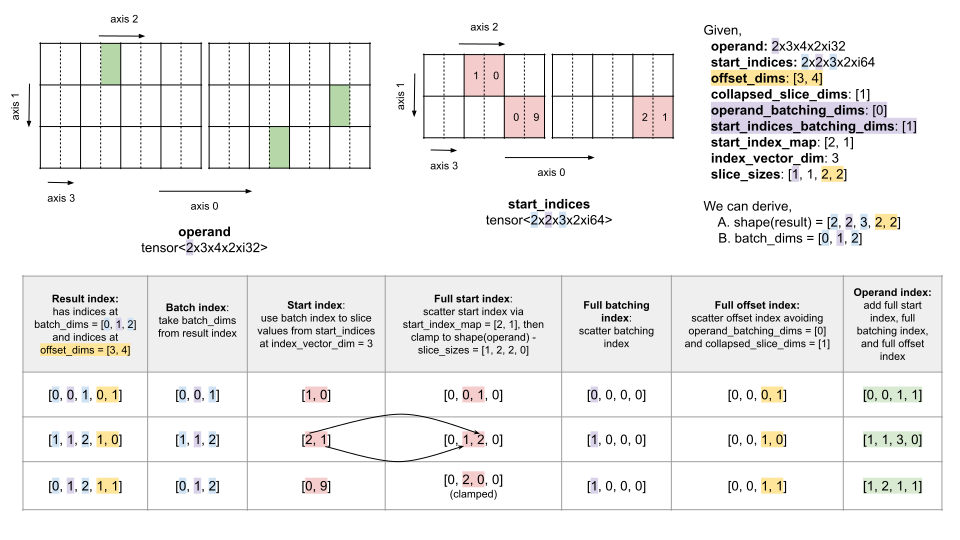
更正式地說,result[result_index] = operand[operand_index],其中:
batch_dims = [d for d in axes(result) and d not in offset_dims]。batch_index = result_index[batch_dims...]。start_index的定義如下:start_indices[bi0, ..., :, ..., biN],其中bi是batch_index中的個別元素,而:則會插入index_vector_dim索引,前提是index_vector_dim<rank(start_indices)。- 其他情況則為
[start_indices[batch_index]]。
- 適用於
axes(operand)中的d_operand,full_start_index[d_operand] = clamp(start_index[d_start], 0, dim(operand, d_operand) - slice_sizes[d_operand])ifd_operand = start_index_map[d_start]。- 其他情況則為
full_start_index[d_operand] = 0。
- 適用於
axes(operand)中的d_operand,full_batching_index[d_operand] = batch_index[d_start - (d_start < index_vector_dim ? 0 : 1)]如果d_operand = operand_batching_dims[i_batching]和d_start = start_indices_batching_dims[i_batching]。- 其他情況則為
full_batching_index[d_operand] = 0。
offset_index = result_index[offset_dims...]。- 其中
oi是offset_index中的個別元素,而0則會插入collapsed_slice_dims和operand_batching_dims的索引。full_offset_index = [oi0, ..., 0, ..., oiN] operand_index = full_start_index + full_batching_index + full_offset_index。
如果 indices_are_sorted 為 true,則實作程序可以假設 start_indices 會根據 start_index_map 排序,否則行為未定義。更正式地說,對於 indices(result) 中的所有 i1 < i2,
full_start_index(i1) <= full_start_index(i2)。
輸入
| 標籤 | 名稱 | 類型 | 限制 |
|---|---|---|---|
| (I1) | operand |
張量或每個張量的量化張量 | (C1)、(C8)、(C11)、(C17)、(C19-C21)、(C23) |
| (I2) | start_indices |
整數型別的張量 | (C2-C3)、(C14)、(C17)、(C22) |
| (I3) | offset_dims |
si64 類型的 1 維張量常數 |
(C1)、(C4-C5)、(C22) |
| (I4) | collapsed_slice_dims |
si64 類型的 1 維張量常數 |
(C1)、(C6-C9)、(C22) |
| (I5) | operand_batching_dims |
si64 類型的 1 維張量常數 |
(C1)、(C6)、(C10-C12)、(C16-C18)、(C22) |
| (I6) | start_indices_batching_dims |
si64 類型的 1 維張量常數 |
(C13-C17) |
| (I7) | start_index_map |
si64 類型的 1 維張量常數 |
(C3)、(C18-C19) |
| (I8) | index_vector_dim |
si64 類型的常數 |
(C2-C3)、(C15)、(C22) |
| (I9) | slice_sizes |
si64 類型的 1 維張量常數 |
(C9)、(C12)、(C20-C22) |
| (I10) | indices_are_sorted |
i1 類型的常數 |
輸出內容
| 名稱 | 類型 | 限制 |
|---|---|---|
result |
張量或每個張量的量化張量 | (C5)、(C22-C23) |
限制
- (C1)
rank(operand) = size(offset_dims) + size(collapsed_slice_dims) +
   size(operand_batching_dims)
。 - (C2)
0 <= index_vector_dim <= rank(start_indices)。 - (C3)
size(start_index_map) =
   index_vector_dim < rank(start_indices) ?
   dim(start_indices, index_vector_dim) : 1
。 - (C4)
is_unique(offset_dims) and is_sorted(offset_dims)。 - (C5)
0 <= offset_dims < rank(result)。 - (C6)
is_unique(concatenate(collapsed_slice_dims, operand_batching_dims)) - (C7)
is_sorted(collapsed_slice_dims)。 - (C8)
0 <= collapsed_slice_dims < rank(operand)。 - (C9)
slice_sizes[collapsed_slice_dims...] <= 1。 - (C10)
is_sorted(operand_batching_dims)。 - (C11)
0 <= operand_batching_dims < rank(operand)。 - (C12)
slice_sizes[operand_batching_dims...] <= 1。 - (C13)
is_unique(start_indices_batching_dims)。 - (C14)
0 <= start_indices_batching_dims < rank(start_indices)。 - (C15)
index_vector_dim not in start_indices_batching_dims。 - (C16)
size(operand_batching_dims) == size(start_indices_batching_dims)。 - (C17)
dim(operand, operand_batching_dims...) =
    dim(start_indices, start_indices_batching_dims...)
。 - (C18)
is_unique(concatenate(start_index_map, operand_batching_dims))。 - (C19)
0 <= start_index_map < rank(operand)。 - (C20)
size(slice_sizes) = rank(operand)。 - (C21)
0 <= slice_sizes <= shape(operand)。 - (C22)
shape(result) = combine(batch_dim_sizes, offset_dim_sizes)其中:batch_dim_sizes = shape(start_indices),但對應於index_vector_dim的start_indices維度大小不包含在內。offset_dim_sizes = slice_sizes,但slice_sizes中對應於collapsed_slice_dims和operand_batching_dims的維度大小不包含在內。combine會將batch_dim_sizes放在對應於batch_dims的軸上,並將offset_dim_sizes放在對應於offset_dims的軸上。
- (C23)
element_type(operand) = element_type(result)。
範例
// %operand: [
//            [
//             [[1, 2], [3, 4], [5, 6], [7, 8]],
//             [[9, 10],[11, 12], [13, 14], [15, 16]],
//             [[17, 18], [19, 20], [21, 22], [23, 24]]
//            ],
//            [
//             [[25, 26], [27, 28], [29, 30], [31, 32]],
//             [[33, 34], [35, 36], [37, 38], [39, 40]],
//             [[41, 42], [43, 44], [45, 46], [47, 48]]
//            ]
//           ]
// %start_indices: [
//                  [
//                   [[0, 0], [1, 0], [2, 1]],
//                   [[0, 1], [1, 1], [0, 9]]
//                  ],
//                  [
//                   [[0, 0], [2, 1], [2, 2]],
//                   [[1, 2], [0, 1], [1, 0]]
//                  ]
//                 ]
%result = "stablehlo.gather"(%operand, %start_indices) {
  dimension_numbers = #stablehlo.gather<
    offset_dims = [3, 4],
    collapsed_slice_dims = [1],
    operand_batching_dims = [0],
    start_indices_batching_dims = [1],
    start_index_map = [2, 1],
    index_vector_dim = 3>,
  slice_sizes = array<i64: 1, 1, 2, 2>,
  indices_are_sorted = false
} : (tensor<2x3x4x2xi32>, tensor<2x2x3x2xi64>) -> tensor<2x2x3x2x2xi32>
// %result: [
//           [
//            [
//             [[1, 2], [3, 4]],
//             [[3, 4], [5, 6]],
//             [[13, 14], [15, 16]]
//            ],
//            [
//             [[33, 34], [35, 36]],
//             [[35, 36], [37, 38]],
//             [[41, 42], [43, 44]]
//            ]
//           ],
//           [
//            [
//             [[1, 2], [3, 4]],
//             [[13, 14], [15, 16]],
//             [[21, 22], [23, 24]]
//            ],
//            [
//             [[43, 44], [45, 46]],
//             [[33, 34], [35, 36]],
//             [[27, 28], [29, 30]]
//            ]
//           ]
//          ]
get_dimension_size
語意
產生指定 dimension 的 operand 大小。更正式地說,result = dim(operand, dimension)。語意只與型別的形狀元件有關。元素類型可以是任何類型。
輸入
| 標籤 | 名稱 | 類型 | 限制 |
|---|---|---|---|
| (I1) | operand |
張量或量化張量 | (C1) |
| (I2) | dimension |
si64 類型的常數 |
(C1) |
輸出內容
| 名稱 | 類型 |
|---|---|
result |
si32 類型的 0 維張量 |
限制
- (C1)
0 <= dimension < rank(operand)。
範例
// %operand: [[1, 2, 3], [4, 5, 6]]
%result = "stablehlo.get_dimension_size"(%operand) {
  dimension = 1 : i64
} : (tensor<2x3xi64>) -> tensor<i32>
// %result: 3
get_tuple_element
語意
擷取 operand 元組 index 位置的元素,並產生 result。更正式地說,result = operand[index]。
輸入
| 標籤 | 名稱 | 類型 | 限制 |
|---|---|---|---|
| (I1) | operand |
元組 | (C1)、(C2) |
| (I2) | index |
si32 類型的常數 |
(C1)、(C2) |
輸出內容
| 名稱 | 類型 | 限制 |
|---|---|---|
result |
任何值 | (C2) |
限制
- (C1)
0 <= index < size(operand)。 - (C2)
type(result) = tuple_element_types(operand)[index]。
範例
// %operand: ([1.0, 2.0], (3))
%result = "stablehlo.get_tuple_element"(%operand) <{index = 0 : i32}> : (tuple<tensor<2xf64>, tuple<tensor<i64>>>) -> tensor<2xf64>
// %result: [1.0, 2.0]
如果
語意
根據 pred 的值,從 true_branch 或 false_branch 執行一個函式,並產生輸出內容。更正式地說,result =
pred ? true_branch() : false_branch()。
輸入
| 標籤 | 名稱 | 類型 | 限制 |
|---|---|---|---|
| (I1) | pred |
i1 類型的 0 維張量 |
|
| (I2) | true_branch |
函式 | (C1-C3) |
| (I3) | false_branch |
函式 | (C1)、(C2) |
輸出內容
| 名稱 | 類型 | 限制 |
|---|---|---|
results |
可變數量的張量、量化張量或權杖 | (C3) |
限制
- (C1)
input_types(true_branch) = input_types(false_branch) = []。 - (C2)
output_types(true_branch) = output_types(false_branch)。 - (C3)
type(results...) = output_types(true_branch)。
範例
// %result_true_branch: 10
// %result_false_branch: 11
// %pred: true
%result = "stablehlo.if"(%pred) ({
  "stablehlo.return"(%result_true_branch) : (tensor<i32>) -> ()
}, {
  "stablehlo.return"(%result_false_branch) : (tensor<i32>) -> ()
}) : (tensor<i1>) -> tensor<i32>
// %result: 10
imag
語意
從 operand 逐一擷取虛部,並產生 result 張量。更正式地說,對於每個元素 x:
imag(x) = is_complex(x) ? imaginary_part(x) :
constant(0, element_type(result))
。
輸入
| 標籤 | 名稱 | 類型 | 限制 |
|---|---|---|---|
| (I1) | operand |
浮點或複數型別的張量 | (C1)、(C2) |
輸出內容
| 名稱 | 類型 | 限制 |
|---|---|---|
result |
浮點類型張量 | (C1)、(C2) |
限制
- (C1)
shape(result) = shape(operand)。 - (C2)
element_type(result)的定義為:complex_element_type(element_type(operand))(如果is_complex(operand))。- 其他情況則為
element_type(operand)。
範例
// %operand: [(1.0, 2.0), (3.0, 4.0)]
%result = "stablehlo.imag"(%operand) : (tensor<2xcomplex<f32>>) -> tensor<2xf32>
// %result: [2.0, 4.0]
infeed
語意
從動態消息讀取資料,並產生 results。
infeed_config 的語意是由實作定義。
results 包含酬載值 (在前) 和權杖 (在後)。我們計畫在日後將酬載和權杖分成兩個獨立輸出,以提升清楚度 (#670)。
輸入
| 標籤 | 名稱 | 類型 |
|---|---|---|
| (I1) | token |
token |
| (I2) | infeed_config |
string 類型的常數 |
輸出內容
| 名稱 | 類型 | 限制 |
|---|---|---|
results |
可變數量的張量、量化張量或權杖 | (C1-C3) |
限制
- (C1)
0 < size(results)。 - (C2)
is_empty(result[:-1])或is_tensor(type(results[:-1]))。 - (C3)
is_token(type(results[-1]))。
範例
// %token: !stablehlo.token
// infeed_queue[0]: [[1, 2], [3, 4]]
// infeed_queue[1]: [[5, 6], [7, 8]]
%results0:2 = "stablehlo.infeed"(%token) {
  infeed_config = ""
} : (!stablehlo.token) -> (tensor<2x2xi64>, !stablehlo.token)
// results0#0: [[1, 2], [3, 4]]
%results1:2 = "stablehlo.infeed"(%token) {
  infeed_config = ""
} : (!stablehlo.token) -> (tensor<2x2xi64>, !stablehlo.token)
// results1#0: [[5, 6], [7, 8]]
iota
語意
沿著 iota_dimension 維度,以遞增順序從零開始填入 output 張量的值。更正式地說,
output[output_index] = constant(is_quantized(output) ?
quantize(output_index[iota_dimension], element_type(output)) :
output_index[iota_dimension], element_type(output))
。
輸入
| 標籤 | 名稱 | 類型 | 限制 |
|---|---|---|---|
| (I1) | iota_dimension |
si64 |
(C1) |
輸出內容
| 名稱 | 類型 | 限制 |
|---|---|---|
output |
整數、浮點數或複數型別的張量,或是每個張量的量化張量 | (C1) |
限制
- (C1)
0 <= iota_dimension < rank(output)。
範例
%output = "stablehlo.iota"() {
  iota_dimension = 0 : i64
} : () -> tensor<4x5xi32>
// %output: [
//           [0, 0, 0, 0, 0],
//           [1, 1, 1, 1, 1],
//           [2, 2, 2, 2, 2],
//           [3, 3, 3, 3, 3]
//          ]

%output = "stablehlo.iota"() {
  iota_dimension = 1 : i64
} : () -> tensor<4x5xi32>
// %output: [
//           [0, 1, 2, 3, 4],
//           [0, 1, 2, 3, 4],
//           [0, 1, 2, 3, 4],
//           [0, 1, 2, 3, 4]
//          ]
is_finite
語意
逐一檢查 x 中的值是否為有限值 (即非 +Inf、-Inf 或 NaN),並產生 y 張量。實作 IEEE-754 規格中的 isFinite 運算。如果是量化型別,結果一律為 true。
輸入
| 標籤 | 名稱 | 類型 | 限制 |
|---|---|---|---|
| (I1) | x |
浮點類型張量或每個張量的量化張量 | (C1) |
輸出內容
| 名稱 | 類型 | 限制 |
|---|---|---|
y |
布林值類型的張量 | (C1) |
限制
- (C1)
shape(x) = shape(y)。
範例
// Logical values: -Inf, +Inf, NaN, ...
// %x: [0xFFF0000000000000, 0x7FF0000000000000, 0x7FF8000000000000, -10.0, -0.0, 0.0, 10.0]
%y = "stablehlo.is_finite"(%x) : (tensor<7xf64) -> tensor<7xi1>
// %y: [false, false, false, true, true, true, true]
log
語意
對 operand 張量執行元素級別的對數運算,並產生 result 張量。視元素類型而定,執行下列操作:
- 浮點數:IEEE-754 的
log。 - 複數:複數對數。
- 量化型別:
dequantize_op_quantize(log, operand, type(result))。
輸入
| 標籤 | 名稱 | 類型 | 限制 |
|---|---|---|---|
| (I1) | operand |
浮點或複數型別的張量,或是每個張量的量化張量 | (C1) |
輸出內容
| 名稱 | 類型 | 限制 |
|---|---|---|
result |
浮點或複數型別的張量,或是每個張量的量化張量 | (C1) |
限制
- (C1)
baseline_type(operand) = baseline_type(result)。
範例
// %operand: [[1.0, 2.0], [3.0, 4.0]]
%result = "stablehlo.log"(%operand) : (tensor<2x2xf64>) -> tensor<2x2xf64>
// %result: [[0.0, 0.69314718055994529], [1.0986122886681098, 1.3862943611198906]]
log_plus_one
語意
對 operand 張量執行元素級別的對數加一運算,並產生 result 張量。視元素類型而定,執行下列操作:
- 浮點數:IEEE-754 的
logp1。 - 如為複數:
complex(log(hypot(real(x) + 1, imag(x))), atan2(imag(x), real(x) + 1)) - 量化型別:
dequantize_op_quantize(log_plus_one, operand, type(result))。
輸入
| 標籤 | 名稱 | 類型 | 限制 |
|---|---|---|---|
| (I1) | operand |
浮點或複數型別的張量,或是每個張量的量化張量 | (C1) |
輸出內容
| 名稱 | 類型 | 限制 |
|---|---|---|
result |
浮點或複數型別的張量,或是每個張量的量化張量 | (C1) |
限制
- (C1)
baseline_type(operand) = baseline_type(result)。
範例
// %operand: [0.0, -0.999, 7.0, 6.38905621, 15.0]
%result = "stablehlo.log_plus_one"(%operand) : (tensor<5xf64>) -> tensor<5xf64>
// %result: [0.0, -6.90776825, 2.07944155, 2.0, 2.77258873]
logistic
語意
對 operand 張量執行元素級別的邏輯運算,並產生 result 張量。視元素類型而定,執行下列操作:
- 浮點數:IEEE-754 的
division(1, addition(1, exp(-x)))。 - 複數:複數邏輯。
- 量化型別:
dequantize_op_quantize(logistic, operand, type(result))。
輸入
| 標籤 | 名稱 | 類型 | 限制 |
|---|---|---|---|
| (I1) | operand |
浮點或複數型別的張量,或是每個張量的量化張量 | (C1) |
輸出內容
| 名稱 | 類型 | 限制 |
|---|---|---|
result |
浮點或複數型別的張量,或是每個張量的量化張量 | (C1) |
限制
- (C1)
baseline_type(operand) = baseline_type(result)。
範例
// %operand: [[0.0, 1.0], [2.0, 3.0]]
%result = "stablehlo.logistic"(%operand) : (tensor<2x2xf64>) -> tensor<2x2xf64>
// %result: [[0.5, 0.73105858], [0.88079708, 0.95257413]]
地圖
語意
沿著 dimensions 將對應函式 computation 套用至 inputs,並產生 result 張量。
更正式地說,result[result_index] = computation(inputs...[result_index])。
輸入
| 標籤 | 名稱 | 類型 | 限制 |
|---|---|---|---|
| (I1) | inputs |
可變數量的張量或每個張量的量化張量 | (C1-C4) |
| (I2) | dimensions |
si64 類型的 1 維張量常數 |
(C3) |
| (I3) | computation |
函式 | (C4) |
輸出內容
| 名稱 | 類型 | 限制 |
|---|---|---|
result |
張量或每個張量的量化張量 | (C1)、(C4) |
限制
- (C1)
shape(inputs...) = shape(result)。 - (C2)
0 < size(inputs) = N。 - (C3)
dimensions = range(rank(inputs[0]))。 - (C4)
computation的型別為(tensor<E0>, ..., tensor<EN-1>) -> tensor<E'>,其中Ei = element_type(inputs[i])和E' = element_type(result)。
範例
// %input0: [[0, 1], [2, 3]]
// %input1: [[4, 5], [6, 7]]
%result = "stablehlo.map"(%input0, %input1) ({
  ^bb0(%arg0: tensor<i64>, %arg1: tensor<i64>):
    %0 = stablehlo.multiply %arg0, %arg1 : tensor<i64>
    stablehlo.return %0 : tensor<i64>
}) {
  dimensions = array<i64: 0, 1>
} : (tensor<2x2xi64>, tensor<2x2xi64>) -> tensor<2x2xi64>
// %result: [[0, 5], [12, 21]]
最高
語意
對張量 lhs 和 rhs 執行元素級別的 max 運算,並產生 result 張量。視元素類型而定,執行下列操作:
- 布林值:邏輯 OR。
- 整數:整數上限。
- 浮點數:IEEE-754 的
maximum。 - 如果是複數,則為
(real, imaginary)配對的字典順序最大值。 對複數強制排序會涉及令人意外的語意,因此我們計畫在未來移除對這項作業的複數支援 (#560)。 - 如為量化型別:
dequantize_op_quantize(maximum, lhs, rhs, type(result))。
輸入
| 標籤 | 名稱 | 類型 | 限制 |
|---|---|---|---|
| (I1) | lhs |
張量或每個張量的量化張量 | (C1) |
| (I2) | rhs |
張量或每個張量的量化張量 | (C1) |
輸出內容
| 名稱 | 類型 | 限制 |
|---|---|---|
result |
張量或每個張量的量化張量 | (C1) |
限制
- (C1)
baseline_type(lhs) = baseline_type(rhs) = baseline_type(result)。
範例
// %lhs: [[1, 2], [7, 8]]
// %rhs: [[5, 6], [3, 4]]
%result = "stablehlo.maximum"(%lhs, %rhs) : (tensor<2x2xi32>, tensor<2x2xi32>) -> tensor<2x2xi32>
// %result: [[5, 6], [7, 8]]
最低
語意
對張量 lhs 和 rhs 執行元素級別的 min 運算,並產生 result 張量。視元素類型而定,執行下列操作:
- 布林值:邏輯 AND。
- 整數:整數最小值。
- 浮點數:IEEE-754 的
minimum。 - 複數:
(real, imaginary)配對的字典順序最小值。 對複數強制排序會涉及令人意外的語意,因此我們計畫在未來移除對這項作業的複數支援 (#560)。 - 如為量化型別:
dequantize_op_quantize(minimum, lhs, rhs, type(result))。
輸入
| 標籤 | 名稱 | 類型 | 限制 |
|---|---|---|---|
| (I1) | lhs |
張量或每個張量的量化張量 | (C1) |
| (I2) | rhs |
張量或每個張量的量化張量 | (C1) |
輸出內容
| 名稱 | 類型 | 限制 |
|---|---|---|
result |
張量或每個張量的量化張量 | (C1) |
限制
- (C1)
baseline_type(lhs) = baseline_type(rhs) = baseline_type(result)。
範例
// %lhs: [[1, 2], [7, 8]]
// %rhs: [[5, 6], [3, 4]]
%result = "stablehlo.minimum"(%lhs, %rhs) : (tensor<2x2xi32>, tensor<2x2xi32>) -> tensor<2x2xi32>
// %result: [[1, 2], [3, 4]]
相乘
語意
執行兩個張量 lhs 和 rhs 的元素乘積,並產生 result 張量。視元素類型而定,執行下列操作:
- 布林值:邏輯 AND。
- 整數:整數乘法。
- 浮點數:IEEE-754 的
multiplication。 - 複數:複數乘法。
- 如為量化型別:
dequantize_op_quantize(multiply, lhs, rhs, type(result))。
輸入
| 標籤 | 名稱 | 類型 | 限制 |
|---|---|---|---|
| (I1) | lhs |
張量或每個張量的量化張量 | (C1) |
| (I2) | rhs |
張量或每個張量的量化張量 | (C1) |
輸出內容
| 名稱 | 類型 | 限制 |
|---|---|---|
result |
張量或每個張量的量化張量 | (C1) |
限制
- (C1)
baseline_type(operand) = baseline_type(result)。
範例
// %lhs: [[1, 2], [3, 4]]
// %rhs: [[5, 6], [7, 8]]
%result = "stablehlo.multiply"(%lhs, %rhs) : (tensor<2x2xi32>, tensor<2x2xi32>) -> tensor<2x2xi32>
// %result: [[5, 12], [21, 32]]
negate
語意
對 operand 張量執行元素層級的否定運算,並產生 result 張量。視元素類型而定,執行下列操作:
- 如為正負號整數:整數的負數。
- 無正負號整數:位元轉換為帶正負號整數、整數否定、位元轉換回無正負號整數。
- 浮點數:IEEE-754 的
negate。 - 如果是複數,則為複數的負數。
- 量化型別:
dequantize_op_quantize(negate, operand, type(result))。
輸入
| 標籤 | 名稱 | 類型 | 限制 |
|---|---|---|---|
| (I1) | operand |
整數、浮點數或複數型別的張量,或是每個張量的量化張量 | (C1) |
輸出內容
| 名稱 | 類型 | 限制 |
|---|---|---|
result |
整數、浮點數或複數型別的張量,或是每個張量的量化張量 | (C1) |
限制
- (C1)
baseline_type(operand) = baseline_type(result)。
範例
// Negation operation with integer Tensors
// %operand: [0, -2]
%result = "stablehlo.negate"(%operand) : (tensor<2xi32>) -> tensor<2xi32>
// %result: [0, 2]

// Negation operation with with complex tensors
// %operand: (2.5, 0.0)
%result = "stablehlo.negate"(%operand) : (tensor<1xcomplex<f32>>) -> tensor<1xcomplex<f32>>
// %result: [-2.5, -0.0]
not
語意
對張量 operand 執行元素層級的 NOT 運算,並產生 result 張量。
視元素類型而定,執行下列操作:
- 布林值:邏輯 NOT。
- 整數:位元 NOT。
引數
| 名稱 | 類型 | 限制 |
|---|---|---|
operand |
布林值或整數類型的張量 | (C1) |
輸出內容
| 名稱 | 類型 | 限制 |
|---|---|---|
result |
布林值或整數類型的張量 | (C1) |
限制
- (C1)
type(operand) = type(result)。
範例
// Bitwise operation with with integer tensors
// %operand: [[1, 2], [3, 4]]
%result = "stablehlo.not"(%operand) : (tensor<2x2xi32>) -> tensor<2x2xi32>
// %result: [[-2, -3], [-4, -5]]

// Bitwise operation with with boolean tensors
// %operand: [true, false]
%result = "stablehlo.not"(%operand) : (tensor<2xi1>) -> tensor<2xi1>
// %result: [false, true]
optimization_barrier
語意
確保產生 operand 的作業會在任何依附於 result 的作業之前執行,並防止編譯器轉換作業跨越障礙。除此之外,這項作業也是身分,即 result = operand。
引數
| 名稱 | 類型 | 限制 |
|---|---|---|
operand |
可變數量的張量、每個張量的量化張量或權杖 | (C1) |
輸出內容
| 名稱 | 類型 | 限制 |
|---|---|---|
result |
可變數量的張量、每個張量的量化張量或權杖 | (C1) |
限制
- (C1)
type(operand...) = type(result...)。
範例
// %operand0: 0.0
// %operand1: 1.0
%result0, %result1 = "stablehlo.optimization_barrier"(%operand0, %operand1) : (tensor<f32>, tensor<f32>) -> (tensor<f32>, tensor<f32>)
// %result0: 0.0
// %result1: 1.0
或
語意
對兩個張量 lhs 和 rhs 執行元素層級的 OR 運算,並產生 result 張量。視元素類型而定,執行下列操作:
- 布林值:邏輯 OR。
- 整數:位元 OR。
輸入
| 標籤 | 名稱 | 類型 | 限制 |
|---|---|---|---|
| (I1) | lhs |
整數或布林值型別的張量 | (C1) |
| (I2) | rhs |
整數或布林值型別的張量 | (C1) |
輸出內容
| 名稱 | 類型 | 限制 |
|---|---|---|
result |
整數或布林值型別的張量 | (C1) |
限制
- (C1)
type(lhs) = type(rhs) = type(result)。
範例
// Bitwise operation with with integer tensors
// %lhs: [[1, 2], [3, 4]]
// %rhs: [[5, 6], [7, 8]]
%result = "stablehlo.or"(%lhs, %rhs) : (tensor<2x2xi32>, tensor<2x2xi32>) -> tensor<2x2xi32>
// %result: [[5, 6], [7, 12]]

// Logical operation with with boolean tensors
// %lhs: [[false, false], [true, true]]
// %rhs: [[false, true], [false, true]]
%result = "stablehlo.or"(%lhs, %rhs) : (tensor<2x2xi1>, tensor<2x2xi1>) -> tensor<2x2xi1>
// %result: [[false, true], [true, true]]
outfeed
語意
將 inputs 寫入輸出饋給,並產生 result 符記。
outfeed_config 的語意是由實作定義。
輸入
| 標籤 | 名稱 | 類型 |
|---|---|---|
| (I1) | inputs |
可變數量的張量或量化張量 |
| (I2) | token |
token |
| (I3) | outfeed_config |
string 類型的常數 |
輸出內容
| 名稱 | 類型 |
|---|---|
result |
token |
範例
%result = "stablehlo.outfeed"(%input0, %token) {
  outfeed_config = ""
} : (tensor<2x2x2xi64>, !stablehlo.token) -> !stablehlo.token
pad
語意
擴展 operand,方法是在張量周圍以及張量的元素之間,填入指定的 padding_value。
edge_padding_low 和 edge_padding_high 分別指定在每個維度的低端 (索引 0 旁) 和高端 (最高索引旁) 新增的邊框間距量。填補量可以是負數,負數填補的絕對值表示要從指定維度移除的元素數量。
interior_padding 會指定在每個維度中,任意兩個元素之間新增的邊框間距量,不得為負值。內部邊框間距會先於邊框間距出現,因此負邊框間距會從內部邊框間距運算元中移除元素。
更正式地說,result[result_index] 的定義如下:
operand[operand_index](如果有的話)。result_index = edge_padding_low + operand_index * (interior_padding + 1)- 其他情況則為
padding_value。
輸入
| 標籤 | 名稱 | 類型 | 限制 |
|---|---|---|---|
| (I1) | operand |
張量或每個張量的量化張量 | (C1)、(C2)、(C4) |
| (I2) | padding_value |
0 維度張量或每個張量的量化張量 | (C1) |
| (I3) | edge_padding_low |
si64 類型的 1 維張量常數 |
(C1)、(C4) |
| (I4) | edge_padding_high |
si64 類型的 1 維張量常數 |
(C1)、(C4) |
| (I5) | interior_padding |
si64 類型的 1 維張量常數 |
(C2-C4) |
輸出內容
| 名稱 | 類型 | 限制 |
|---|---|---|
result |
張量或每個張量的量化張量 | (C3-C6) |
限制
- (C1)
element_type(operand) = element_type(padding_value) =
element_type(result)
。 - (C2)
size(edge_padding_low) = size(edge_padding_high) =
size(interior_padding) = rank(operand)
。 - (C3)
0 <= interior_padding。 - (C4)
shape(result) = shape(operand) + edge_padding_low +
max(shape(operand) - 1, 0) * interior_padding + edge_padding_high
。
範例
// %operand: [
//            [1, 2, 3],
//            [4, 5, 6]
//           ]
// %padding_value: 0
%result = "stablehlo.pad"(%operand, %padding_value) {
  edge_padding_low = array<i64: 0, 1>,
  edge_padding_high = array<i64: 2, 1>,
  interior_padding = array<i64: 1, 2>
} : (tensor<2x3xi32>, tensor<i32>) -> tensor<5x9xi32>
// %result: [
//           [0, 1, 0, 0, 2, 0, 0, 3, 0],
//           [0, 0, 0, 0, 0, 0, 0, 0, 0],
//           [0, 4, 0, 0, 5, 0, 0, 6, 0],
//           [0, 0, 0, 0, 0, 0, 0, 0, 0],
//           [0, 0, 0, 0, 0, 0, 0, 0, 0]
//          ]
partition_id
語意
產生目前程序的 partition_id。
輸出內容
| 名稱 | 類型 |
|---|---|
result |
ui32 類型的 0 維張量 |
範例
%result = "stablehlo.partition_id"() : () -> tensor<ui32>
popcnt
語意
對 operand 張量中設定的位元數執行元素層級的計數,並產生 result 張量。
輸入
| 標籤 | 名稱 | 類型 | 限制 |
|---|---|---|---|
| (I1) | operand |
整數型別的張量 | (C1) |
輸出內容
| 名稱 | 類型 | 限制 |
|---|---|---|
result |
整數型別的張量 | (C1) |
限制
- (C1)
type(operand) = type(result)。
範例
// %operand: [0, 1, 2, 127]
%result = "stablehlo.popcnt"(%operand) : (tensor<4xi64>) -> tensor<4xi64>
// %result: [0, 1, 1, 7]
功率
語意
對 lhs 張量執行元素級別的指數運算,並產生 result 張量。rhs視元素類型而定,執行下列操作:
- 整數:整數指數運算。
- 浮點數:IEEE-754 的
pow。 - 複數:複數指數。
- 量化型別:
dequantize_op_quantize(power, lhs, rhs, type(result))。
輸入
| 標籤 | 名稱 | 類型 | 限制 |
|---|---|---|---|
| (I1) | lhs |
整數、浮點數或複數型別的張量,或是每個張量的量化張量 | (C1) |
| (I2) | rhs |
整數、浮點數或複數型別的張量,或是每個張量的量化張量 | (C1) |
輸出內容
| 名稱 | 類型 | 限制 |
|---|---|---|
result |
整數、浮點數或複數型別的張量,或是每個張量的量化張量 | (C1) |
限制
- (C1)
baseline_type(operand) = baseline_type(result)。
範例
// %lhs: [-2.0, -0.0, -36.0, 5.0, 3.0, 10000.0]
// %rhs: [2.0, 2.0, 1.1, 2.0, -1.0, 10.0]
%result = "stablehlo.power"(%lhs, %rhs) : (tensor<6xf64>, tensor<6xf64>) -> tensor<6xf64>
// %result: [4.0, 0.0, -nan, 25.0, 0.333333343, inf]
real
語意
從 operand 中逐一擷取實部,並產生 result 張量。更正式地說,對於每個元素 x:
real(x) = is_complex(x) ? real_part(x) : x。
輸入
| 標籤 | 名稱 | 類型 | 限制 |
|---|---|---|---|
| (I1) | operand |
浮點或複數型別的張量 | (C1)、(C2) |
輸出內容
| 名稱 | 類型 | 限制 |
|---|---|---|
result |
浮點類型張量 | (C1)、(C2) |
限制
- (C1)
shape(result) = shape(operand)。 - (C2)
element_type(result)的定義為:complex_element_type(element_type(operand))(如果is_complex(operand))。- 其他情況則為
element_type(operand)。
範例
// %operand: [(1.0, 2.0), (3.0, 4.0)]
%result = "stablehlo.real"(%operand) : (tensor<2xcomplex<f32>>) -> tensor<2xf32>
// %result: [1.0, 3.0]
recv
語意
從具有 channel_id 的管道接收資料,並產生 results。
如果 is_host_transfer 為 true,則作業會從主機傳輸資料。否則,系統會根據 source_target_pairs 的值,從其他裝置轉移資料。這個旗標會重複 channel_type 中提供的資訊,因此我們日後只會保留其中一個 (#666)。如果 is_host_transfer = false 且 source_target_pairs 為 None 或空白,則視為未定義的行為。
results 包含酬載值 (在前) 和權杖 (在後)。我們計畫在日後將酬載和權杖分成兩個獨立輸出,以提升清楚度 (#670)。
輸入
| 標籤 | 名稱 | 類型 | 限制 |
|---|---|---|---|
| (I1) | token |
token |
|
| (I2) | channel_id |
si64 類型的常數 |
|
| (I3) | channel_type |
DEVICE_TO_DEVICE 和 DEVICE_TO_HOST 的列舉 |
(C5) |
| (I4) | is_host_transfer |
i1 類型的常數 |
(C5-C6) |
| (I5) | source_target_pairs |
si64 類型的 2 維張量常數 |
(C1-C4)、(C6) |
輸出內容
| 名稱 | 類型 | 限制 |
|---|---|---|
results |
可變數量的張量、量化張量或權杖 | (C2-C4) |
限制
- (C1)
dim(source_target_pairs, 1) = 2。 - (C2)
is_unique(source_target_pairs[:, 0])。 - (C3)
is_unique(source_target_pairs[:, 1])。 - (C4)
0 <= source_target_pairs < N,其中N定義為:- 如果使用
cross_replica,則為num_replicas。 - 如果使用
cross_partition,則為num_partitions。
- 如果使用
- (C5)
channel_type的定義為:- 若
is_host_transfer = true,則設為DEVICE_TO_HOST - 其他情況則為
DEVICE_TO_DEVICE。
- 若
範例
%results0, %results1 = "stablehlo.recv"(%token) {
  channel_handle = #stablehlo.channel_handle<handle = 0, type = 1>,
  is_host_transfer = false,
  source_target_pairs = dense<[[0, 1], [1, 2]]> : tensor<2x2xi64>
} : (!stablehlo.token) -> (tensor<2x2xi64>, !stablehlo.token)
減少
語意
沿著 dimensions 對 inputs 和 init_values 套用縮減函式 body,並產生 results 張量。
縮減順序是由實作定義,也就是說,body 和 init_values 必須形成單體,才能確保運算在所有實作中,對所有輸入產生相同的結果。不過,許多常見的縮減方式並不符合這項條件。舉例來說,body 的浮點加法和 init_values 的零實際上不會形成單體,因為浮點加法不遵守結合律。
更正式地說,results...[j0, ..., jR-1] = reduce(input_slices_converted),其中:
input_slices = inputs...[j0, ..., :, ..., jR-1],其中:會插入dimensions。input_slices_converted = to_destination_type(input_slices..., type(func_inputs(body)[:len(func_inputs(body))//2])...)。init_values_converted = to_destination_type(init_values..., type(func_inputs(body)[len(func_inputs(body))//2:])...)。reduce(input_slices_converted) = exec(schedule),其中:scheduleexec(node) = body(exec(node.left), exec(node.right))。exec(leaf) = leaf.value。
schedule是實作定義的完整二元樹,其中序遍歷包含:input_slices_converted...[index]值,適用於index中所有index_space(input_slices_converted),且index依字典順序遞增。- 並在實作定義的位置插入實作定義數量的
init_values_converted。
輸入
| 標籤 | 名稱 | 類型 | 限制 |
|---|---|---|---|
| (I1) | inputs |
可變數量的張量或每個張量的量化張量 | (C1-C4)、(C6)、(C7) |
| (I2) | init_values |
可變數量的 0 維度張量或每個張量的量化張量 | (C2)、(C3) |
| (I3) | dimensions |
si64 類型的 1 維張量常數 |
(C4)、(C5)、(C7) |
| (I4) | body |
函式 | (C6) |
輸出內容
| 名稱 | 類型 | 限制 |
|---|---|---|
results |
可變數量的張量或每個張量的量化張量 | (C3)、(C7)、(C8) |
限制
- (C1)
same(shape(inputs...))。 - (C2)
element_type(inputs...) = element_type(init_values...)。 - (C3)
0 < size(inputs) = size(init_values) = size(results) = N。 - (C4)
0 <= dimensions < rank(inputs[0])。 - (C5)
is_unique(dimensions)。 - (C6)
body具有(tensor<E0>, ..., tensor<EN-1>, tensor<E0>, ...,類型,其中tensor<EN-1>) -> (tensor<E0>, ..., tensor<EN-1>)。is_promotable(element_type(inputs[i]), Ei) - (C7)
shape(results...) = shape(inputs...),但對應dimensions的inputs...維度大小不包含在內。 - (C8)
element_type(results[i]) = Ei適用於[0,N)中的所有i。
範例
// %input = [[0, 1, 2, 3, 4, 5]]
// %init_value = 0
%result = "stablehlo.reduce"(%input, %init_value) ({
  ^bb0(%arg0: tensor<i64>, %arg1: tensor<i64>):
    %0 = "stablehlo.add"(%arg0, %arg1) : (tensor<i64>, tensor<i64>) -> tensor<i64>
    "stablehlo.return"(%0) : (tensor<i64>) -> ()
}) {
  dimensions = array<i64: 1>
} : (tensor<1x6xi64>, tensor<i64>) -> tensor<1xi64>
// %result = [15]
reduce_precision
語意
對 operand 執行元素層級的轉換,轉換成使用 exponent_bits 和 mantissa_bits 的其他浮點類型,然後再轉換回原始浮點類型,並產生 output 張量。
更正式地來說:
- 原始值的尾數位元會更新,以使用
roundToIntegralTiesToEven語意,將原始值四捨五入至mantissa_bits可表示的最接近值。 - 然後,如果
mantissa_bits小於原始值的尾數位元數,尾數位元會截斷為mantissa_bits。 - 接著,如果中間結果的指數位元不符合
exponent_bits提供的範圍,中間結果就會溢位至無限大 (使用原始符號),或下溢至零 (使用原始符號)。 - 如果是量化型別,則會執行
dequantize_op_quantize(
lambda operand: reduce_precision(operand, exponent_bits, mantissa_bits),
operand, type(result))
。
輸入
| 標籤 | 名稱 | 類型 | 限制 |
|---|---|---|---|
| (I1) | operand |
浮點類型張量或每個張量的量化張量 | (C1) |
| (I2) | exponent_bits |
si32 類型的常數 |
(C2) |
| (I3) | mantissa_bits |
si32 類型的常數 |
(C3) |
輸出內容
| 名稱 | 類型 | 限制 |
|---|---|---|
output |
浮點類型張量或每個張量的量化張量 | (C1) |
限制
- (C1)
baseline_type(operand) = baseline_type(output)。 - (C2)
1 <= exponent_bits。 - (C3)
0 <= mantissa_bits。
範例
// Logical values: +Inf, NaN, +Denormal, 0.0, 65519.0, 65520.0
// %operand: [0x7FF0000000000000, 0x7FFFFFFFFFFFFFFF, 0x0000000000000001, 0.0, 65519.0, 65520.0]
%output = "stablehlo.reduce_precision"(%operand) {
  exponent_bits = 5 : i32,
  mantissa_bits = 10 : i32
} : (tensor<6xf64>) -> tensor<6xf64>
// Logical values: +Inf, NaN, 0.0, 0.0, 65504.0, +Inf
// %output: [0x7FF0000000000000, 0x7FFFFFFFFFFFFFFF, 0.0, 0.0, 65504.0, 0x7FF0000000000000]
reduce_scatter
語意
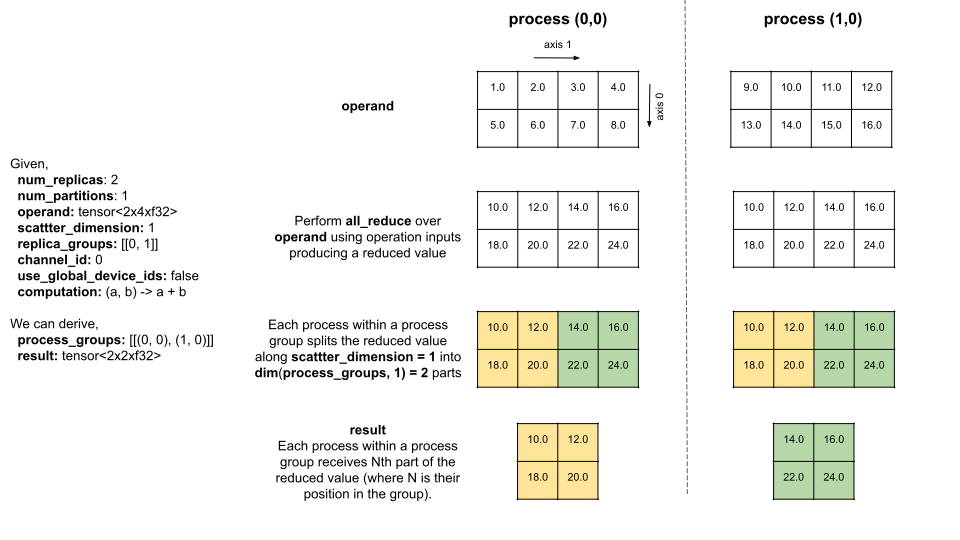
在 StableHLO 程序格的每個程序群組中,使用 computations 對每個程序的 operand 張量值執行縮減作業,沿著 scatter_dimension 將縮減結果分割成多個部分,並在程序之間分散分割部分,產生 result。
這項作業會將 StableHLO 程序格線分割成 process_groups,定義如下:
cross_replica(replica_groups)ifchannel_id <= 0 and use_global_device_ids = false。cross_replica_and_partition(replica_groups)ifchannel_id > 0 and use_global_device_ids = false。flattened_ids(replica_groups)ifchannel_id > 0 and use_global_device_ids = true。
接著,在每個 process_group 中執行下列操作:
reduced_value = all_reduce(operand, replica_groups, channel_id, use_global_device_ids, computation)。parts@sender = split(reduced_value@sender, dim(process_groups, 1), scatter_dimension)。result@receiver = parts@sender[receiver_index],其中sender位於process_group,且receiver_index = process_group.index(receiver)。
輸入
| 標籤 | 名稱 | 類型 | 限制 |
|---|---|---|---|
| (I1) | operand |
張量或每個張量的量化張量 | (C1)、(C2)、(C7)、(C8) |
| (I2) | scatter_dimension |
si64 類型的常數 |
(C1)、(C2)、(C8) |
| (I3) | replica_groups |
si64 類型的 2 維張量常數 |
(C3-C5) |
| (I4) | channel_id |
si64 類型的常數 |
(C6) |
| (I5) | use_global_device_ids |
i1 類型的常數 |
(C6) |
| (I6) | computation |
函式 | (C7) |
輸出內容
| 名稱 | 類型 | 限制 |
|---|---|---|
result |
張量或每個張量的量化張量 | (C8-C9) |
限制
- (C1)
dim(operand, scatter_dimension) % dim(process_groups, 1) = 0。 - (C2)
0 <= scatter_dimension < rank(operand)。 - (C3)
is_unique(replica_groups)。 - (C4)
size(replica_groups)的定義為:- 如果使用
cross_replica,則為num_replicas。 - 如果使用
cross_replica_and_partition,則為num_replicas。 - 如果使用
flattened_ids,則為num_processes。
- 如果使用
- (C5)
0 <= replica_groups < size(replica_groups)。 - (C6) If
use_global_device_ids = true, thenchannel_id > 0. - (C7)
computation具有(tensor<E>, tensor<E>) -> (tensor<E>)類型,其中is_promotable(element_type(operand), E)。 - (C8)
shape(result) = shape(operand)除外:dim(result, scatter_dimension) = dim(operand, scatter_dimension) / dim(process_groups, 1)。
- (C9)
element_type(result) = E。
範例
// num_replicas: 2
// num_partitions: 1
// %operand@(0, 0): [[1, 2, 3, 4],
//                   [5, 6, 7, 8]]
// %operand@(1, 0): [[9, 10, 11, 12],
//                   [13, 14, 15, 16]]
%result = "stablehlo.reduce_scatter"(%operand) ({
  ^bb0(%arg0: tensor<i64>, %arg1: tensor<i64>):
  %0 = "stablehlo.add"(%arg0, %arg1) : (tensor<i64>, tensor<i64>) -> tensor<i64>
  "stablehlo.return"(%0) : (tensor<i64>) -> ()
}) {
  scatter_dimension = 1 : i64,
  replica_groups = dense<[[0, 1]]> : tensor<1x2xi64>,
  channel_handle = #stablehlo.channel_handle<handle = 0, type = 0>
} : (tensor<2x4xi64>) -> tensor<2x2xi64>
//
// %result@(0, 0): [[10, 12],
//                  [18, 20]]
// %result@(1, 0): [[14, 16],
//                  [22, 24]]
reduce_window
語意
將縮減函式 body 套用至 inputs 和 init_values 的視窗,並產生 results。
下圖以具體範例說明如何從 inputs... 計算 results... 中的元素。
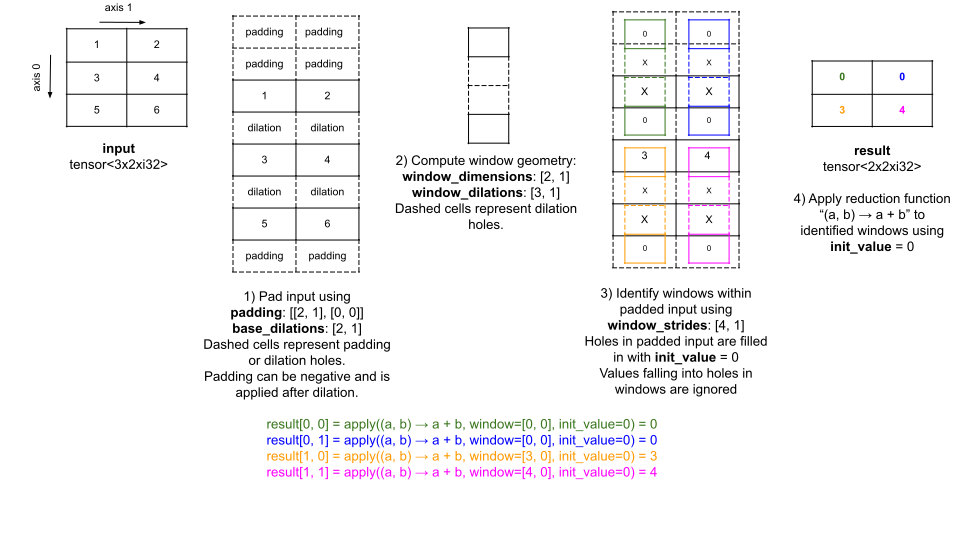
更正式地說,
results...[result_index] = reduce(windows, init_values, axes(inputs...), body)
(請參閱 reduce),其中:
padded_inputs = pad(inputs..., init_values..., padding[:, 0], padding[:, 1], base_dilations - 1)。window_start = result_index * window_strides。window_end = window_start + (window_dimensions - 1) * window_dilations + 1。windows = slice(padded_inputs..., window_start, window_end, window_dilations)。
輸入
| 標籤 | 名稱 | 類型 | 限制 |
|---|---|---|---|
| (I1) | inputs |
可變數量的張量或每個張量的量化張量 | (C1-C4)、(C6)、(C8)、(C10)、(C12)、(C13)、(C15) |
| (I2) | init_values |
可變數量的 0 維度張量或每個張量的量化張量 | (C1)、(C13) |
| (I3) | window_dimensions |
si64 類型的 1 維張量常數 |
(C4)、(C5)、(C15) |
| (I4) | window_strides |
si64 類型的 1 維張量常數 |
(C6)、(C7)、(C15) |
| (I5) | base_dilations |
si64 類型的 1 維張量常數 |
(C8)、(C9)、(C15) |
| (I6) | window_dilations |
si64 類型的 1 維張量常數 |
(C10)、(C11)、(C15) |
| (I7) | padding |
si64 類型的 2 維張量常數 |
(C12)、(C15) |
| (I8) | body |
函式 | (C13) |
輸出內容
| 名稱 | 類型 | 限制 |
|---|---|---|
results |
可變數量的張量或每個張量的量化張量 | (C1)、(C14-C16) |
限制
- (C1)
0 < size(inputs) = size(init_values) = size(results) = N。 - (C2)
same(shape(inputs...))。 - (C3)
element_type(inputs...) = element_type(init_values...)。 - (C4)
size(window_dimensions) = rank(inputs[0])。 - (C5)
0 < window_dimensions。 - (C6)
size(window_strides) = rank(inputs[0])。 - (C7)
0 < window_strides。 - (C8)
size(base_dilations) = rank(inputs[0])。 - (C9)
0 < base_dilations。 - (C10)
size(window_dilations) = rank(inputs[0])。 - (C11)
0 < window_dilations。 - (C12)
shape(padding) = [rank(inputs[0]), 2]。 - (C13)
body的類型為(tensor<E0>, ..., tensor<EN-1>, tensor<E0>, ...,tensor<EN-1>) -> (tensor<E0>, ..., tensor<EN-1>),其中is_promotable(element_type(inputs[i]), Ei)。 - (C14)
same(shape(results...))。 - (C15)
shape(results[0]) = num_windows其中:dilated_input_shape = shape(inputs[0]) = 0 ? 0 : (shape(inputs[0]) - 1) * base_dilations + 1。padded_input_shape = padding[:, 0] + dilated_input_shape + padding[:, 1]。dilated_window_shape = (window_dimensions - 1) * window_dilations + 1。is_empty_window = padded_input_shape = 0 || dilated_window_shape > padded_input_shape。num_windows = is_empty_window ? 0 : floor((padded_input_shape - dilated_window_shape) / window_strides) + 1。
- (C16)
element_type(results[i]) = Ei適用於[0,N)中的所有i。
範例
// %input = [[1, 2], [3, 4], [5, 6]]
// %init_value = 0
%result = "stablehlo.reduce_window"(%input, %init_value) ({
  ^bb0(%arg0: tensor<i64>, %arg1: tensor<i64>):
    %0 = "stablehlo.add"(%arg0, %arg1) : (tensor<i64>, tensor<i64>) -> tensor<i64>
    "stablehlo.return"(%0) : (tensor<i64>) -> ()
}) {
  window_dimensions = array<i64: 2, 1>,
  window_strides = array<i64: 4, 1>,
  base_dilations = array<i64: 2, 1>,
  window_dilations = array<i64: 3, 1>,
  padding = dense<[[2, 1], [0, 0]]> : tensor<2x2xi64>
} : (tensor<3x2xi64>, tensor<i64>) -> tensor<2x2xi64>
// %result = [[0, 0], [3, 4]]
餘數
語意
對被除數 lhs 和除數 rhs 張量執行元素層級的餘數運算,並產生 result 張量。
更正式地來說,結果的正負號取自被除數,且結果的絕對值一律小於除數的絕對值。餘數計算方式為 lhs - d * rhs,其中 d 的計算方式如下:
- 整數:
stablehlo.divide(lhs, rhs)。 - 浮點數:來自 IEEE-754,並具有捨入屬性
division(lhs, rhs)roundTowardZero。 - 複數:待定 (#997)。
- 如為量化型別:
dequantize_op_quantize(remainder, lhs, rhs, type(result))。
對於浮點元素型別,這項作業與 IEEE-754 規格中的 remainder 作業相反,後者是與 lhs/rhs 的確切值最接近的整數值,且會將同分值捨入為偶數。d
輸入
| 標籤 | 名稱 | 類型 | 限制 |
|---|---|---|---|
| (I1) | lhs |
整數、浮點數或複數型別的張量,或是每個張量的量化張量 | (C1) |
| (I2) | rhs |
整數、浮點數或複數型別的張量,或是每個張量的量化張量 | (C1) |
輸出內容
| 名稱 | 類型 | 限制 |
|---|---|---|
result |
整數、浮點數或複數型別的張量,或是每個張量的量化張量 | (C1) |
限制
- (C1)
baseline_type(operand) = baseline_type(result)。
範例
// %lhs: [17, -17, 17, -17]
// %rhs: [3, 3, -3, -3]
%result = "stablehlo.remainder"(%lhs, %rhs) : (tensor<4xi64>, tensor<4xi64>) -> tensor<4xi64>
// %result: [2, -2, 2, -2]
replica_id
語意
產生目前程序的 replica_id。
輸出內容
| 名稱 | 類型 |
|---|---|
result |
ui32 類型的 0 維張量 |
範例
%result = "stablehlo.replica_id"() : () -> tensor<ui32>
reshape
語意
將 operand 張量重塑為 result 張量。從概念上來說,這相當於保留相同的標準表示法,但可能會變更形狀,例如從 tensor<2x3xf32> 變更為 tensor<3x2xf32> 或 tensor<6xf32>。
更正式地來說,result[result_index] = operand[operand_index] 其中 result_index 和 operand_index 在 index_space(result) 和 index_space(operand) 的字典順序中具有相同位置。
輸入
| 標籤 | 名稱 | 類型 | 限制 |
|---|---|---|---|
| (I1) | operand |
張量或量化張量 | (C1-C3) |
輸出內容
| 名稱 | 類型 | 限制 |
|---|---|---|
result |
張量或量化張量 | (C1-C3) |
限制
- (C1)
element_type(result)由以下項目提供:element_type(operand)(如果!is_per_axis_quantized(operand))。element_type(operand),但quantization_dimension(operand)和quantization_dimension(result)可能不同。
- (C2)
size(operand) = size(result)。 - (C3) If
is_per_axis_quantized(operand):reduce(dims(operand, [0, 1, ..., quantization_dimension(operand) - 1]), init_values=1, dimensions=[0], body=lambda x, y: x * y) = reduce(dims(result, [0, 1, ..., quantization_dimension(result) - 1]), init_values=1, dimensions=[0], body=lambda x, y: x * y)。dim(operand, quantization_dimension(operand)) = dim(result, quantization_dimension(result))。reduce(dims(operand, [quantization_dimension(operand) + 1, ..., rank(operand) - 1]), init_values=1, dimensions=[0], body=lambda x, y: x * y) = reduce(dims(result, [quantization_dimension(result) + 1, ..., rank(result) - 1]), init_values=1, dimensions=[0], body=lambda x, y: x * y)。
範例
// %operand: [[1, 2, 3], [4, 5, 6]]
%result = "stablehlo.reshape"(%operand) : (tensor<2x3xi32>) -> tensor<3x2xi32>
// %result: [[1, 2], [3, 4], [5, 6]]
反向排序
語意
沿指定 dimensions 翻轉 operand 中的元素順序,並產生 result 張量。更正式地說,result[result_index] = operand[operand_index],其中:
operand_index[d] = dim(result, d) - result_index[d] - 1ifdindimensions.- 其他情況則為
operand_index[d] = result_index[d]。
輸入
| 標籤 | 名稱 | 類型 | 限制 |
|---|---|---|---|
| (I1) | operand |
張量或每個張量的量化張量 | (C1)、(C3) |
| (I2) | dimensions |
si64 類型的 1 維張量常數 |
(C2)、(C3) |
輸出內容
| 名稱 | 類型 | 限制 |
|---|---|---|
result |
張量或每個張量的量化張量 | (C1)、(C3) |
限制
- (C1)
type(operand) = type(result)。 - (C2)
is_unique(dimensions)。 - (C3)
0 <= dimensions < rank(result)。
範例
// %operand = [[1, 2], [3, 4], [5, 6]]
%result = "stablehlo.reverse"(%operand) {
  dimensions = array<i64: 1>
} : (tensor<3x2xi32>) -> tensor<3x2xi32>
// %result: [[2, 1], [4, 3], [6, 5]]
rng
語意
使用 rng_distribution 演算法產生隨機數,並產生指定形狀 shape 的 result 張量。
如果是 rng_distribution = UNIFORM,則隨機數字會按照間隔 [a, b) 的均勻分布產生。如果 a >= b,行為未定義。
如果 rng_distribution = NORMAL,系統會按照常態分布產生隨機數字,平均值 = a,標準差 = b。如果是 b < 0,行為則未定義。
隨機數字的確切產生方式取決於實作。舉例來說,這些函式可能具有決定性,也可能不具決定性,而且可能使用隱藏狀態,也可能不使用。
在與許多利害關係人對話時,這個作業已有效停用,因此我們計畫在未來移除這個作業 (#597)。
輸入
| 標籤 | 名稱 | 類型 | 限制 |
|---|---|---|---|
| (I1) | a |
整數、布林值或浮點值類型的 0 維張量 | (C1)、(C2) |
| (I2) | b |
整數、布林值或浮點值類型的 0 維張量 | (C1)、(C2) |
| (I3) | shape |
si64 類型的 1 維張量常數 |
(C3) |
| (I4) | rng_distribution |
UNIFORM 和 NORMAL 的列舉 |
(C2) |
輸出內容
| 名稱 | 類型 | 限制 |
|---|---|---|
result |
整數、布林值或浮點類型張量 | (C1-C3) |
限制
- (C1)
element_type(a) = element_type(b) = element_type(result)。 - (C2) If
rng_distribution = NORMAL, thenis_float(a). - (C3)
shape(result) = shape。
範例
// %a = 0
// %b = 2
// %shape = [3, 3]
%result = "stablehlo.rng"(%a, %b, %shape) {
  rng_distribution = #stablehlo<rng_distribution UNIFORM>
} : (tensor<i32>, tensor<i32>, tensor<2xi64>) -> tensor<3x3xi32>
// %result: [
//           [1, 0, 1],
//           [1, 1, 1],
//           [0, 0, 0]
//          ]
rng_bit_generator
語意
傳回以均勻隨機位元填滿的 output,以及使用虛擬亂數產生器演算法 rng_algorithm (以初始狀態 initial_state 為準) 更新的輸出狀態 output_state。輸出內容保證是 initial_state 的決定性函式,但不保證在實作之間是決定性的。
rng_algorithm 是下列其中一項:
DEFAULT:實作定義的演算法。THREE_FRY:Threefry 演算法的實作定義變體。*PHILOX:Philox 演算法的實作定義變體。*
* 參閱:Salmon 等人,SC 2011。平行隨機數:簡單 3 步驟。
輸入
| 標籤 | 名稱 | 類型 | 限制 |
|---|---|---|---|
| (I1) | rng_algorithm |
DEFAULT、THREE_FRY 和 PHILOX 的列舉 |
(C2) |
| (I2) | initial_state |
ui64 類型的 1 維張量 |
(C1)、(C2) |
輸出內容
| 名稱 | 類型 | 限制 |
|---|---|---|
output_state |
ui64 類型的 1 維張量 |
(C1) |
output |
整數或浮點類型張量 |
限制
- (C1)
type(initial_state) = type(output_state)。 - (C2)
size(initial_state)的定義為:- 如果
rng_algorithm = DEFAULT,則為實作定義。 2(如果rng_algorithm = THREE_FRY)。2或3(如果rng_algorithm = PHILOX)。
- 如果
範例
// %initial_state: [1, 2]
%output_state, %output = "stablehlo.rng_bit_generator"(%initial_state) {
  rng_algorithm = #stablehlo<rng_algorithm THREE_FRY>
} : (tensor<2xui64>) -> (tensor<2xui64>, tensor<2x2xui64>)
// %output_state: [1, 6]
// %output: [
//           [9236835810183407956, 16087790271692313299],
//           [18212823393184779219, 2658481902456610144]
//          ]
round_nearest_afz
語意
對 operand 張量執行元素層級的四捨五入,取最接近的整數,並產生 result 張量。實作 IEEE-754 規格中的 roundToIntegralTiesToAway 運算。如果是量化型別,則會執行 dequantize_op_quantize(round_nearest_afz, operand, type(result))。
輸入
| 標籤 | 名稱 | 類型 | 限制 |
|---|---|---|---|
| (I1) | operand |
浮點類型張量或每個張量的量化張量 | (C1) |
輸出內容
| 名稱 | 類型 | 限制 |
|---|---|---|
result |
浮點類型張量或每個張量的量化張量 | (C1) |
限制
- (C1)
baseline_type(operand) = baseline_type(result)。
範例
// %operand = [-2.5, 0.4, 0.5, 0.6, 2.5]
%result = "stablehlo.round_nearest_afz"(%operand) : (tensor<5xf64>) -> tensor<5xf64>
// %result: [-3.0, 0.0, 1.0, 1.0, 3.0]
round_nearest_even
語意
對 operand 張量執行元素層級的四捨五入,取最接近的整數,並將結果存入 result 張量。如果兩個整數與原始值距離相等,則取偶數。實作 IEEE-754 規格的 roundToIntegralTiesToEven 運算。如果是量化型別,則會執行 dequantize_op_quantize(round_nearest_even, operand, type(result))。
輸入
| 標籤 | 名稱 | 類型 | 限制 |
|---|---|---|---|
| (I1) | operand |
浮點類型張量或每個張量的量化張量 | (C1) |
輸出內容
| 名稱 | 類型 | 限制 |
|---|---|---|
result |
浮點類型張量或每個張量的量化張量 | (C1) |
限制
- (C1)
baseline_type(operand) = baseline_type(result)。
範例
// %operand = [-2.5, 0.4, 0.5, 0.6, 2.5]
%result = "stablehlo.round_nearest_even"(%operand) : (tensor<5xf64>) -> tensor<5xf64>
// %result: [-2.0, 0.0, 0.0, 1.0, 2.0]
rsqrt
語意
對 operand 張量執行元素級別的平方根倒數運算,並產生 result 張量。視元素類型而定,執行下列操作:
- 浮點數:IEEE-754 的
rSqrt。 - 複數:複數的倒數平方根。
- 量化型別:
dequantize_op_quantize(rsqrt, operand, type(result))。
輸入
| 標籤 | 名稱 | 類型 | 限制 |
|---|---|---|---|
| (I1) | operand |
浮點或複數型別的張量,或是每個張量的量化張量 | (C1) |
輸出內容
| 名稱 | 類型 | 限制 |
|---|---|---|
result |
浮點或複數型別的張量,或是每個張量的量化張量 | (C1) |
限制
- (C1)
baseline_type(operand) = baseline_type(result)。
範例
// %operand: [[1.0, 4.0], [9.0, 25.0]]
%result = "stablehlo.rsqrt"(%operand) : (tensor<2x2xf32>) -> tensor<2x2xf32>
// %result: [[1.0, 0.5], [0.33333343, 0.2]]
散布
語意
產生與 inputs 張量相等的 results 張量,但使用 update_computation 時,scatter_indices 指定的幾個切片會以 updates 值更新。
下圖以具體範例說明 updates... 中的元素如何對應至 results... 中的元素。這張圖表會選取幾個範例 updates... 索引,並詳細說明這些索引對應的 results... 索引。
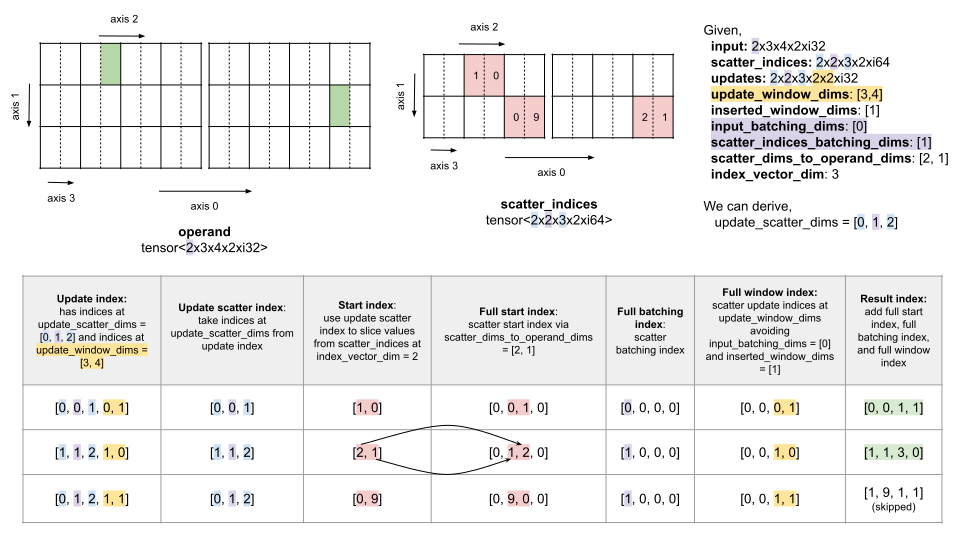
更正式地說,對於 index_space(updates[0]) 中的所有 update_index:
update_scatter_dims = [d for d in axes(updates[0]) and d not in update_window_dims]。update_scatter_index = update_index[update_scatter_dims...]。start_index的定義如下:scatter_indices[si0, ..., :, ..., siN],其中si是update_scatter_index中的個別元素,而:則插入index_vector_dim索引,前提是index_vector_dim<rank(scatter_indices)。- 其他情況則為
[scatter_indices[update_scatter_index]]。
- 適用於
axes(inputs[0])中的d_input,full_start_index[d_input] = start_index[d_start](如果有的話)。d_input = scatter_dims_to_operand_dims[d_start]- 其他情況則為
full_start_index[d_input] = 0。
- 適用於
axes(inputs[0])中的d_input,full_batching_index[d_input] = update_scatter_index[d_start - (d_start < index_vector_dim ? 0 : 1)]如果d_input = input_batching_dims[i_batching]和d_start = scatter_indices_batching_dims[i_batching]。- 其他情況則為
full_batching_index[d_input] = 0。
update_window_index = update_index[update_window_dims...]。- 其中
wi是update_window_index中的個別元素,而0則會插入inserted_window_dims和input_batching_dims的索引。full_window_index = [wi0, ..., 0, ..., wiN] result_index = full_start_index + full_batching_index + full_window_index。
因此,results = exec(schedule, inputs),其中:
schedule是index_space(updates[0])的實作定義排列。exec([update_index, ...], results) = exec([...], updated_results)where:- 如果
result_index位於shape(results...)的邊界內 updates_converted = to_destination_type( updates...[update_index], type(func_inputs(update_computation) [len(func_inputs(update_computation))//2:])... )updated_values = update_computation(results...[result_index], updates_converted)updated_results是results的副本,且results...[result_index]設為updated_values...。- 你也可以
updated_results = results。
- 如果
exec([], results) = results。
如果 indices_are_sorted 為 true,則實作項目可以假設 scatter_indices 會根據 scatter_dims_to_operand_dims 排序,否則行為未定義。更正式地說,對於 indices(result) 中的所有 i1 < i2,full_start_index(i1) <= full_start_index(i2)。
如果 unique_indices 是 true,則實作項目可以假設所有要分散的 result_index 索引都是不重複的。如果 unique_indices 為 true,但要分散到的索引並非不重複,則行為未定義。
輸入
| 標籤 | 名稱 | 類型 | 限制 |
|---|---|---|---|
| (I1) | inputs |
可變數量的張量或每個張量的量化張量 | (C1)、(C2)、(C4-C6)、(C11)、(C13)、(C18)、(C21)、(C23-C24) |
| (I2) | scatter_indices |
整數型別的張量 | (C4)、(C15)、(C19)、(C22) |
| (I3) | updates |
可變數量的張量或每個張量的量化張量 | (C3-C6)、(C8) |
| (I4) | update_window_dims |
si64 類型的 1 維張量常數 |
(C2)、(C4)、(C7-C8) |
| (I5) | inserted_window_dims |
si64 類型的 1 維張量常數 |
(C2)、(C4)、(C9-C11) |
| (I6) | input_batching_dims |
si64 類型的 1 維張量常數 |
(C2)、(C4)、(C9)、(C12-13)、(C17-18)、(C20) |
| (I7) | scatter_indices_batching_dims |
si64 類型的 1 維張量常數 |
(C14-C18) |
| (I8) | scatter_dims_to_operand_dims |
si64 類型的 1 維張量常數 |
(C19-C21) |
| (I9) | index_vector_dim |
si64 類型的常數 |
(C4)、(C16)、(C19)、(C22) |
| (I10) | indices_are_sorted |
i1 類型的常數 |
|
| (I11) | unique_indices |
i1 類型的常數 |
|
| (I12) | update_computation |
函式 | (C23) |
輸出內容
| 名稱 | 類型 | 限制 |
|---|---|---|
results |
可變數量的張量或每個張量的量化張量 | (C24-C25) |
限制
- (C1)
same(shape(inputs...))。 - (C2)
rank(inputs[0]) = size(update_window_dims) + size(inserted_window_dims) + size(input_batching_dims)。 - (C3)
same(shape(updates...))。 - (C4)
shape(updates[0]) = combine(update_scatter_dim_sizes, update_window_dim_sizes)其中:update_scatter_dim_sizes = shape(scatter_indices),但對應至index_vector_dim的scatter_indices維度大小不包含在內。update_window_dim_sizes <= shape(inputs[0]),但對應於inserted_window_dims和input_batching_dims的inputs[0]維度大小不包含在內。combine會將update_scatter_dim_sizes放在對應於update_scatter_dims的軸上,並將update_window_dim_sizes放在對應於update_window_dims的軸上。
- (C5)
0 < size(inputs) = size(updates) = N。 - (C6)
element_type(updates...) = element_type(inputs...)。 - (C7)
is_unique(update_window_dims) and is_sorted(update_window_dims)。 - (C8)
0 <= update_window_dims < rank(updates[0])。 - (C9)
is_unique(concatenate(inserted_window_dims, input_batching_dims)) - (C10)
is_sorted(inserted_window_dims)。 - (C11)
0 <= inserted_window_dims < rank(inputs[0])。 - (C12)
is_sorted(input_batching_dims)。 - (C13)
0 <= input_batching_dims < rank(inputs[0]))。 - (C14)
is_unique(scatter_indices_batching_dims)。 - (C15)
0 <= scatter_indices_batching_dims < rank(scatter_indices)。 - (C16)
index_vector_dim not in scatter_indices_batching_dims。 - (C17)
size(input_batching_dims) == size(scatter_indices_batching_dims)。 - (C18)
dim(inputs[0], input_batching_dims...) =
    dim(scatter_indices, scatter_indices_batching_dims...)
。 - (C19)
size(scatter_dims_to_operand_dims) =
    index_vector_dim < rank(scatter_indices) ?
    dim(scatter_indices, index_vector_dim) : 1
。 - (C20)
is_unique(concatenate(scatter_dims_to_operand_dims,
    input_batching_dims))
。 - (C21)
0 <= scatter_dims_to_operand_dims < rank(inputs[0])。 - (C22)
0 <= index_vector_dim <= rank(scatter_indices)。 - (C23)
update_computation的類型為(tensor<E0>, ..., tensor<EN-1>, tensor<E0>, ..., tensor<EN-1>) -> (tensor<E0>, ..., tensor<EN-1>),其中is_promotable(element_type(inputs[i]), Ei)。 - (C24)
shape(inputs...) = shape(results...)。 - (C25)
element_type(results[i]) = Ei適用於所有i中的[0,N)。
範例
// %input: [
//          [
//           [[1, 2], [3, 4], [5, 6], [7, 8]],
//           [[9, 10],[11, 12], [13, 14], [15, 16]],
//           [[17, 18], [19, 20], [21, 22], [23, 24]]
//          ],
//          [
//           [[25, 26], [27, 28], [29, 30], [31, 32]],
//           [[33, 34], [35, 36], [37, 38], [39, 40]],
//           [[41, 42], [43, 44], [45, 46], [47, 48]]
//          ]
//         ]
// %scatter_indices: [
//                    [
//                     [[0, 0], [1, 0], [2, 1]],
//                     [[0, 1], [1, 1], [0, 9]]
//                    ],
//                    [
//                     [[0, 0], [2, 1], [2, 2]],
//                     [[1, 2], [0, 1], [1, 0]]
//                    ]
//                   ]
// %update: [
//           [
//            [[[1, 1], [1, 1]], [[1, 1], [1, 1]], [[1, 1], [1, 1]]],
//            [[[1, 1], [1, 1]], [[1, 1], [1, 1]], [[1, 1], [1, 1]]]
//           ],
//           [
//            [[[1, 1], [1, 1]], [[1, 1], [1, 1]], [[1, 1], [1, 1]]],
//            [[[1, 1], [1, 1]], [[1, 1], [1, 1]], [[1, 1], [1, 1]]]
//           ]
//          ]
%result = "stablehlo.scatter"(%input, %scatter_indices, %update) ({
  ^bb0(%arg0: tensor<i64>, %arg1: tensor<i64>):
    %0 = "stablehlo.add"(%arg0, %arg1) : (tensor<i64>, tensor<i64>) -> tensor<i64>
    "stablehlo.return"(%0) : (tensor<i64>) -> ()
}) {
  scatter_dimension_numbers = #stablehlo.scatter<
    update_window_dims = [3, 4],
    inserted_window_dims = [1],
    input_batching_dims = [0],
    scatter_indices_batching_dims = [1],
    scatter_dims_to_operand_dims = [2, 1],
    index_vector_dim = 3>,
  indices_are_sorted = false,
  unique_indices = false
} : (tensor<2x3x4x2xi64>, tensor<2x2x3x2xi64>, tensor<2x2x3x2x2xi64>) -> tensor<2x3x4x2xi64>
// %result: [
//           [
//            [[3, 4], [6, 7], [6, 7], [7, 8]],
//            [[9, 10],[11, 12], [15, 16], [17, 18]],
//            [[17, 18], [19, 20], [22, 23], [24, 25]]
//           ],
//           [
//            [[25, 26], [28, 29], [30, 31], [31, 32]],
//            [[35, 36], [38, 39], [38, 39], [39, 40]],
//            [[41, 42], [44, 45], [46, 47], [47, 48]]
//           ]
//          ]
選取
語意
產生 result 張量,其中每個元素都是根據 pred 對應元素的值,從 on_true 或 on_false 張量中選取。
更正式地說,result[result_index] = pred_element ? on_true[result_index] :
on_false[result_index],其中 pred_element = rank(pred) = 0 ? pred[] :
pred[result_index]。如果是量化型別,則會執行 dequantize_select_quantize(pred, on_true, on_false, type(result))。
輸入
| 標籤 | 名稱 | 類型 | 限制 |
|---|---|---|---|
| (I1) | pred |
i1 類型的張量 |
(C1) |
| (I2) | on_true |
張量或每個張量的量化張量 | (C1-C2) |
| (I3) | on_false |
張量或每個張量的量化張量 | (C2) |
輸出內容
| 名稱 | 類型 | 限制 |
|---|---|---|
result |
張量或每個張量的量化張量 | (C2) |
限制
- (C1)
rank(pred) = 0 or shape(pred) = shape(on_true)。 - (C2)
baseline_type(on_true) = baseline_type(on_false) = baseline_type(result)。
範例
// %pred: [[false, true], [true, false]]
// %on_true: [[1, 2], [3, 4]]
// %on_false: [[5, 6], [7, 8]]
%result = "stablehlo.select"(%pred, %on_true, %on_false) : (tensor<2x2xi1>, tensor<2x2xi32>, tensor<2x2xi32>) -> tensor<2x2xi32>
// %result: [[5, 2], [3, 8]]
select_and_scatter
語意
使用 scatter,根據 input 張量使用 select 的 reduce_window 結果,分散 source 張量的值,並產生 result 張量。
下圖以具體範例說明如何從 operand 和 source 計算 result 中的元素。
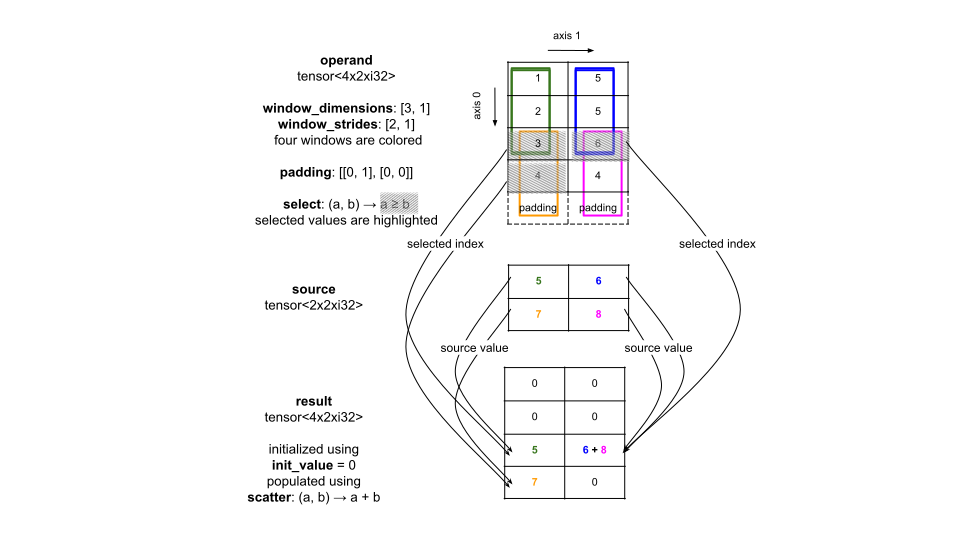
更正式地來說:
selected_values = reduce_window_without_init(...),並提供下列輸入內容:inputs = [operand].window_dimensions、window_strides和padding,並照原樣使用。base_dilations = windows_dilations = 1。body定義如下:
def body(arg0: tensor<E>, arg1: tensor<E>) -> tensor<E>:
  return select(arg0, arg1) ? arg0 : arg1;
其中
E = element_type(operand)和reduce_window_without_init的運作方式與reduce_window完全相同,但基礎reduce的schedule(請參閱 reduce) 不包含 init 值。目前尚未指定如果對應視窗沒有值會發生什麼情況 (#731)。result[result_index] = reduce([source_values], [init_value], [0], scatter)其中:source_values = [source[source_index] for source_index in source_indices]。- 如果
selected_values[source_index]含有operand_index的operand元素,則為selected_index(source_index) = operand_index。 source_indices = [source_index for source_index in indices(source) if selected_index(source_index) = result_index]。
輸入
| 標籤 | 名稱 | 類型 | 限制 |
|---|---|---|---|
| (I1) | operand |
張量或每個張量的量化張量 | (C1-C4)、(C6)、(C8-C11) |
| (I2) | source |
張量或每個張量的量化張量 | (C1)、(C2) |
| (I3) | init_value |
0 維度張量或每個張量的量化張量 | (C3) |
| (I4) | window_dimensions |
si64 類型的 1 維張量常數 |
(C2)、(C4)、(C5) |
| (I5) | window_strides |
si64 類型的 1 維張量常數 |
(C2)、(C6)、(C7) |
| (I6) | padding |
si64 類型的 2 維張量常數 |
(C2)、(C8) |
| (I7) | select |
函式 | (C9) |
| (I8) | scatter |
函式 | (C10) |
輸出內容
| 名稱 | 類型 | 限制 |
|---|---|---|
result |
張量或每個張量的量化張量 | (C11-C12) |
限制
- (C1)
element_type(operand) = element_type(source)。 - (C2)
shape(source) = num_windows其中:padded_operand_shape = padding[:, 0] + shape(operand) + padding[:, 1]。is_empty_window = padded_operand_shape = 0 || window_dimensions > padded_operand_shape。num_windows = is_empty_window ? 0 : floor((padded_operand_shape - window_dimensions) / window_strides) + 1。
- (C3)
element_type(init_value) = element_type(operand)。 - (C4)
size(window_dimensions) = rank(operand)。 - (C5)
0 < window_dimensions。 - (C6)
size(window_strides) = rank(operand)。 - (C7)
0 < window_strides。 - (C8)
shape(padding) = [rank(operand), 2]。 - (C9)
select具有(tensor<E>, tensor<E>) -> tensor<i1>類型,其中E = element_type(operand)。 - (C10)
scatter的型別為(tensor<E>, tensor<E>) -> tensor<E>,其中is_promotable(element_type(operand), E)。 - (C11)
shape(operand) = shape(result)。 - (C12)
element_type(result) = E。
範例
// %operand: [[1, 5], [2, 5], [3, 6], [4, 4]]
// %source: [[5, 6], [7, 8]]
// %init_value: 0
%result = "stablehlo.select_and_scatter"(%operand, %source, %init_value) ({
  ^bb0(%arg0: tensor<i64>, %arg1: tensor<i64>):
    %0 = "stablehlo.compare"(%arg0, %arg1) {
      comparison_direction = #stablehlo<comparison_direction GE>
    } : (tensor<i64>, tensor<i64>) -> tensor<i1>
    "stablehlo.return"(%0) : (tensor<i1>) -> ()
}, {
  ^bb0(%arg0: tensor<i64>, %arg1: tensor<i64>):
    %0 = "stablehlo.add"(%arg0, %arg1) : (tensor<i64>, tensor<i64>) -> tensor<i64>
    "stablehlo.return"(%0) : (tensor<i64>) -> ()
}) {
  window_dimensions = array<i64: 3, 1>,
  window_strides = array<i64: 2, 1>,
  padding = dense<[[0, 1], [0, 0]]> : tensor<2x2xi64>
} : (tensor<4x2xi64>, tensor<2x2xi64>, tensor<i64>) -> tensor<4x2xi64>
// %result: [[0, 0], [0, 0], [5, 14], [7, 0]]
傳送
語意
將 inputs 傳送至頻道 channel_id。然後,輸入內容會按照 source_target_pairs 指定的順序傳送至其他裝置。這項作業會產生 result 權杖。
如果 is_host_transfer 為 true,作業會將資料傳輸至主機。否則,系統會根據 source_target_pairs 的值將資料轉移至其他裝置。這個旗標會重複 channel_type 中提供的資訊,因此我們日後只會保留其中一個 (#666)。如果 is_host_transfer = false 且 source_target_pairs 為 None 或空白,則視為未定義的行為。
輸入
| 標籤 | 名稱 | 類型 | 限制 |
|---|---|---|---|
| (I1) | inputs |
可變數量的張量或量化張量 | |
| (I2) | token |
token |
|
| (I3) | channel_id |
si64 類型的常數 |
|
| (I4) | channel_type |
DEVICE_TO_DEVICE 和 DEVICE_TO_HOST 的列舉 |
(C5) |
| (I5) | is_host_transfer |
i1 類型的常數 |
(C5-C6) |
| (I6) | source_target_pairs |
si64 類型的 2 維張量常數 |
(C1-C4)、(C6) |
輸出內容
| 名稱 | 類型 |
|---|---|
result |
token |
限制
- (C1)
dim(source_target_pairs, 1) = 2。 - (C2)
is_unique(source_target_pairs[:, 0])。 - (C3)
is_unique(source_target_pairs[:, 1])。 - (C4)
0 <= source_target_pairs < N,其中N定義為:- 如果使用
cross_replica,則為num_replicas。 - 如果使用
cross_partition,則為num_partitions。
- 如果使用
- (C5)
channel_type的定義為:- 若
is_host_transfer = true,則設為DEVICE_TO_HOST - 其他情況則為
DEVICE_TO_DEVICE。
- 若
範例
%result = "stablehlo.send"(%operand, %token) {
  channel_handle = #stablehlo.channel_handle<handle = 0, type = 1>,
  is_host_transfer = false,
  source_target_pairs = dense<[[0, 1], [1, 2]]> : tensor<2x2xi64>
} : (tensor<2x2xi64>, !stablehlo.token) -> !stablehlo.token
shift_left
語意
對 lhs 張量執行元素級別的左移運算,移動位元數為 rhs,並產生 result 張量。
輸入
| 標籤 | 名稱 | 類型 | 限制 |
|---|---|---|---|
| (I1) | lhs |
整數型別的張量 | (C1) |
| (I2) | rhs |
整數型別的張量 | (C1) |
輸出內容
| 名稱 | 類型 | 限制 |
|---|---|---|
result |
整數型別的張量 | (C1) |
限制
- (C1)
type(lhs) = type(rhs) = type(result)。
範例
// %lhs: [-1, 0, 1]
// %rhs: [1, 2, 3]
%result = "stablehlo.shift_left"(%lhs, %rhs): (tensor<3xi64>, tensor<3xi64>) -> tensor<3xi64>
// %result: [-2, 0, 8]
shift_right_arithmetic
語意
對 lhs 張量執行元素算術右移運算,位移量為 rhs 位元,並產生 result 張量。
輸入
| 標籤 | 名稱 | 類型 | 限制 |
|---|---|---|---|
| (I1) | lhs |
整數型別的張量 | (C1) |
| (I2) | rhs |
整數型別的張量 | (C1) |
輸出內容
| 名稱 | 類型 | 限制 |
|---|---|---|
result |
整數型別的張量 | (C1) |
限制
- (C1)
type(lhs) = type(rhs) = type(result)。
範例
// %lhs: [-1, 0, 8]
// %rhs: [1, 2, 3]
%result = "stablehlo.shift_right_arithmetic"(%lhs, %rhs): (tensor<3xi64>, tensor<3xi64>) -> tensor<3xi64>
// %result: [-1, 0, 1]
shift_right_logical
語意
對 lhs 張量執行元素層級的邏輯右移運算,位元數為 rhs,並產生 result 張量。
輸入
| 標籤 | 名稱 | 類型 | 限制 |
|---|---|---|---|
| (I1) | lhs |
整數型別的張量 | (C1) |
| (I2) | rhs |
整數型別的張量 | (C1) |
輸出內容
| 名稱 | 類型 | 限制 |
|---|---|---|
result |
整數型別的張量 | (C1) |
限制
- (C1)
type(lhs) = type(rhs) = type(result)。
範例
// %lhs: [-1, 0, 8]
// %rhs: [1, 2, 3]
%result = "stablehlo.shift_right_logical"(%lhs, %rhs): (tensor<3xi64>, tensor<3xi64>) -> tensor<3xi64>
// %result: [9223372036854775807, 0, 1]
簽署
語意
傳回 operand 的元素層級符號,並產生 result 張量。
更正式地說,對於每個元素 x,語意可使用 Python 語法表示如下:
def sign(x):
if is_integer(x):
if compare(x, 0, LT, SIGNED): return -1
if compare(x, 0, EQ, SIGNED): return 0
return 1
elif is_float(x):
if is_nan(x): return NaN
if compare(x, -0.0, EQ, FLOAT): return -0.0
if compare(x, +0.0, EQ, FLOAT): return +0.0
if compare(x, 0.0, LT, FLOAT): return -1.0
return 1.0
elif is_complex(x):
if is_nan(real(x)) or is_nan(imag(x)): return (NaN, NaN)
if compare(x, (0.0, 0.0), EQ, FLOAT): return (0.0, 0.0)
return divide(x, convert(abs(x), type(x)))
如果是量化型別,則會執行 dequantize_op_quantize(sign, operand, type(result))。
輸入
| 標籤 | 名稱 | 類型 | 限制 |
|---|---|---|---|
| (I1) | operand |
有符號整數、浮點數或複數型別的張量,或是每個張量的量化張量 | (C1) |
輸出內容
| 名稱 | 類型 | 限制 |
|---|---|---|
result |
有符號整數、浮點數或複數型別的張量,或是每個張量的量化張量 | (C1) |
限制
- (C1)
baseline_type(operand) = baseline_type(result)。
範例
// Logical values: +NaN, -1.0, -0.0, +0.0, 1.0
// operand: [0x7FFFFFFFFFFFFFFF, -1.0, -0.0, 0.0, 1.0]
%result = "stablehlo.sign"(%operand) : (tensor<5xf64>) -> tensor<5xf64>
// Logical values: +NaN, -1.0, -0.0, +0.0, 1.0
// %result: [0x7FFFFFFFFFFFFFFF, -1.0, -0.0, 0.0, 1.0]
正弦
語意
對 operand 張量執行元素級別的正弦運算,並產生 result 張量。視元素類型而定,執行下列操作:
- 浮點數:IEEE-754 的
sin。 - 複數:複數正弦值。
- 量化型別:
dequantize_op_quantize(sine, operand, type(result))。
輸入
| 標籤 | 名稱 | 類型 | 限制 |
|---|---|---|---|
| (I1) | operand |
浮點或複數型別的張量,或是每個張量的量化張量 | (C1) |
輸出內容
| 名稱 | 類型 | 限制 |
|---|---|---|
result |
浮點或複數型別的張量,或是每個張量的量化張量 | (C1) |
限制
- (C1)
baseline_type(operand) = baseline_type(result)。
範例
// %operand: [
// [0.0, 1.57079632], // [0, pi/2]
// [3.14159265, 4.71238898] // [pi, 3pi/2]
// ]
%result = "stablehlo.sine"(%operand) : (tensor<2x2xf32>) -> tensor<2x2xf32>
// %result: [[0.0, 1.0], [0.0, -1.0]]
配量
語意
使用靜態計算的起始索引,從 operand 中擷取切片,並產生 result 張量。start_indices 包含每個維度的切片起始索引,limit_indices 包含每個維度的切片結束索引 (不含),strides 則包含每個維度的步幅。
更正式地說,result[result_index] = operand[operand_index],其中 operand_index = start_indices + result_index * strides。
輸入
| 標籤 | 名稱 | 類型 | 限制 |
|---|---|---|---|
| (I1) | operand |
張量或每個張量的量化張量 | (C1-C3)、(C5) |
| (I2) | start_indices |
si64 類型的 1 維張量常數 |
(C2)、(C3)、(C5) |
| (I3) | limit_indices |
si64 類型的 1 維張量常數 |
(C2)、(C3)、(C5) |
| (I4) | strides |
si64 類型的 1 維張量常數 |
(C2)、(C4) |
輸出內容
| 名稱 | 類型 | 限制 |
|---|---|---|
result |
張量或每個張量的量化張量 | (C1)、(C5) |
限制
- (C1)
element_type(operand) = element_type(result)。 - (C2)
size(start_indices) = size(limit_indices) = size(strides) = rank(operand)。 - (C3)
0 <= start_indices <= limit_indices <= shape(operand)。 - (C4)
0 < strides。 - (C5)
shape(result) = ceil((limit_indices - start_indices) / strides)。
範例
// %operand: [
// [0, 0, 0, 0],
// [0, 0, 1, 1],
// [0, 0, 1, 1]
// ]
%result = "stablehlo.slice"(%operand) {
start_indices = array<i64: 1, 2>,
limit_indices = array<i64: 3, 4>,
strides = array<i64: 1, 1>
} : (tensor<3x4xi64>) -> tensor<2x2xi64>
// % result: [
// [1, 1],
// [1, 1]
// ]
排序
語意
根據 comparator 沿著維度 dimension 一起排序 inputs 的 1 維切片,並產生 results。
與其他作業中的類似輸入不同,dimension 允許負值,語意如下所述。基於一致性考量,日後可能會禁止這麼做 (#1377)。
如果 is_stable 為 true,則排序穩定,也就是說,比較子視為相等的元素會保留相對順序。如果只有單一輸入內容,當且僅當 comparator(e1, e2) = comparator(e2, e1) = false 時,比較子才會將兩個元素 e1 和 e2 視為相等。請參閱下方的正式化說明,瞭解如何將這個概念推廣至多個輸入內容。
更正式地說,對於 index_space(results[0]) 中的所有 result_index:
adjusted_dimension = dimension >= 0 ? dimension : rank(inputs[0]) + dimension。- 其中
riN是result_index中的個別元素,而:則會插入adjusted_dimension。result_slice = [ri0, ..., :, ..., riR-1] inputs_together = (inputs[0]..., ..., inputs[N-1]...)。results_together[result_slice] = sort(inputs_together[result_slice], comparator_together)。- 其中
sort會以非遞減順序排序一維切片,並預期如果左側引數小於右側第二個引數,comparator_together會傳回true。 def comparator_together(lhs_together, rhs_together): args = [] for (lhs_el, rhs_el) in zip(lhs_together, rhs_together): args.append(lhs_el) args.append(rhs_el) return comparator(*args)(results[0]..., ..., results[N-1]...) = results_together。
輸入
| 標籤 | 名稱 | 類型 | 限制 |
|---|---|---|---|
| (I1) | inputs |
可變數量的張量或每個張量的量化張量 | (C1-C5) |
| (I2) | dimension |
si64 類型的常數 |
(C4) |
| (I3) | is_stable |
i1 類型的常數 |
|
| (I4) | comparator |
函式 | (C5) |
輸出內容
| 名稱 | 類型 | 限制 |
|---|---|---|
results |
可變數量的張量或每個張量的量化張量 | (C2)、(C3) |
限制
- (C1)
0 < size(inputs)。 - (C2)
type(inputs...) = type(results...)。 - (C3)
same(shape(inputs...) + shape(results...))。 - (C4)
-R <= dimension < R,其中R = rank(inputs[0])。 - (C5)
comparator具有(tensor<E1>, tensor<E1>, ..., tensor<EN-1>, tensor<EN-1>) -> tensor<i1>類型,其中Ei = element_type(inputs[i])。
範例
// %input0 = [[1, 2, 3], [3, 2, 1]]
// %input1 = [[3, 2, 1], [1, 2, 3]]
%result0, %result1 = "stablehlo.sort"(%input0, %input1) ({
^bb0(%arg0: tensor<i64>, %arg1: tensor<i64>, %arg2: tensor<i64>, %arg3: tensor<i64>):
%predicate = "stablehlo.compare"(%arg0, %arg1) {
comparison_direction = #stablehlo<comparison_direction GT>
} : (tensor<i64>, tensor<i64>) -> tensor<i1>
"stablehlo.return"(%predicate) : (tensor<i1>) -> ()
}) {
dimension = 0 : i64,
is_stable = true
} : (tensor<2x3xi64>, tensor<2x3xi64>) -> (tensor<2x3xi64>, tensor<2x3xi64>)
// %result0 = [[3, 2, 3], [1, 2, 1]]
// %result1 = [[1, 2, 1], [3, 2, 3]]
sqrt
語意
對 operand 張量執行元素級別的平方根運算,並產生 result 張量。視元素類型而定,執行下列操作:
- 浮點數:IEEE-754 的
squareRoot。 - 複數:複數平方根。
- 量化型別:
dequantize_op_quantize(sqrt, operand, type(result))。
輸入
| 標籤 | 名稱 | 類型 | 限制 |
|---|---|---|---|
| (I1) | operand |
浮點或複數型別的張量,或是每個張量的量化張量 | (C1) |
輸出內容
| 名稱 | 類型 | 限制 |
|---|---|---|
result |
浮點或複數型別的張量,或是每個張量的量化張量 | (C1) |
限制
- (C1)
baseline_type(operand) = baseline_type(result)。
範例
// %operand: [[0.0, 1.0], [4.0, 9.0]]
%result = "stablehlo.sqrt"(%operand) : (tensor<2x2xf32>) -> tensor<2x2xf32>
// %result: [[0.0, 1.0], [2.0, 3.0]]
subtract
語意
執行兩個張量 lhs 和 rhs 的元素級別減法,並產生 result 張量。視元素類型而定,執行下列操作:
- 整數:整數減法。
- 浮點數:IEEE-754 的
subtraction。 - 複數:複數減法。
- 如為量化型別:
dequantize_op_quantize(subtract, lhs, rhs, type(result))。
輸入
| 標籤 | 名稱 | 類型 | 限制 |
|---|---|---|---|
| (I1) | lhs |
整數、浮點數或複數型別的張量,或是每個張量的量化張量 | (C1) |
| (I2) | rhs |
整數、浮點數或複數型別的張量,或是每個張量的量化張量 | (C1) |
輸出內容
| 名稱 | 類型 | 限制 |
|---|---|---|
result |
整數、浮點數或複數型別的張量,或是每個張量的量化張量 | (C1) |
限制
- (C1)
baseline_type(lhs) = baseline_type(rhs) = baseline_type(result)。
範例
// %lhs: [[6, 8], [10, 12]]
// %rhs: [[5, 6], [7, 8]]
%result = "stablehlo.subtract"(%lhs, %rhs) : (tensor<2x2xf32>, tensor<2x2xf32>) -> (tensor<2x2xf32>)
// %result: [[1, 2], [3, 4]]
tan
語意
對 operand 張量執行元素級別的正切運算,並產生 result 張量。視元素類型而定,執行下列操作:
- 浮點數:IEEE-754 的
tan。 - 複數:複數正切值。
- 量化型別:
dequantize_op_quantize(tan, operand, type(result))。
輸入
| 標籤 | 名稱 | 類型 | 限制 |
|---|---|---|---|
| (I1) | operand |
浮點或複數型別的張量,或是每個張量的量化張量 | (C1) |
輸出內容
| 名稱 | 類型 | 限制 |
|---|---|---|
result |
浮點或複數型別的張量,或是每個張量的量化張量 | (C1) |
限制
- (C1)
baseline_type(operand) = baseline_type(result)。
範例
// %operand: [
// [0.0, 1.57079632], // [0, pi/2]
// [3.14159265, 4.71238898] // [pi, 3pi/2]
// ]
%result = "stablehlo.tan"(%operand) : (tensor<2x2xf64>) -> tensor<2x2xf64>
// %result: [
// [0.0, 1.63312e+16],
// [0.0, 5.44375e+15]
// ]
tanh
語意
對 operand 張量執行元素級別的雙曲正切運算,並產生 result 張量。視元素類型而定,執行下列操作:
- 浮點數:IEEE-754 的
tanh。 - 複數:複數雙曲正切值。
- 如為量化型別:
dequantize_op_quantize(tanh, operand, type(result))。
輸入
| 標籤 | 名稱 | 類型 | 限制 |
|---|---|---|---|
| (I1) | operand |
浮點或複數型別的張量,或是每個張量的量化張量 | (C1) |
輸出內容
| 名稱 | 類型 | 限制 |
|---|---|---|
result |
浮點或複數型別的張量,或是每個張量的量化張量 | (C1) |
限制
- (C1)
baseline_type(operand) = baseline_type(result)。
範例
// %operand: [-1.0, 0.0, 1.0]
%result = "stablehlo.tanh"(%operand) : (tensor<3xf32>) -> tensor<3xf32>
// %result: [-0.76159416, 0.0, 0.76159416]
轉置
語意
使用 permutation 排列 operand 張量的維度,並產生 result 張量。更正式地說,result[result_index] = operand[operand_index]
其中 result_index[d] = operand_index[permutation[d]]。
輸入
| 標籤 | 名稱 | 類型 | 限制 |
|---|---|---|---|
| (I1) | operand |
張量或量化張量 | (C1-C4) |
| (I2) | permutation |
si64 類型的 1 維張量常數 |
(C2-C4) |
輸出內容
| 名稱 | 類型 | 限制 |
|---|---|---|
result |
張量或量化張量 | (C1)、(C3-C4) |
限制
- (C1)
element_type(result)由以下項目提供:element_type(operand)(如果!is_per_axis_quantized(operand))。element_type(operand),但quantization_dimension(operand)和quantization_dimension(result)可能不同。
- (C2)
permutation是range(rank(operand))的排列。 - (C3)
shape(result) = dim(operand, permutation...)。 - (C4) If
is_per_axis_quantized(result), thenquantization_dimension(operand) = permutation(quantization_dimension(result)).
範例
// %operand: [
// [[1,2], [3,4], [5,6]],
// [[7,8], [9,10], [11,12]]
// ]
%result = "stablehlo.transpose"(%operand) {
permutation = array<i64: 2, 1, 0>
} : (tensor<2x3x2xi32>) -> tensor<2x3x2xi32>
// %result: [
// [[1,7], [3,9], [5,11]],
// [[2,8], [4,10], [6,12]]
// ]
triangular_solve
語意
解開多批聯立線性方程式,係數矩陣為上或下三角矩陣。
更正式地來說,假設有 a 和 b,當 left_side 為 true 或 x * op(a[i0, ..., iR-3, :, :]) = b[i0, ..., iR-3, :, :] 時,result[i0, ..., iR-3, :, :] 是 op(a[i0, ..., iR-3, :, :]) * x = b[i0, ..., iR-3, :, :] 的解,而 left_side 為 false 時,result[i0, ..., iR-3, :, :] 是 op(a[i0, ..., iR-3, :, :]) * x = b[i0, ..., iR-3, :, :] 的解,求解變數 x,其中 op(a) 由 transpose_a 決定,transpose_a 可以是下列其中一項:
NO_TRANSPOSE:使用a執行作業。TRANSPOSE:對a的轉置執行運算。ADJOINT:對a的共軛轉置執行運算。
如果 lower 是 true,則輸入資料只會從 a 的下三角形讀取;否則會從 a 的上三角形讀取。輸出資料會以相同三角形傳回,其他三角形中的值則由實作定義。
如果 unit_diagonal 為 true,實作項目可以假設 a 的對角線元素等於 1,否則行為未定義。
如果是量化型別,則會執行 dequantize_op_quantize(lambda x, y: triangular_solve(x, y, left_side, lower,
unit_diagonal, transpose_a), a, b, type(result))。
輸入
| 標籤 | 名稱 | 類型 | 限制 |
|---|---|---|---|
| (I1) | a |
浮點或複數型別的張量,或是每個張量的量化張量 | (C1-C3) |
| (I2) | b |
浮點或複數型別的張量,或是每個張量的量化張量 | (C1-C4) |
| (I3) | left_side |
i1 類型的常數 |
(C3) |
| (I4) | lower |
i1 類型的常數 |
|
| (I5) | unit_diagonal |
i1 類型的常數 |
|
| (I6) | transpose_a |
NO_TRANSPOSE、TRANSPOSE 和 ADJOINT 的列舉 |
輸出內容
| 名稱 | 類型 | 限制 |
|---|---|---|
result |
浮點或複數型別的張量,或是每個張量的量化張量 | (C1) |
限制
- (C1)
baseline_element_type(a) = baseline_element_type(b)。 - (C2)
2 <= rank(a) = rank(b) = R。 - (C3)
shape(a)和shape(b)之間的關係定義如下:shape(a)[:-3] = shape(b)[:-3]。dim(a, -2) = dim(a, -1) = dim(b, left_side ? -2 : -1)。
- (C4)
baseline_type(b) = baseline_type(result)。
範例
// %a = [
// [1.0, 0.0, 0.0],
// [2.0, 4.0, 0.0],
// [3.0, 5.0, 6.0]
// ]
// %b = [
// [2.0, 0.0, 0.0],
// [4.0, 8.0, 0.0],
// [6.0, 10.0, 12.0]
// ]
%result = "stablehlo.triangular_solve"(%a, %b) {
left_side = true,
lower = true,
unit_diagonal = false,
transpose_a = #stablehlo<transpose NO_TRANSPOSE>
} : (tensor<3x3xf32>, tensor<3x3xf32>) -> tensor<3x3xf32>
// %result: [
// [2.0, 0.0, 0.0],
// [0.0, 2.0, 0.0],
// [0.0, 0.0, 2.0]
// ]
元組
語意
從值 val 產生 result 元組。
輸入
| 標籤 | 名稱 | 類型 | 限制 |
|---|---|---|---|
| (I1) | val |
可變數量的數值 | (C1) |
輸出內容
| 名稱 | 類型 | 限制 |
|---|---|---|
result |
元組 | (C1) |
限制
- (C1)
result具有tuple<E0, ..., EN-1>類型,其中Ei = type(val[i])。
範例
// %val0: memref[1.0, 2.0]
// %val1: (3)
%result = "stablehlo.tuple"(%val0, %val1) : (memref<2xf32>, tuple<tensor<i32>>) -> tuple<memref<2xf32>, tuple<tensor<i32>>>
// %result: (memref[1.0, 2.0], (3))
uniform_dequantize
語意
根據 operand 型別定義的量化參數,將量化張量 operand 的元素逐一轉換為浮點張量 result。
更正式地說,result = dequantize(operand)。
輸入
| 標籤 | 名稱 | 類型 | 限制 |
|---|---|---|---|
| (I1) | operand |
量化張量 | (C1)、(C2) |
輸出內容
| 名稱 | 類型 | 限制 |
|---|---|---|
result |
浮點類型張量 | (C1)、(C2) |
限制
- (C1)
shape(operand) = shape(result)。 - (C2)
element_type(result) = expressed_type(operand)。
範例
// %operand: [10, 10]
%result = "stablehlo.uniform_dequantize"(%operand) : (tensor<2x!quant.uniform<i8:f32:0, {0.1:-30,0.5:-20}>>) -> tensor<2xf32>
// %result: [4.0, 15.0]
uniform_quantize
語意
根據 result 型別定義的量化參數,將浮點張量或量化張量 operand 逐一轉換為量化張量 result。
更正式地說,
- 如果
is_float(operand):result = quantize(operand, type(result))。
- 如果
is_quantized(operand):float_result = dequantize(operand)。result = quantize(float_result, type(result))。
輸入
| 標籤 | 名稱 | 類型 | 限制 |
|---|---|---|---|
| (I1) | operand |
浮點或量化型別的張量 | (C1)、(C2) |
輸出內容
| 名稱 | 類型 | 限制 |
|---|---|---|
result |
量化張量 | (C1)、(C2) |
限制
- (C1)
shape(operand) = shape(result)。 - (C2)
expressed_type(result) = is_float(operand) ? element_type(operand) : expressed_type(operand)。
範例
// %operand: [4.0, 15.0]
%result = "stablehlo.uniform_quantize"(%operand) : (tensor<2xf32>) -> tensor<2x!quant.uniform<i8:f32:0, {0.1:-30,0.5:-20}>>
// %result: [10, 10]
// %operand: [10, 10]
%result = "stablehlo.uniform_quantize"(%operand) : (tensor<2x!quant.uniform<i8:f32:0, {0.1:-30,0.5:-20}>>) -> tensor<2x!quant.uniform<i8:f32:0, {0.1:-20,0.2:-30}>>
// %result: [20, 45]
while
語意
在 cond 函式輸出 true 時,執行 body 函式 0 次以上,並產生輸出內容。更正式地說,語意可以使用 Python 語法表示如下:
internal_state = operand
while cond(*internal_state):
internal_state = body(*internal_state)
results = internal_state
無限迴圈的行為待定 (#383)。
輸入
| 標籤 | 名稱 | 類型 | 限制 |
|---|---|---|---|
| (I1) | operand |
可變數量的數值 | (C1-C3) |
| (I2) | cond |
函式 | (C1) |
| (I3) | body |
函式 | (C2) |
輸出內容
| 名稱 | 類型 | 限制 |
|---|---|---|
results |
可變數量的數值 | (C3) |
限制
- (C1)
cond的型別為(T0, ..., TN-1) -> tensor<i1>,其中Ti = type(operand[i])。 - (C2)
body具有(T0, ..., TN-1) -> (T0, ..., TN-1)類型,其中Ti = type(operand[i])。 - (C3)
type(results...) = type(operand...)。
範例
// %init_i: 1
// %init_sum: 0
// %one: 1
// %ten: 10
%results0, %results1 = "stablehlo.while"(%init_i, %init_sum) ({
^bb0(%arg0: tensor<i64>, %arg1: tensor<i64>):
%cond = "stablehlo.compare"(%arg0, %ten) {
comparison_direction = #stablehlo<comparison_direction LT>
} : (tensor<i64>, tensor<i64>) -> tensor<i1>
stablehlo.return %cond : tensor<i1>
}, {
^bb0(%arg0: tensor<i64>, %arg1: tensor<i64>):
%new_sum = stablehlo.add %arg1, %one : tensor<i64>
%new_i = stablehlo.add %arg0, %one : tensor<i64>
stablehlo.return %new_i, %new_sum : tensor<i64>, tensor<i64>
}) : (tensor<i64>, tensor<i64>) -> (tensor<i64>, tensor<i64>)
// %results0: 10
// %results1: 10
xor
語意
對兩個張量 lhs 和 rhs 執行元素層級的 XOR 運算,並產生 result 張量。視元素類型而定,執行下列操作:
- 布林值:邏輯 XOR。
- 整數:位元 XOR。
輸入
| 標籤 | 名稱 | 類型 | 限制 |
|---|---|---|---|
| (I1) | lhs |
布林值或整數類型的張量 | (C1) |
| (I2) | rhs |
布林值或整數類型的張量 | (C1) |
輸出內容
| 名稱 | 類型 | 限制 |
|---|---|---|
result |
布林值或整數類型的張量 | (C1) |
限制
- (C1)
type(lhs) = type(rhs) = type(result)。
範例
// Bitwise operation with with integer tensors
// %lhs: [[1, 2], [3, 4]]
// %rhs: [[5, 6], [7, 8]]
%result = "stablehlo.xor"(%lhs, %rhs) : (tensor<2x2xi32>, tensor<2x2xi32>) -> tensor<2x2xi32>
// %result: [[4, 4], [4, 12]]
// Logical operation with with boolean tensors
// %lhs: [[false, false], [true, true]]
// %rhs: [[false, true], [false, true]]
%result = "stablehlo.xor"(%lhs, %rhs) : (tensor<2x2xi1>, tensor<2x2xi1>) -> tensor<2x2xi1>
// %result: [[false, true], [true, false]]
方言互通性
目前,實際使用的 StableHLO 程式有時會包含 StableHLO 未定義的作業。
模組、函式、呼叫和傳回
StableHLO 會使用上游 MLIR 作業,處理 ModuleOp、FuncOp、CallOp 和 ReturnOp。這是為了與現有的 MLIR 機制進行更好的互通性,因為許多實用的傳遞都是以 FuncOp 和 ModuleOp 為目標,而且許多編譯管道都預期會出現這些作業。這些作業會套用完整相容性保證。如果這些作業有任何不相容的變更 (即移除),系統會新增 StableHLO 對等項目,以維持相容性。
CHLO
CHLO opset 包含可分解為 StableHLO 的高階作業。目前我們不保證 CHLO 的相容性。為確保相容性,必須先使用 chlo-legalize-to-stablehlo 傳遞,才能進行序列化。
形狀作業
在社群中,常見的用途是在動態 StableHLO 程式中使用核心 MLIR 方言的特定作業,執行形狀計算。最常見的包括 shape 方言運算子 (如 shape_of 或 num_elements)、tensor 方言運算子 (如 dim 或 from_elements),以及內建的 index 型別。
Dynamism RFC > O2 將這些項目標示為超出範圍,但為了互通性,我們仍納入部分 index 類型支援。我們不保證這些作業或型別的相容性。shape-legalize-to-stablehlo 傳遞可用於將這些作業轉換為完全支援的 StableHLO 作業。
已淘汰的作業
有幾項 StableHLO 作業是從 MHLO 繼承而來,這些作業已遭淘汰,即將從 StableHLO 移除。如要瞭解這些移除作業的完整詳細資料,請參閱 StableHLO v1.0 Cleanup #2283。這些淘汰項目的追蹤問題是 #2340。
這些作業可分為幾類:
- StableHLO 作業的「Not in HLO」類別 - 這些作業最初是 StableHLO 作業集的一部分,但後來被認為不太適合:
broadcast、create_token、cross-replica-sum、dot、einsum、torch_index_select、unary_einsum(#3)。 - 未使用的作業 - 這些作業可能在某個時間點很有用,但作業不是開發不足,就是使用這些作業的管道已重構,不再需要這些作業。包括
map、tuple(#598)、get_tuple_element、rng、complex比較 #560, 以及捲積window_reversal(#1181)。
其中部分作業可使用現有作業 (broadcast、create_token、cross-replica-sum、dot、unary_einsum) 表示,因此可輕鬆移除,並會在現有相容性時間範圍 (6 個月) 結束後移除。其他運算子仍在評估是否要移除 (einsum、get_tuple_element、map、rng、torch_index_select、tuple、complex 比較、window_reversal)。我們會根據社群意見回饋,決定是否移除這些運算子,或是將其加入規格並提供完整支援。在這些作業的未來發展明朗之前,我們只能保證 6 個月的相容性。
執行
依序執行
執行 StableHLO 程式時,需要為 main 函式提供輸入值,並計算輸出值。函式的輸出值是透過執行以對應 return 運算為根的運算圖計算而得。
只要與資料流一致 (也就是在作業使用前執行作業),執行順序就是實作定義。在 StableHLO 中,所有具有副作用的運算都會消耗一個權杖並產生一個權杖 (多個權杖可透過 after_all 多工處理成一個權杖),因此副作用的執行順序也會與資料流程保持一致。舉例來說,在下列程式中,可能的執行順序有兩種:%0 → %1 → %2 → return 和 %1 → %0 → %2 → return。
func.func @main() -> tensor<f64> {
%0 = stablehlo.constant dense<1.0> : tensor<f64>
%1 = stablehlo.constant dense<2.0> : tensor<f64>
%2 = stablehlo.add %0, %1 : tensor<f64>
return %2 : tensor<f64>
}
更正式地來說,StableHLO 程序是以下項目的組合:
1) StableHLO 程式、2) 作業狀態 (尚未執行、已執行),以及 3) 程序正在處理的中間值。
這個程序會先將輸入值傳送至 main 函式,然後透過作業圖表更新作業狀態和中繼值,最後輸出值。正式化作業的後續進展待定 (#484)。
平行執行
StableHLO 程式可以並行執行,並整理成 num_replicas x num_partitions 的 2D 處理網格,兩者皆為 ui32 型別。
在 StableHLO 程序格線中,num_replicas * num_partitions 個 StableHLO 程序會同時執行。每個程序都有專屬的 process_id = (replica_id, partition_id),其中 replica_ids = range(num_replicas) 和 partition_ids = range(num_partitions) 中的 replica_id 和 partition_id 都是 ui32 型別。
每個程式的程序格線大小都是靜態已知的 (未來我們計畫將其明確納入 StableHLO 程式 #650),而程序格線中的位置也是每個程序靜態已知的。每個程序都能透過 replica_id 和 partition_id 運算,存取程序格線中的位置。
在程序格中,所有程式可以相同 (「單一程式,多個資料」樣式),也可以不同 (「多個程式,多個資料」樣式),或介於兩者之間。我們計畫在日後支援其他定義平行 StableHLO 程式的慣用語,包括 GSPMD (#619)。
在程序格中,程序大多彼此獨立,具有個別的作業狀態、輸入/中間/輸出值,且大部分的作業都會在程序之間個別執行,但少數集體作業除外 (詳情請參閱下文)。
由於大多數作業的執行都只會使用來自相同程序的數值,因此通常可以明確地依名稱參照這些值。不過,在描述集合運算的語意時,這還不夠,因此產生了 name@process_id 符號,用於參照特定程序中的 name 值。(從這個角度來看,不合格的 name 可視為 name@(replica_id(), partition_id()) 的簡寫)。
程序間的執行順序由實作定義,但點對點通訊和集體作業引入的同步除外,詳情請見下文。
點對點通訊
StableHLO 程序可透過 StableHLO 通道彼此通訊。頻道以 si64 類型的正向 ID 表示。透過各種作業,您可以將值傳送至管道,並從管道接收值。
進一步的正式化 (例如這些頻道 ID 的來源、程序程式如何得知這些 ID,以及這些 ID 導入的同步類型) 待定 (#484)。
串流通訊
每個 StableHLO 程序都可以存取兩個串流介面:
- 可供讀取的動態消息。
- 可寫入的外送。
與用於程序間通訊的管道不同,管道兩端都有程序,但 infeeds 和 outfeeds 的另一端實作方式則由實作定義。
進一步的正式化 (例如串流通訊如何影響執行順序,以及串流通訊導入的同步類型) 待定 (#484)。
集體作業
StableHLO 中有六個集合運算:all_gather、all_reduce、all_to_all、collective_broadcast、collective_permute 和 reduce_scatter。所有這些作業都會將 StableHLO 程序格中的程序分割成 StableHLO 程序群組,並在每個程序群組中執行聯合運算,與其他程序群組無關。
在每個程序群組中,集體作業可能會造成同步障礙。進一步的正式化 (例如詳細說明確切的同步時間、程序如何確切地到達這個障礙,以及如果沒有到達會發生什麼情況) 待定 (#484)。
如果程序群組涉及跨分區通訊 (也就是程序群組中有分區 ID 不同的程序),則集體作業的執行需要管道,且集體作業必須提供 si64 類型的正 channel_id。跨副本通訊不需要管道。
集體作業執行的運算作業專屬於個別作業,詳情請參閱上方的個別作業章節。不過,將程序格線分割為程序群組的策略會在這些作業之間共用,並在本節中說明。更正式地來說,StableHLO 支援下列四種策略。
cross_replica
每個程序群組內只會發生跨副本通訊。這項策略會採用 replica_groups (副本 ID 清單的清單),並計算 replica_groups 的笛卡兒積 (以 partition_ids 為單位)。replica_groups 必須具有專屬元素,並涵蓋所有 replica_ids。更正式地說,使用
Python 語法:
def cross_replica(replica_groups: List[List[ReplicaId]]) -> List[List[ProcessId]]:
for replica_group in replica_groups:
for partition_id in partition_ids:
process_group = []
for replica_id in replica_group:
process_group.append((replica_id, partition_id))
yield process_group
舉例來說,如果輸入 replica_groups = [[0, 1], [2, 3]] 和 num_partitions = 2,cross_replica 會產生 [[(0, 0), (1, 0)], [(0, 1), (1, 1)], [(2, 0), (3, 0)], [(2, 1), (3, 1)]]。
cross_partition
每個程序群組只會發生跨分割區通訊。這項策略會採用 partition_groups (分割區 ID 清單的清單),並計算 partition_groups 的笛卡兒積 (以 replica_ids 為準)。partition_groups 必須包含專屬元素,並涵蓋所有 partition_ids。更正式地說,使用 Python 語法:
def cross_partition(partition_groups: List[List[PartitionId]]) -> List[List[ProcessId]]:
for partition_group in partition_groups:
for replica_id in replica_ids:
process_group = []
for partition_id in partition_group:
process_group.append((replica_id, partition_id))
yield process_group
舉例來說,如果輸入 partition_groups = [[0, 1]] 和 num_replicas = 4,cross_partition 會產生 [[(0, 0), (0, 1)], [(1, 0), (1, 1)], [(2, 0), (2, 1)], [(3, 0), (3, 1)]]。
cross_replica_and_partition
每個程序群組中都可能發生跨副本和跨分割區的通訊。這項策略會採用 replica_groups (副本 ID 清單的清單),並計算每個 replica_group 的笛卡兒積 (以 partition_ids 為單位)。replica_groups 必須包含專屬元素,並涵蓋所有 replica_ids。更正式地說,使用 Python 語法:
def cross_replica_and_partition(replica_groups: List[List[ReplicaId]]) -> List[List[ProcessId]]:
for replica_group in replica_groups:
process_group = []
for partition_id in partition_ids:
for replica_id in replica_group:
process_group.append((replica_id, partition_id))
yield process_group
舉例來說,如果輸入 replica_groups = [[0, 1], [2, 3]] 和 num_partitions = 2,cross_replica_and_partition 會產生 [[(0, 0), (1, 0), (0, 1), (1, 1)], [(2, 0), (3, 0), (2, 1), (3, 1)]]。
flattened_ids
這項策略會採用 flattened_id_groups - 一組「扁平化」程序 ID 清單 (格式為 replica_id * num_partitions + partition_id) - 並將其轉換為程序 ID。flattened_id_groups 必須包含專屬元素,並涵蓋所有 process_ids。更正式地說,使用 Python 語法:
def flattened_ids(flattened_id_groups: List[List[ui32]]) -> List[List[ProcessId]]:
for flattened_id_group in flattened_id_groups:
process_group = []
for flattened_id in flattened_id_group:
replica_id = flattened_id // num_partitions
partition_id = flattened_id % num_partitions
process_group.append((replica_id, partition_id))
yield process_group
舉例來說,如果是 flattened_id_groups = [[0, 1, 2, 3], [4, 5, 6, 7]]、num_replicas = 4 和 num_partitions = 2,flattened_ids 會產生 [[(0, 0), (0, 1), (1, 0), (1, 1)], [(2, 0), (2, 1), (3, 0), (3, 1)]]。
準確率
目前 StableHLO 不保證數值準確度,但日後可能會有所變動 (#1156)。
量化作業的執行語意
量化 StableHLO 作業的解讀方式可能因硬體需求和功能而異。舉例來說,某些硬體可能會選擇使用「取消量化、執行浮點運算,最後再量化」策略來解讀量化作業。其他則可能使用整數算術執行整個計算。因此,量化 StableHLO 作業的解讀方式完全取決於特定實作方式。混合量化 (#1575) 的解讀應以規格中規定的語意為準 (透過 1792)。
錯誤
StableHLO 程式會透過一組廣泛的個別作業限制進行驗證,因此可在執行階段前排除許多類型的錯誤。不過,仍可能發生錯誤情況,例如整數溢位、超出範圍的存取等。除非明確指出,否則所有這些錯誤都會導致實作定義的行為,但這項行為日後可能會變更 (#1157)。
浮點例外狀況
這項規則的例外狀況是 StableHLO 程式中的浮點例外狀況,這類例外狀況具有明確定義的行為。如果作業導致 IEEE-754 標準定義的例外狀況 (無效作業、除以零、溢位、下溢或不精確的例外狀況),就會產生預設結果 (如標準所定義),並繼續執行,不會引發對應的狀態旗標;這與標準的 raiseNoFlag 例外狀況處理方式類似。非標準作業 (例如複雜的算術和特定超越函式) 的例外狀況由實作定義。
形狀不符
StableHLO 支援動態形狀張量。不過,形狀必須在執行階段一致,否則行為未定義。StableHLO 不會明確提供可在執行階段判斷張量是否具有特定形狀的作業。製作人有責任生成正確的代碼。
舉例來說,以下程式是有效的。不過,在執行階段,%arg0 和 %arg1 的確切形狀必須相同,否則程式的行為會不確定:
func.func @foo(%arg0: tensor<?xi32>, %arg1: tensor<?xi32>) -> tensor<?xi32> {
%0 = stablehlo.add %arg0, %arg1 : tensor<?xi32>
return %0 : tensor<?xi32>
}
Notation
為說明語法,本文採用 EBNF 語法的修改版 (ISO/IEC 14977:1996、Wikipedia),
並進行兩項修改:1) 規則是使用 ::= 而非 = 定義,
2) 串連是使用並列表示,而不是 ,。
如要說明語意 (即「型別」、「常數」和「作業」部分),我們使用以 Python 語法為基礎的公式,並擴充支援簡潔表示陣列作業,如下所述。這項功能很適合處理小型程式碼片段,但如果需要較大的程式碼片段,我們就會使用標準 Python 語法,並明確說明。
使用公式
讓我們根據dot_general規格中的範例,瞭解公式的運作方式。這項作業的限制條件之一如下所示:
dim(lhs, lhs_batching_dimensions...) = dim(rhs, rhs_batching_dimensions...)。
這個公式中使用的名稱來自兩個來源:1) 全域函式,即 dim;2) 對應程式元素的成員定義,即 lhs、lhs_batching_dimensions、rhs 和 rhs_batching_dimensions 輸入內容,定義於 dot_general 的「輸入內容」部分。
如上所述,這項公式的語法是以 Python 為基礎,並加入一些以簡潔為導向的擴充功能。如要瞭解公式,請將公式轉換為標準 Python 語法。
A) 在這些公式中,我們使用 = 代表等號,因此取得 Python 語法的第一步是將 = 替換為 ==,如下所示:dim(lhs, lhs_batching_dimensions...) == dim(rhs, rhs_batching_dimensions...)。
B) 此外,這些公式支援省略號 (...),可將純量運算式轉換為張量運算式。簡單來說,f(xs...) 大致是指「針對張量 xs 中的每個純量 x,計算純量 f(x),然後將所有這些純量結果一起做為張量結果傳回」。在原始 Python 語法中,我們的範例公式會變成:[dim(lhs, dim1) for dim1 in lhs_batching_dimensions] ==
[dim(rhs, dim2) for dim2 in rhs_batching_dimensions]。
有了省略號,通常就能避免處理個別純量。不過,在某些複雜情況下,可能會使用較低層級的半正式語法,例如 gather 規格中的 start_indices[bi0, ..., :, ..., biN] 公式。為求簡潔,我們不會提供將這類語法轉換為原生 Python 的確切形式主義,但希望您仍能根據個別情況直覺地理解。如果某些特定公式看起來不透明,請告訴我們,我們會盡力改善。
此外,您會發現公式使用省略號展開各種清單,包括張量、張量清單 (例如,可能來自可變數量的張量) 等。這是另一個我們未提供確切形式主義的領域 (例如,清單甚至不屬於 StableHLO 型別系統),而是依賴直覺式的可理解性。
C) 我們採用的最後一個值得注意的標記車輛是隱含廣播。雖然 StableHLO 作業集不支援隱含廣播,但公式支援,同樣是為了簡潔。簡單來說,如果在預期使用張量的環境中使用純量,系統會將純量廣播至預期形狀。
繼續以 dot_general 為例,以下是另一項限制:
0 <= lhs_batching_dimensions < rank(lhs)。如 dot_general 規格所定義,lhs_batching_dimensions 是張量,但 0 和 rank(lhs) 都是純量。套用隱含廣播後,公式會變成 [0, ..., 0] <= lhs_batching_dimensions < [rank(lhs), ..., rank(lhs)]。
套用至特定 dot_general 運算時,這個公式會評估布林值的張量。如果公式用做限制,只要公式的計算結果為 true 或只含 true 元素的張量,限制就會成立。
名稱
在公式中,詞法範圍包括:1) 全域函式、2) 成員定義、
3) 當地定義。以下列出全域函式。元素定義清單取決於套用符號的程式元素:
- 如果是作業,成員定義會包含「輸入」和「輸出」部分中導入的名稱。
- 至於其他所有項目,成員定義會包含程式元素的結構部分,並以對應的 EBNF 非終端命名。在大多數情況下,這些結構部分的名稱是透過將非終端名稱轉換為蛇形命名法 (例如
IntegerLiteral=>integer_literal) 取得,但有時名稱會在過程中縮寫 (例如QuantizationStorageType=>storage_type),在這種情況下,名稱會明確導入,類似於作業規格中的「輸入」/「輸出」部分。 - 此外,成員定義一律會包含
self,以參照對應的程式元素。
值
評估公式時,會使用下列類型的值:
1) Value (實際值,例如 dense<[[1, 2], [3, 4]]> : tensor<2x2xi32>;這些值一律會知道自己的類型),
2) Placeholder (未來值,例如 lhs、rhs 或 result;這些值的實際值尚未知,只知道類型),
3) Type (「類型」一節中定義的類型),
4) Function (「函式」一節中定義的全域函式)。
視情況而定,名稱可能參照不同的值。更具體來說,運算元的「語意」部分 (以及其他程式元素的對等項目) 會定義執行階段邏輯,因此所有輸入內容都會以 Value 形式提供。相較之下,作業 (和同等項目) 的「Constraints」部分會定義「編譯時間」邏輯,也就是通常在執行階段之前執行的項目,因此只有常數輸入可做為 Value,其他輸入只能做為 Placeholder。
| 名稱 | 在「語意」中 | 在「限制」中 |
|---|---|---|
| 全域函式 | Function |
Function |
| 常數輸入 | Value |
Value |
| 非常數輸入內容 | Value |
Placeholder |
| 輸出內容 | Value |
Placeholder |
| 本機定義 | 視定義而定 | 視定義而定 |
以下列 transpose 作業為例:
%result = "stablehlo.transpose"(%operand) {
permutation = dense<[2, 1, 0]> : tensor<3xi64>
} : (tensor<2x3x2xi32>) -> tensor<2x3x2xi32>
在這項作業中,permutation 是常數,因此在語意和限制條件中都可做為 Value 使用。相較之下,operand 和 result 可做為語意中的 Value,但只能做為限制中的 Placeholder。
函式
型別的建構
沒有可用於建構型別的函式。我們改為直接使用型別語法,因為通常更簡潔。例如:(tensor<E>, tensor<E>) -> (tensor<E>),而不是 function_type(
[tensor_type([], E), tensor_type([], E)], [tensor_type([], E)])。
類型函式
element_type是在張量類型和量化張量類型上定義,並分別傳回對應TensorType或QuantizedTensorType的TensorElementType或QuantizedTensorElementType部分。
def element_type(x: Value | Placeholder | Type):
if type(x) == TensorType:
return tensor_element_type(x)
if type(x) == QuantizedTensorType:
return quantized_tensor_element_type(x)
if type(x) is not Type:
return element_type(type(x))
is_per_axis_quantized(x: Value | Placeholder | Type) -> Value是is_quantized(x) and quantization_dimension(x) is not None的捷徑。is_per_tensor_quantized(x: Value | Placeholder | Type) -> Value是is_quantized(x) and quantization_dimension(x) is None的捷徑。is_promotable(x: Type, y: Type) -> bool會檢查型別x是否可以升級為型別y。如果x和y都是QuantizedTensorElementType,促銷活動只會套用至storage_type。這項促銷活動的特定版本目前用於計算折扣 (詳情請參閱 RFC)。
def is_promotable(x: Type, y: Type) -> Value:
is_same_type = (is_bool(x) and is_bool(y)) or
(is_integer(x) and is_integer(y)) or (is_float(x) and is_float(y)) or
(is_complex(x) and is_complex(y)) or
(is_quantized(x) and is_quantized(y) and expressed_type(x) = expressed_type(y))
if is_same_type == False:
return False
if is_integer(x) or is_float(x):
return bitwidth(x) <= bitwidth(y)
if is_complex(x):
return bitwidth(element_type(x)) <= bitwidth(element_type(y))
if is_quantized(x):
return bitwidth(storage_type(x)) <= bitwidth(storage_type(y))
return false
is_quantized(x: Value | Placeholder | Type) -> Value是is_quantized_tensor_element_type(x)的捷徑。is_type_name(x: Value | Placeholder | Type) -> Value。適用於所有類型。舉例來說,如果x是FloatType,is_float(x)會傳回true。 如果x是值或預留位置,這個函式是is_type_name(type(x))的捷徑。max_value(x: Type) -> Value會傳回TensorElementType的最大值。如果x不是TensorElementType,則會傳回None。min_value(x: Type) -> Value會傳回TensorElementType的最小值。如果x不是TensorElementType,則會傳回None。member_name(x: Value | Placeholder | Type) -> Any。適用於所有類型的所有成員定義member_name。舉例來說,tensor_element_type(x)會傳回對應TensorType的TensorElementType部分。如果x是值或預留位置,這個函式是member_name(type(x))的捷徑。如果x不是具有適當成員的型別,或這類型別的值或預留位置,則會傳回None。is_empty_algorithm(*args: Type)會檢查是否已將所有點演算法欄位設為None。這是因為點演算法已定義預設行為,因此指定預設值會不正確。
建構值
operation_name(*xs: Value | Type) -> Value。適用於所有作業。 舉例來說,add(lhs, rhs)會採用兩個張量值lhs和rhs,並傳回使用這些輸入值評估add運算的輸出內容。對於某些運算 (例如broadcast_in_dim),輸出內容的類型屬於「負重」,也就是評估運算時需要用到。在這種情況下,函式會將這些型別做為引數。
值的函式
to_destination_type(x: Value, destination_type: Type) -> Value是在張量上定義,並根據type(x)和destination_type傳回x的轉換值,如下所示:
def to_destination_type(x: Value, destination_type: Type) -> Value:
if type(x) == destination_type:
return x
if is_quantized(destination_type):
if is_quantized(type(x)):
return quantize(x, destination_type)
assert is_float(type(x))
return quantize(x, destination_type)
if is_quantized(type(x)):
assert destination_type = expressed_type(type(x))
return dequantize(type(x))
return convert(x, destination_type)
目前正在初步討論合併 convert、uniform_quantize 和 uniform_dequantize 作業 (#1576)。合併後,我們不需要上述函式,可以改用 convert 的作業名稱。
is_nan(x: Value) -> Value是在張量上定義,如果x的所有元素都是NaN,則會傳回true,否則會傳回false。如果x不是張量,則會傳回None。is_sorted(x: Value) -> Value是針對張量定義,如果x的元素是依索引的遞增字典順序排序,則傳回true,否則傳回false。如果x不是張量,則會傳回None。is_unique(x: Value) -> Value是在張量上定義,如果x沒有重複元素,則會傳回true,否則會傳回false。如果x不是張量,則會傳回None。系統會為所有值的成員定義
member_name(x: Value) -> Any。member_name舉例來說,real_part(x)會傳回對應ComplexConstant的RealPart部分。如果x不是具有適當成員的值,則傳回None。same(x: Value) -> Value是在張量上定義,如果x的元素全部相等,則傳回true,否則傳回false。如果張量沒有元素,則視為「彼此相等」,也就是函式會傳回true。如果x不是張量,則會傳回None。split(x: Value, num_results: Value, axis: Value) -> Value是在張量上定義,並沿著軸axis傳回x的num_results切片。如果x不是張量或dim(x, axis) % num_results != 0,則會傳回None。is_defined_in_parent_scope(x: Value) -> Value是在字串上定義,如果x是在與相關運算元的父項函式相同範圍內定義的函式名稱,則會傳回true。is_namespaced_op_name(x: Value) -> Value是針對字串定義,如果x是有效的運算名稱 (即符合下列規則運算式:[a-zA-Z][a-zA-Z0-9_]*([.][a-zA-Z0-9_$]+)+),則會傳回true。
形狀運算
axes(x: Value | Placeholder | Type) -> Value是range(rank(x))的捷徑。dim(x: Value | Placeholder | Type, axis: Value) -> Value是shape(x)[axis]的捷徑。dims(x: Value | Placeholder | Type, axes: List) -> List是list(map(lambda axis: dim(x, axis), axes))的捷徑。index_space(x: Value | Placeholder | Type) -> Value是在張量上定義,並傳回以遞增字典順序排序的對應TensorType索引,即[0, ..., 0]、[0, ..., 1]、...、shape(x) - 1。size(x)如果x不是張量型別、量化張量型別,或其中一種型別的值/預留位置,則會傳回None。rank(x: Value | Placeholder | Type) -> Value是size(shape(x))的捷徑。shape(x: Value | Placeholder | Type) -> Value是透過「Functions on types」部分中的member_name定義。size(x: Value | Placeholder | Type) -> Value是reduce(lambda x, y: x * y, shape(x))的捷徑。
量化運算
def baseline_element_type(x: Value | Placeholder | Type) -> Type是element_type(baseline_type(x))的捷徑。baseline_type是在張量型別和量化張量型別上定義,並將其轉換為「基準」,也就是形狀相同但元素型別的量化參數重設為預設值的型別。這項實用技巧可統一比較張量和量化張量類型,這類比較相當常見。如果是量化型別,這項功能可讓您比較型別,並忽略量化參數,也就是說,shape、storage_type、expressed_type、storage_min、storage_max和quantization_dimension(適用於每個軸的量化型別) 都必須相符,但scales和zero points可能不同。
def baseline_type(x: Value | Placeholder | Type) -> Type:
if type(x) == TensorType:
return x
if type(x) == QuantizedTensorType:
element_type = quantized_tensor_element_type(x)
baseline_element_type = QuantizedTensorElementType(
storage_type = storage_type(element_type),
storage_min = storage_min(element_type),
storage_max = storage_max(element_type),
expressed_type = expressed_type(element_type),
quantization_dimension = quantization_dimension(element_type),
scales = [constant(1.0, expressed_type(element_type))] * dim(x, quantization_dimension(element_type)),
zero_points = [constant(0, storage_type(element_type))] * dim(x, quantization_dimension(element_type)))
return QuantizedTensorType(shape(x), baseline_element_type)
if type(x) is not Type:
return baseline_element_type(type(x))
dequantize是針對量化張量類型定義,可將其轉換為浮點張量類型。方法是使用與量化元素類型相關聯的零點和比例,將代表儲存類型整數值的量化元素,轉換為對應的表示類型浮點值。
def compute_zero_points(quantized_type, result_type):
if is_per_tensor_quantized(quantized_type):
return broadcast_in_dim(constant(zero_point(quantized_type), storage_type(quantized_type)), [], result_type)
if is_per_axis_quantized(quantized_type):
for i in index_space(result_type):
d = quantization_dimension(quantized_type)
zero_points[i] = zero_points(quantized_type)[i[d]]
return zero_points
def compute_scales(quantized_type, result_type):
if is_per_tensor_quantized(quantized_type):
return broadcast_in_dim(constant(scale(quantized_type), expressed_type(quantized_type)), [],
type(result_type))
if is_per_axis_quantized(quantized_type):
for i in index_space(result_type):
d = quantization_dimension(quantized_type)
scales[i] = scales(quantized_type)[i[d]]
return scales
def dequantize(x: Value) -> Value:
assert is_quantized(x)
x_storage = bitcast_convert(x, storage_type(x))
x_storage_sub = x_storage - compute_zero_points(type(x), type(x_storage))
x_expressed_sub = convert(x_storage_sub, expressed_type(x))
return x_expressed_sub * compute_scales(type(x), type(x_expressed_sub))
quantize是針對浮點張量類型定義,並會將其轉換為量化張量類型。具體做法是使用與量化元素類型相關聯的零點和比例,將所表示類型的浮點值轉換為儲存類型的對應整數值。
def quantize(x: Value, result_type: Type) -> Value:
assert is_float(x) and is_quantized(result_type)
zero_points = compute_zero_points(result_type, TensorType(shape(x), storage_type(result_type)))
converted_zero_points = convert(zero_points, expressed_type(result_type))
converted_min = convert(storage_min(result_type), expressed_type(result_type))
converted_max = convert(storage_max(result_type), expressed_type(result_type))
x_scaled = x / compute_scales(result_type, type(x))
x_scaled_add_zp = x_scaled + converted_zero_points
x_clamped = clamp(converted_min, x_scaled_add_zp, converted_max)
x_rounded = round_nearest_even(x_clamped)
return convert(x_rounded, result_type)
dequantize_op_quantize用於指定量化張量的元素運算。也就是說,它會先將量化元素轉換為所表示的型別,然後執行運算,再將結果轉換回儲存型別。目前這項功能僅適用於張量量化。正在開發逐軸量化功能 (#1574)。
def dequantize_op_quantize(op, *inputs_and_output_type):
inputs = inputs_and_output_type[:-1]
output_type = inputs_and_output_type[-1]
float_inputs = map(dequantize, inputs)
float_result = op(*float_inputs)
return quantize(float_result, output_type)
def dequantize_batch_norm_grad_or_training_quantize(op, *inputs_and_output_types):
inputs = inputs_and_output_type[:-3]
float_inputs = map(dequantize, inputs)
float_results = op(*float_inputs)
return map(quantize, float_results, inputs_and_output_type[-3:])
def dequantize_compare(lhs, rhs, comparison_direction):
float_lhs = dequantize(lhs)
float_rhs = dequantize(rhs)
return compare(float_lhs, float_rhs, comparison_direction, FLOAT)
def dequantize_select_quantize(pred, on_true, on_false, output_type):
float_on_true = dequantize(on_true)
float_on_false = dequantize(on_false)
float_result = select(pred, float_on_true, float_on_false)
return quantize(float_result, output_type)
hybrid_dequantize_then_op用於指定混合運算的權重專屬量化,這類運算會接受浮點數的 lhs,以及量化型別的 rhs。這個函式會將量化輸入內容去量化為其表示類型,並以浮點數執行運算。浮點數左側張量的元素類型,以及量化右側張量的表示類型應相同。
def hybrid_dequantize_then_op(op, lhs, rhs):
assert(is_float(lhs) and is_quantized(rhs) and element_type(lhs) == expressed_type(rhs))
return op(lhs, dequantize(rhs))
格線運算
cross_partition(replica_groups: Value) -> Value。請參閱上方的「cross_replica」一節。cross_replica(replica_groups: Value) -> Value。請參閱上方的「cross_replica」一節。cross_replica_and_partition(replica_groups: Value) -> Value。請參閱上方的「cross_replica_and_partition」一節。flattened_ids(replica_groups: Value) -> Value。請參閱上方的「flattened_ids」部分。
動態
StableHLO 值可以有動態維度大小,例如 tensor<?xi64>。
不過,StableHLO 值不能有動態維度數量 (未排序的動態,例如 tensor<*xi64>)。運算元和結果可使用動態維度大小,即使大小有限制也沒問題。系統會盡可能靜態驗證限制,否則會延後至執行階段,不符的限制會導致未定義的行為。請查看以下範例。
一元元素運算的形狀不符
請參考下列玩具程式:
func.func @foo(%arg0: tensor<?xf64>) {
%0 = stablehlo.abs %arg0 : (tensor<?xf64>) -> tensor<2xf64>
return
}
這類程式並不常見,因為通常會知道結果的形狀,但不知道輸入的形狀。不過,這仍是有效的 StableHLO 程式。在這個程式中,無法靜態驗證 abs 作業,因為運算元的確切形狀不明。不過,這些形狀確實相容,而且可以靜態檢查:? 可能會在執行階段變成 2,但不會有問題。不過,? 也可能變成其他整數,在這種情況下,行為未定義。
請注意,如果結果中的維度大小是動態的,則不得有未定義的行為。事實上,沒有「預期」大小,因此不會發生不符的情況。
二元元素運算的形狀不符
請參考下列玩具程式:
func.func @foo(%arg0: tensor<?xf64>, %arg1: tensor<?xf64>) {
%0 = stablehlo.add %arg0, %arg0 : (tensor<?xf64>, tensor<?xf64>) -> tensor<?xf64>
return
}
如果是二元元素運算,輸入和結果的形狀必須在執行階段一致。在編譯時,靜態維度必須相等,否則只要相容即可。如果輸入內容中任何維度是動態的,執行階段可能會出現未定義的行為,因為動態大小可能與其他運算元 (靜態或動態) 中的對應大小不符。如果所有輸入內容都是靜態,結果是否為動態並不重要:靜態已知的維度會經過靜態檢查,動態維度則不會施加任何限制。
將輸出形狀做為運算元的作業形狀不符
請參考下列玩具程式:
func.func @foo(%arg0: tensor<2xi32>) {
%0 = stablehlo.dynamic_iota %arg0, dim = 0 : (tensor<2xi32>) -> tensor<3x4xi64>
return
}
執行階段的形狀運算元值必須與結果的形狀相符,否則行為未定義。也就是說,在執行階段,%arg0 的值必須為 dense<[3, 4]> : tensor<2xi32>。如果形狀運算元是常數,則可靜態驗證。如果結果形狀完全動態,就不會發生不符情況。