
Everyone can contribute to OpenXLA, and we value everyone’s contributions. There are several ways to contribute, including:
Answering questions on OpenXLA’s discussions forums (openxla-discuss)
Improving or expanding OpenXLA’s documentation
Contributing to OpenXLA’s code-base
Contributing in any of the above ways to the broader ecosystem of libraries built on OpenXLA
The OpenXLA project follows Google’s Open Source Community Guidelines.
Before you begin
Sign the Contributor License Agreement
Contributions to this project must be accompanied by a Contributor License Agreement (CLA). You (or your employer) retain the copyright to your contribution; this simply gives us permission to use and redistribute your contributions as part of the project.
If you or your current employer have already signed the Google CLA (even if it was for a different project), you probably don't need to do it again.
Visit <https://cla.developers.google.com/> to see your current agreements or to sign a new one.
Review the Code of Conduct
This project follows Tensorflow's Code of Conduct.
Contribution process
Developer Guide
For a guide on how to setup a development environment for OpenXLA, including getting code, building it, running tests and submitting changes, please refer to the Developer guide.
Contribution guide
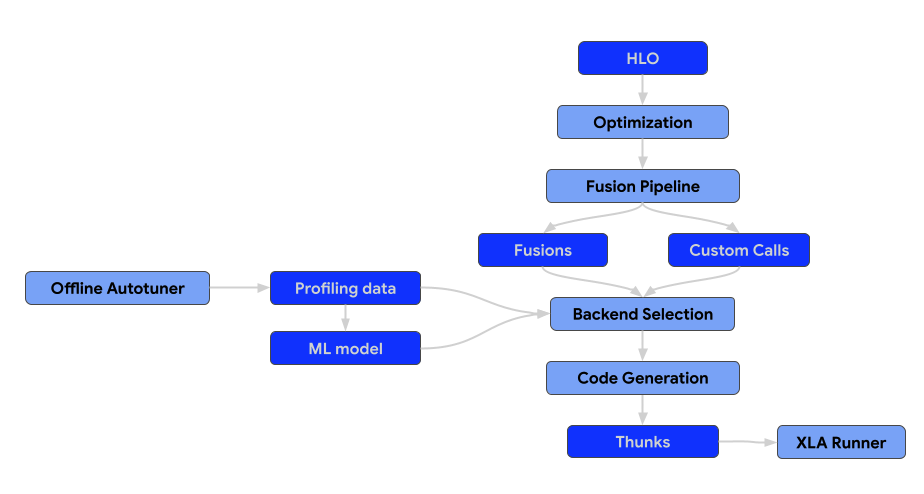
The architecture of the compiler consists of the following components.
Optimization passes
Optimization passes execute transformations on the HLO to enhance computational efficiency. These transformations span from architecture-agnostic, high-level improvements to hardware-specific adjustments (e.g., for NVIDIA GPUs).
What we generally accept:
- Passes that generalize across multiple workloads and demonstrate a clear and significant positive impact on performance benchmarks.
What we generally reject:
- Passes that perform unique optimizations targeting specific models.
Fusion passes
Fusion is a critical optimization that combines multiple HLO operations into a single kernel to reduce memory I/O and kernel launch overhead.
All fusion passes should be added to the fusion pipeline only, not before or after. That also means that the pre-optimized HLO module should not contain fusion instructions. If the fusion is formed early in the pipeline, it becomes a barrier for the optimization passes. If the fusion is formed late, then we lose an ability to select and tune the backend for the generated fusion.
Fusion into the custom calls, i.e. pattern-matching custom calls with the producers/consumers and rewriting them into the new custom calls is not allowed. In that case, it should be replaced with a proper fusion pass.
Backends & Autotuning
Backends for the unnested ops, e.g. custom calls and fusions, should implement CodegenBackend interface.
This interface is necessary to enable optimal backend selection, because it provides the methods to include the parameters for the given HLO instructions into the search space of the autotuner.
// Returns all supported configs for the given HLO instruction.
virtual absl::StatusOr<std::vector<std::unique_ptr<BackendConfig>>>
  GetSupportedConfigs(const HloInstruction& instr);

// Returns a default config for the given HLO instruction.
virtual absl::StatusOr<std::unique_ptr<BackendConfig>> GetDefaultConfig(
  const HloInstruction& instr);
Runtime
The end result of the XLA compilation pipeline is a thunk sequence that can be serialized.
All of the new thunk types should be serializable, i.e. GpuCompiler or
CpuCompiler should be able to compile the program, serialize it, so that later
the XLA runner could load and execute the program. That means that there should
be no pointers to HloInstruction or to other parts of the compiler or the
StreamExecutor.
GPU Compatibility Window {#gpu_compatibility_window}
XLA:GPU guarantees 6 months of backward compatibility (runtimes must execute programs compiled up to 6 months earlier) and 2 weeks of forward compatibility (runtimes up to 2 weeks older must execute newly compiled programs).
For detailed rules, change triage, rollout procedures, and testing guidance, see the GPU AOT compatibility guide.
Code standards
Coding style: We follow Google's code style guide. Specifically see the C/C++ and Python guides. All code submitted must strictly conform to these style guides.
Compact changes: We follow Google's engineering practices. In particular, please observe the guide on writing compact changes. Doing so will greatly increase the speed at which you can get your code merged due to improve reviewability, and reducing the likelihood of unintentional side effects of change. Even if you have a large change, there are many strategies for breaking it up into more incremental changes. If your PR is too large, it will receive an automated comment asking you to break it down into smaller PRs.
Test Coverage: All changes should include appropriate unit tests. Unit tests should not be dependent on specific hardware (CPU, GPU, etc.) timings, and should make liberal use of mocks and fakes in order to make deterministic and focused tests. Changes seeking to extend existing code that’s currently hard to test should make appropriate improvements to testability.
All changes should include appropriate benchmark results as well in the change title to ensure the benefits are clearly understood.
Feature Flags: All somewhat complicated new features should be guarded with a flag first (e.g., via
DebugOptions). This allows for easy rollback of the flag flip if problems arise, and affected users can temporarily set the flag themselves before a rollback is performed.Preprocessor Conditionals (
#ifdef): Avoid using#if/#ifdeffor backend-, hardware-, or version-specific logic whenever possible. Prefer runtime checks viaStreamExecutor'sDeviceDescriptionor separate build targets. See The Hitchhiker's Guide to Fewer#ifdefs in XLA for details and examples.When in doubt as to conventions within the code, it is always a good idea to examine pre-existing code and to try to follow the patterns already in place in OpenXLA.
Review Process
All submissions, including submissions by project members, require review. We use GitHub pull requests for this purpose. Consult GitHub Help for more information on using pull requests.
Code must follow all standards listed above prior to review. These are not optional and it is critical that the submitter ensure their code conforms before requesting review in order to assure timely acceptance of changes.
All tests and additional checks on GitHub must pass. If you find that a test is broken and the issue is not related to your build environment or otherwise your changes, please contact the maintainers.
Avoid scope creep during the review process. This is the responsibility of both the submitter and the reviewer. If a change starts to get too large, consider breaking it up into multiple changes.
After a change is approved on GitHub but before it is merged, it will undergo internal testing that uses code internal to Google and other hardware vendors. This can potentially add extra steps to the review process if there are failures on internal tests that our public CI doesn't catch. The Googler reviewing your change will communicate any internal test failures and describe what needs to be fixed. The overall state of the internal checks is visible in the checks list on GitHub:
- import/copybara — Change imported to the internal review system: Your PR has been imported in Google's internal system and checks are running.
- import/copybara — An error happened while migrating the change: Your PR could not be imported into Google's internal system. This very rarely happens. If you see this state please ping your reviewer.
- feedback/copybara — Google internal checks PASS for runs with create time...: All internal checks pass. Your PR should be merged soon.
- feedback/copybara — Google internal checks FAILED for runs with create time ...: Some internal checks failed. A Google engineer will soon post a comment with more details. If you don't get any info about the failures within a day please ping your reviewer.
AI-generated contributions
AI-generated PRs can be accepted in many cases. However, we experience a large review load due to AI-generated code and we do not want to waste valuable time reviewing PRs that are not beneficial to the broader community. To streamline code reviews, each AI-generated PR should be:
- Labeled - The first line after the title in the PR description should
be this tag:
#ai_generated - Relevant - Just because a PR can be generated does not mean it should be
submitted. We do not want to merge PRs that only defend against theoretical
edge cases without providing any real value. Such "fixes" only clutter the
code-base. You can demonstrate the relevance of a PR by providing the
following:
- A convincing explanation of where you encountered the problem in practice.
- A convincing HLO or especially JAX test.
- Realistic benchmarks showing improvements.
Understood by its author - PR authors must understand all the code in their PRs in detail regardless of whether it was generated by AI or not. Moreover, if we ask questions about the PR we expect a human-written answer.
Concise - The PR description should be short and to the point. AI often generates long-winded text with superfluous detail and this needs to be edited for brevity. The same applies to code and comments (e.g. don't check for error conditions that can't occur).
If we suspect that a PR is AI-generated and it does not have the qualities above we may reject it or ask you to revise it with this canned response:
This looks like an AI-generated PR that does not fully follow the guidance at:
https://openxla.org/xla/contributing#ai-generated-contributions

Please revise the PR according to the guidance above or it will be rejected.
If we receive an AI-generated answer to one of our comments or questions on the PR, the PR will be immediately rejected without further discussion.
Frequently asked questions (FAQ)
"This infrastructure change is not related to my PR. Why should I do it?"
The XLA team doesn't have a dedicated infrastructure team, so it's up to us all to build helper libraries and avoid technical debt. We consider it to be a regular part of making changes to XLA, and everyone is expected to participate. We generally build infrastructure as needed when writing code.
XLA reviewers may ask you to build some infrastructure (or otherwise make a large change to a PR) along with a PR that you've written. This request may seem unnecessary or orthogonal to the change you're trying to make. This is likely because of a mismatch between your expectations about how much infra you need to build and your reviewer's expectations for the same.
A mismatch in expectations is okay! That's expected when you're new to a project (and it sometimes even happens to us old hats). It's likely that projects you've worked on in the past have different expectations. That's also okay and expected! It doesn't mean either one of these projects has the wrong approach; they're just different. We invite you to take infra requests alongside all other review comments as an opportunity to learn what we expect on this project.
"Can I address your comment in a future PR?"
A frequent question with respect to infrastructure requests (or other large requests) in PRs is whether or not the change must be made in the original PR, or whether it can be done as a follow-up in a future PR.
In general, XLA does not allow PR authors to address review comments with a follow-up PR. When a reviewer decides that something needs to be addressed in a given PR, we generally expect authors to address it in that PR, even if what's requested is a large change. This standard applies externally and also internally within Google.
There are a few reasons that XLA takes this approach.
Trust: Having earned the reviewer's trust is a key component. In an open-source project, contributors can appear or disappear at will. After we approve a PR, reviewers have no way to ensure that any promised follow-ups actually get done.
Impact on other developers: If you have sent a PR touching a particular part of XLA, there's a good chance other people are looking at the same part. If we accept technical debt in your PR, then everyone who's looking at this file will be impacted by this debt until the follow-up is submitted.
Reviewer bandwidth: Deferring a change to a follow-up imposes multiple costs on our already overloaded reviewers. Reviewers will probably forget what the first PR was about while waiting for the follow-up, making the next review more difficult. Also, reviewers will have to keep track of expected follow-ups, making sure that they actually happen. If the change can be made such that it is truly orthogonal to the original PR so that some other reviewer could review it, bandwidth would be less of a problem. In our experience, this is rarely the case.
What is the turn around time for code review and merge?
The OpenXLA project has a large contributor base. While we strive for quick reviews and code merges, there are delays due to peaks of work.
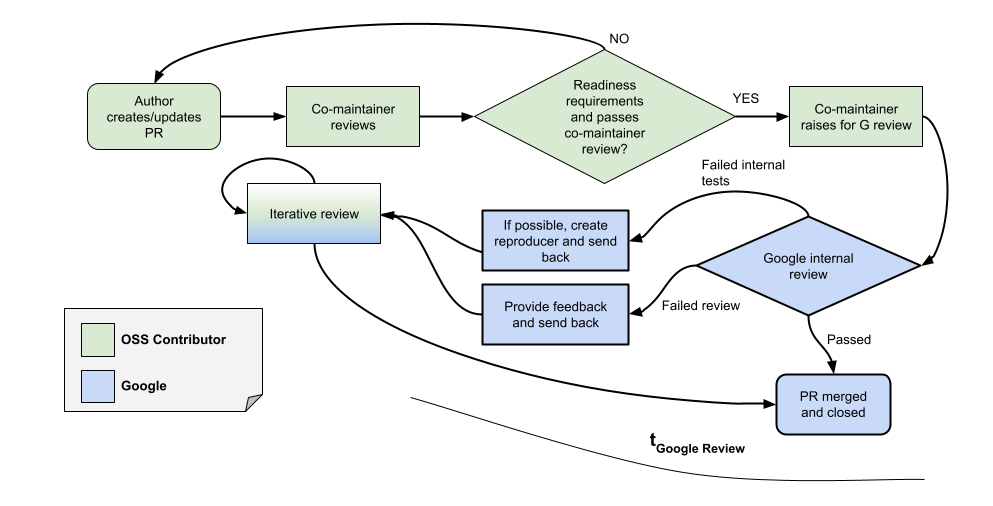
In order to empower our partner teams to contribute high quality features and fixes to the codebase, and to get quicker reviews and merges, we have established the co-maintainer program. In this program, selected trusted partner contributors ensure that the PRs submitted by those partners meet OpenXLA quality requirements as specified in this contributing guide.
If co-maintainers from external partner teams have approved a PR, the Google XLA team commits to reviewing and merging (if approved) within a controlled SLO (tGoogle Review in the diagram below). If the PR is not approved, the Google XLA team will provide a documented justification and where available a reproducer of the failure.
At this moment the list of co-maintainers from our partner teams is:
| Percentile | Target for tGoogle Review (co-maintainer approval to PR merged) |
|---|---|
| 50 percentile of PRs | 3 business days |
| 80 percentile of PRs | 5 business days |
When Google reviews the PR, it may fail due to an internal test. In this case, Google will try to generate a reproducer and share it with the partner. In other cases, the review may fail for technical, architectural or stylish reasons - Google will share the feedback with the author. We expect that if the PR is rejected in the first pass, we will enter a tight loop iteration between the partner team and Google (“Iterative review”) to bring the PR to the desired state.
The OpenXLA project is committed to strengthening its co-maintainer program and adding more contributors to this list. We plan to review on a monthly basis the target turnaround times and report back to the participating teams.