
The XLA compiler can push (offload) certain ops off TensorCore onto SparseCore, so the two units run in parallel. When these operations are offloaded, several types of failures can manifest. The SparseCore mismatch detector tool allows users to diagnose potential failures and identify exactly which offloaded operations are responsible for these failures.
The detector works with a variety of operations, including collective operations
(all-gather, all-reduce, reduce-scatter), as well as gather, scatter,
sort, copy, and others.
Understand how the mismatch detector tool works
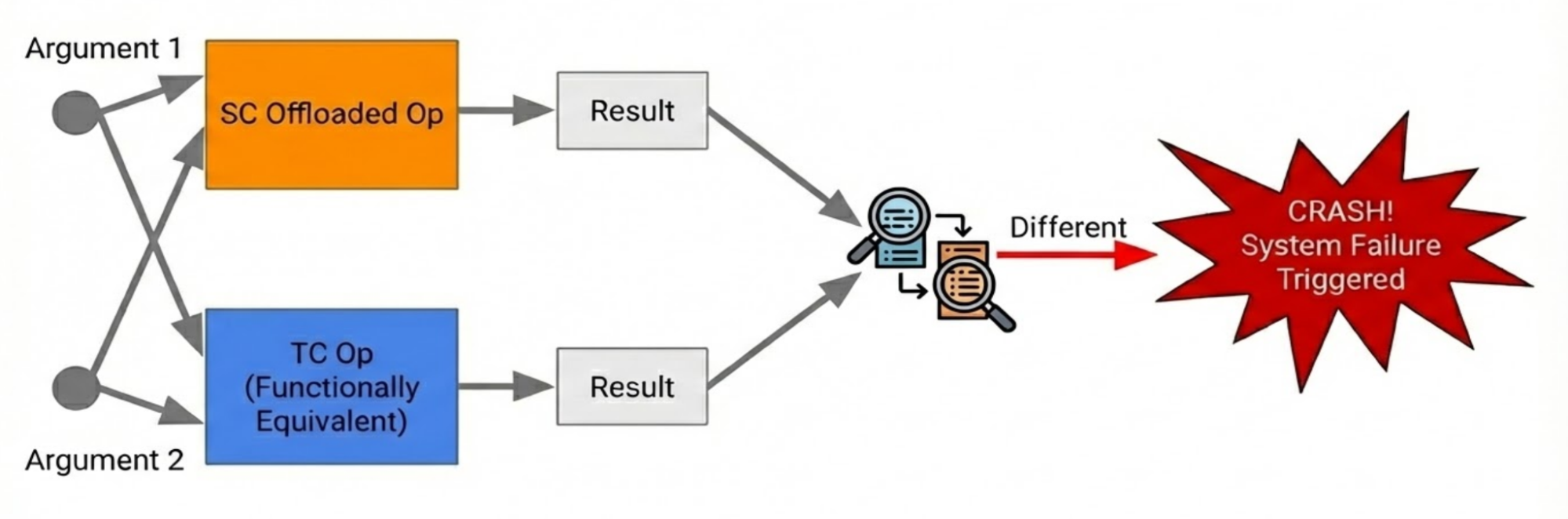
The mismatch detector was initially developed for SparseCore offloaded collective operations. The core principle is that for each SparseCore offloaded operation, the tool creates a functionally equivalent TensorCore operation that uses the same operands and runs on the TC thread. This approach provides a direct comparison between the SparseCore implementation and its TensorCore equivalent, identifying when an offloaded operation produces incorrect results. If the results diverge, the system will either log the mismatch or crash, depending on the configuration flags.
Sample HLO code
To illustrate how the mismatch detector transforms the HLO (High Level Operations) code, consider this example of an all-gather operation.
Before the mismatch detector is applied:
%color_operand.1 = f32[8,256,256]{2,1,0:T(8,128)} broadcast(%convert), dimensions={}
%constant = s32[8]{0:T(128)} constant({0, 1, 1, -1, 1, 0, 0, -1})
%all-gather.2.cloned.call-start = ((f32[8,256,256]{2,1,0:T(8,128)}, s32[8]{0:T(128)}), f32[16,256,256]{2,1,0}, u32[]) async-start(%color_operand.1, %constant), async_execution_thread="sparsecore", calls=%async_computation, metadata={op_type="AllGather" op_name="ag0"}
%all-gather.2.cloned.call-done = f32[16,256,256]{2,1,0} async-done(%all-gather.2.cloned.call-start), metadata={op_type="AllGather" op_name="ag0"}
After the mismatch detector is applied:
%color_operand.1 = f32[8,256,256]{2,1,0:T(8,128)} broadcast(%convert), dimensions={}
%all-gather = f32[16,256,256]{2,1,0} all-gather(%color_operand.1), replica_groups={ {0,1} }, dimensions={0}
%constant = s32[8]{0:T(128)} constant({0, 1, 1, -1, 1, 0, 0, -1})
%all-gather.2.cloned.call-start = ((f32[8,256,256]{2,1,0:T(8,128)}, s32[8]{0:T(128)}), f32[16,256,256]{2,1,0}, u32[]) async-start(%color_operand.1, %constant), async_execution_thread="sparsecore", calls=%async_computation, metadata={op_type="AllGather" op_name="ag0"}
%all-gather.2.cloned.call-done = f32[16,256,256]{2,1,0} async-done(%all-gather.2.cloned.call-start), metadata={op_type="AllGather" op_name="ag0"}
%call.3 = pred[] call(%all-gather, %all-gather.2.cloned.call-done, %constant.1, %constant.2), to_apply=%all_close
%not.2 = pred[] not(%call.3)
%custom-call.8 = token[] custom-call(%not.2, %call.3, %call.3), custom_call_target="xla-tpu-log", custom_call_has_side_effect=true, backend_config={"flag_configs":[],"scoped_memory_configs":[],"used_scoped_memory_configs":[],"log_config":{"severity":"LOG_INFO","tag":"Found Mismatch in offloaded op all-gather.2.cloned.call-start:  ","extra_args":[],"opcode":"LOG_OPCODE_MESSAGE"} }
Notice how the transformed version adds a TensorCore all-gather operation
(%all-gather), a comparison using an all_close function (%call.3), and a
custom call for logging mismatches.
Evaluate comparison results
To determine whether SparseCore and TensorCore results match, consider the nature of the operation being tested. For operations that don't involve computations—such as all-gather, sort, and copy—we can expect an exact match between the results. Any difference in these cases indicates a clear problem.
However, for operations that do involve computations—such as all-reduce,
reduce-scatter, and scatter—we expect the results to be close but not
necessarily identical. This is because floating-point arithmetic can produce
slightly different results when executed on different hardware or in different
orders. For these operations, the tolerance parameters atol (absolute
tolerance) and rtol (relative tolerance) define what "close" means.
Specifically, two values are considered close if
abs(a-b) <= atol + rtol*abs(b). The all-close check is performed for each
element of each result shape.
Handle numerical edge cases
Several edge cases require special handling in the mismatch detector.
- When dealing with NaN (Not a Number) values, the TensorCore result may also
contain NaN values. In such cases, NaN values at the same position in both
results are excluded from comparison, since
NaN != NaNby definition in floating-point arithmetic. - Similarly, for
Inf(infinity) values, the TensorCore result may also have infinity values. When the same infinity (positive or negative) appears at the same position in both results, it is excluded from comparison. - Sort operations present a challenge due to differences in sort stability. SparseCore uses radix sort, which is stable (preserving the relative order of equal elements), while TensorCore's bitonic sort is unstable. To ensure fair comparison, the TensorCore sort must also be made stable, for example by using an iota operand as a tiebreaker.
Configuration flags
The mismatch detector is controlled through several configuration flags:
Required flags:
xla_tpu_enable_sparse_core_mismatch_detector=true: Use this flag to enable the mismatch detector tool.xla_tpu_enable_log_recorder=true: Enables the LLO logger to capture SparseCore runtime trace logs. You MUST enable the LLO logger to see the mismatch reports in all cases.
Optional flags:
xla_tpu_sparse_core_mismatch_detector_on_specified_ops: If you know the type of the potentially offending op(s), use this flag to filter which operations to check. For example, to check only all-gather and sort operations, pass--xla_tpu_sparse_core_mismatch_detector_on_specified_ops='all-gather,sort'xla_tpu_sparse_core_mismatch_detector_crash_on_mismatch: To halt the program immediately upon the first detected mismatch, set this flag totrue. The error message will include the name of the specific op instance that failed the check. If this flag is set tofalse, the mismatch detector tool will perform an exhaustive search and report all mismatches without halting.xla_tpu_sparse_core_mismatch_detector_atol: Sets the absolute tolerance for comparisons (Default:1e-8)xla_tpu_sparse_core_mismatch_detector_rtol: Sets the relative tolerance for comparisons (Default:1e-8)
Usage
We recommend the following steps when using the mismatch detector to debug.
- Identify the problematic op: First, try to narrow down which SparseCore
op is causing the unexpected results. The mismatch detector currently
supports instrumentation for these ops:
- Collectives: all-gather, all-reduce, reduce-scatter
- Compute Ops: gather, scatter, sort, copy
- Run your program with the mismatch detector enabled:
- For JAX workloads on Cloud TPU:
# Enable mismatch detector
export LIBTPU_INIT_ARGS="--xla_tpu_enable_sparse_core_mismatch_detector=true \
                         --xla_tpu_enable_log_recorder=true"

# Optional: Enable HLO dumps for debugging. This is highly recommended.
# Dumps help verify which operations are being offloaded and provide context if mismatches occur.
export XLA_FLAGS="--xla_dump_to=/tmp/xla_dump --xla_dump_hlo_as_text"
mkdir -p /tmp/xla_dump

# Run your JAX program
python3 your_jax_sparse_core_program.py
- For PyTorch:
# Set environment variables to enable SparseCore offloading
export XLA_FLAGS="--xla_tpu_enable_sparse_core_mismatch_detector=true \
                  --xla_tpu_enable_log_recorder=true"

# Create a directory for HLO dumps
mkdir -p /tmp/xla_dump

# Run your PyTorch program
python3 your_pytorch_sparse_model.py
- Interpreting output: If a mismatch is detected, you will find a log message similar to the following:
Found Mismatch in offloaded op all-gather.2.cloned.call-start: ...
What to do next
If the SparseCore mismatch detection tool flags a numerical or structural mismatch, the root cause is typically an XLA compiler bug during operation offloading rather than an error in your model definitions.
Follow these steps to unblock your pipeline and report the issue:
- Isolate the affected operation: Examine the mismatch detection logs to identify which specific layer or XLA operation triggered the divergence.
- Apply the workaround (Disable op offloading): Modify your compilation settings to prevent XLA from offloading the problematic operation(s) to SparseCore. Running these specific ops on standard TPU cores allows your workload to continue running accurately while minimizing performance impact.
- Report the XLA compiler bug: File an issue to the XLA issue tracker on GitHub. Attach the mismatch detection tool output, your model setup, and relevant HLO dumps so the compiler team can reproduce and fix the underlying bug.