
XLA SDC checker (XSC) is a set of XLA instrumentations (flags) designed to help detect some cases of silent data corruptions (SDC) on a TPU.
It is designed to detect non-deterministic corrupt outcomes of the execution (of the same instructions on the same data), which makes it a useful debugging tool. It can also detect NaN/Inf values in the results.
Quickstart: Run model with SDC checker
You can run a model with an SDC checker enabled to hopefully identify potential SDCs early by passing the following flags to the TPU worker:
# Enable SDC Checker during model run
--xla_tpu_enable_sdc_checker=true
Default reports (logs) of SDC events
When the SDC checker detects an error (like an output checksum mismatch) the TPU program stops and the error is written into the TPU worker's log. Closely, the information reported looks like this:
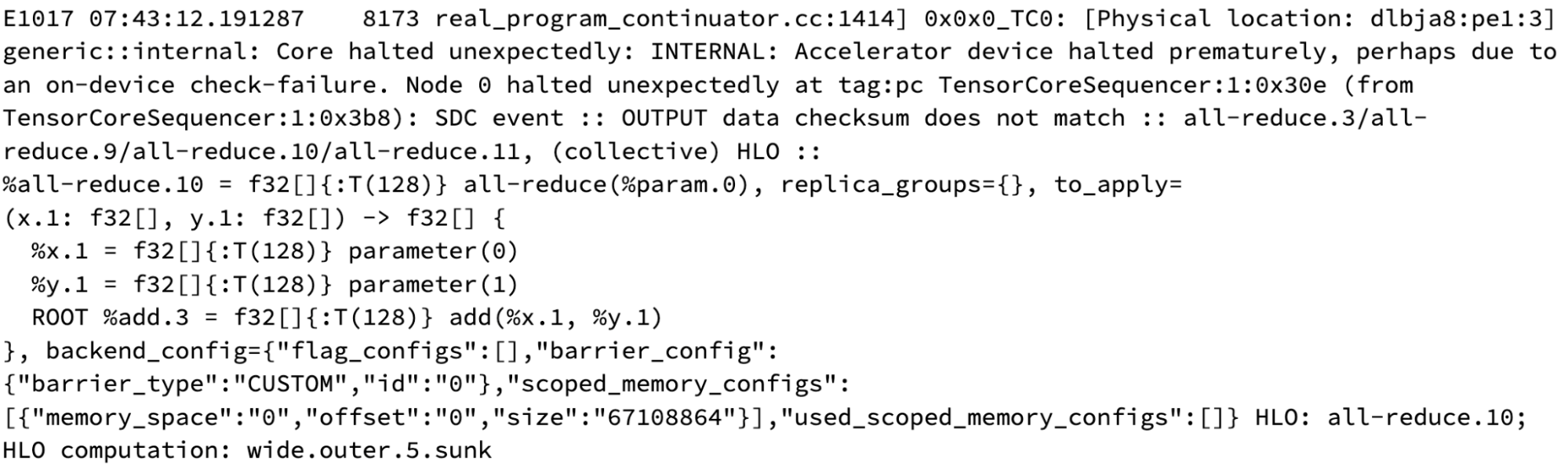
Here:
rs/15is the host in the slice the SDC was detected onOUTPUT data checksum does not matchis the fingerprint of the SDC reported by the SDC checker, followed by information about the HLO/LLO details to be used to locate the failure point3x3x1_TC0specifies the chip and TensorCore the SDC was detectedPhysical locationgives details about where it is located
HLO re-run
Enabled by default, this involves instrumenting some HLOs, such that the same HLO is executed two or more times on the same inputs, and asserting that the results from all runs are identical. The assertion is based on the checksum of the output data.
You can increase the number of repeats with the following flag:
--xla_tpu_sdc_check_repeat_count=N # By default N=1
Increasing the number of re-runs may increase the chances of reproducing some rare cases of non-determinism.
Silent reporting of SDC events
By default, your program will crash when an SDC event is detected.
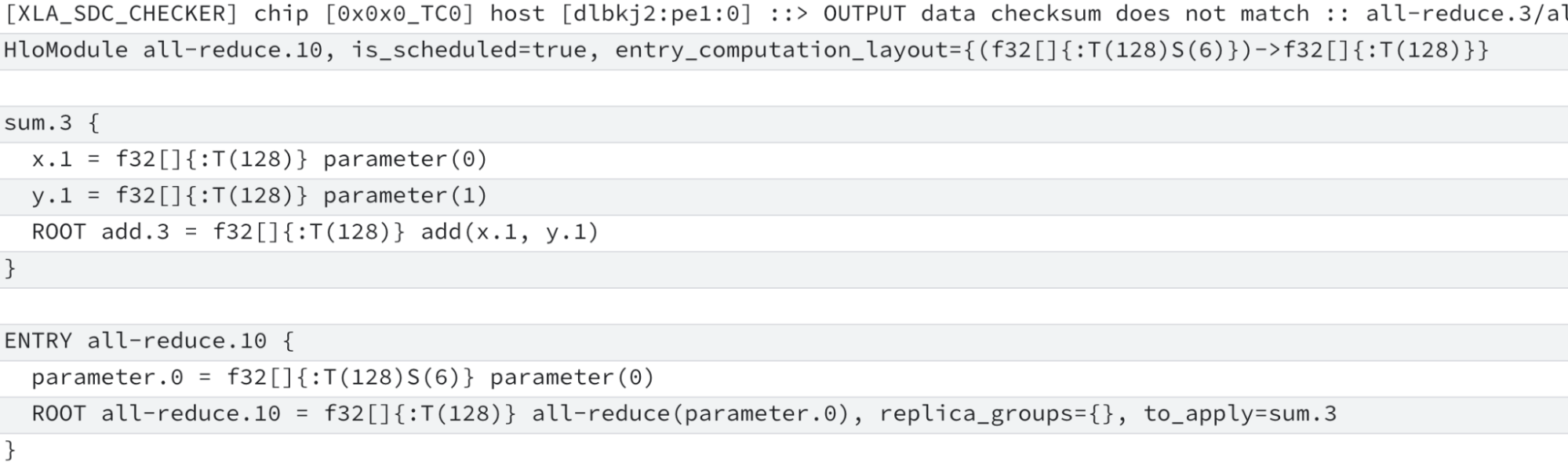
With the following flag set, XSC will instrument code to NOT crash the TPU program on SDC event detection, but log SDC event data to the program log and continue program execution. This option allows collecting more than one SDC instance during TPU program execution.
--xla_tpu_sdc_check_halt_on_detection=false # Default: true
Example output:
Fine-level HLO filtering
By default, all HLOs are included in instrumentation. Filtering for certain HLOs can aid in localizing the problematic HLO or removing false positives. You can filter HLO with the following flag:
--xla_tpu_sdc_checker_extra_filter=...
Setting the flag:
- The value of a flag is a sequence of regexp-like clauses separated with
;. - The rules are either allowlist rules (starting with
+, optional) or denylist rules (starting with-). - Rules are case insensitive.
- Rules are applied in the order they are specified in the string:
tlpmeans TLP outside of any HLO<regex>specifies a rule for an HLO name, it will be applied as a full match of the HLO name, same as if it were^<regex>$.*means any HLO name including TLP
Examples:
“*”- all HLOs or TLP are allowed,“”- same as above,“-”- the same as “-*”,“.*”- HLOs are allowed but TLP is not considered,“all-reduce.;-”- only allows all-reduce HLOs,“-all-reduce.123;all-reduce.;-”- all-reduces except for all-reduce.123.
Working with deduplicated HLOs
When XLA knows that the result of compilation of some HLOs will be exactly the same, it compiles them only once and reuses the code between all of them, a set of equivalent HLOs is usually called deduplicated HLOs and only instrumented once:

When an SDC Event is being reported it mentions all deduplicated HLOs since there is no way of distinguishing them, but for understanding what exact HLO actually produced the SDC event, it is usually useful to disambiguate them. Passing the following flag helps to compile all HLOs without deduplication:
--xla_jf_hlo_deduplication_all_unique=true
This may result in significant increase in compilation time and program size in some cases (with possibility of OOM). To mitigate that effect, it is recommended to specify exact names of HLOs to not deduplicate based on the SDC events being investigated:
--xla_jf_hlo_deduplication_all_unique_filter='fusion25.*'
Checking HLO with aliasing
XSC does not copy inputs before rerun and assumes them to be unchecked, so it cannot instrument HLOs with aliased input/output. You can use the following flag to force HLOs specified by this filter to not have aliasing (unless HLO requires it).
--xla_tpu_disable_aliasing_extra_filter=...
Change checksum algorithm
XSC supports two checksum algorithms: 'xor' and a variation of 'siphash13'. The default algorithm is a simple xor which proved to be most efficient with enough precision for most of the cases.
"SipHash 1-3" may be enabled when it is known that xor checksum won't be good for the particular data sets, or when there is a suspicion for that. To do so, set the flag:
--xla_tpu_sdc_checker_checksum_algo='siphash13'
Performance Impact
It is expected that executing many HLOs several times along with computing output checksums may significantly increase the execution time. Currently, we do not focus on performance and execution time increase may be as large as about 2-2.5x on XLA benchmarks.